
What Is Alibaba’s Qwen App — And Why It Signals the Rise of AI That Gets Things Done
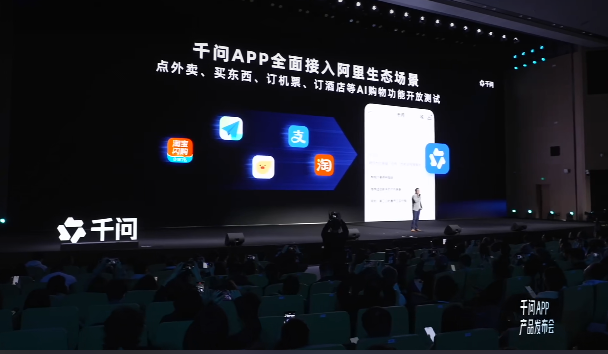
- Qwen App (千问) is Alibaba’s AI assistant designed not just to chat, but to complete real-world tasks such as ordering food, booking flights, and shopping.
- By deeply integrating with Taobao, Alipay, Ele.me, Fliggy, and Amap, Qwen enables end-to-end transactions inside a single AI interface.
- This marks a shift from conversational AI to action-oriented AI agents, where success is measured by completed transactions, not engagement time.
- Alibaba’s approach contrasts sharply with rivals like ByteDance and mirrors global trends seen at Google, Walmart, and OpenAI.
What Is the Qwen App?
Qwen App (千问) is Alibaba’s consumer-facing AI assistant built on the company’s Qwen large language model. Launched in late 2025, the app reached over 100 million monthly active users within two months, signaling rapid consumer adoption.
Unlike most AI chatbots, Qwen is designed to execute tasks, not merely generate text. Users can issue a single natural-language command — such as “order milk tea” or “book a flight to Beijing tomorrow” — and the app completes the transaction by directly calling Alibaba ecosystem services.
In short, Qwen is Alibaba’s attempt to turn AI into a universal transaction interface.
How Does Qwen Actually Work?
Qwen’s core innovation is not the model itself, but how the model is connected to services.
Deep Integration With Alibaba’s Ecosystem
Qwen is natively connected to:
- Taobao / Taobao Instant Shopping for e-commerce and food delivery
- Alipay for payments
- Fliggy for flights and hotels
- Amap (Gaode) for location-based recommendations
- Ele.me for local services and dining
Because these services belong to the same corporate ecosystem, Qwen can bypass the usual friction of cross-app switching and API negotiations.
One Command, Full Transaction
In real-world tests:
- Ordering food automatically applies discounts and handles minimum order requirements
- Booking flights compares multiple options before redirecting users to payment
- Hotel bookings combine Fliggy listings with Amap location rankings
This creates a closed loop from intent → decision → payment, all inside a single AI interface.
Why Is This Called the “AI That Gets Things Done” Moment?
For years, consumer AI has suffered from what investors call “high engagement, low monetization.”
Users chatted with models, generated poems, or created images — but rarely completed transactions.
Qwen directly addresses this problem.
From Chatbots to Action Bots
Traditional AI assistants:
- Offer advice
- Suggest options
- Stop short of execution
Qwen:
- Understands intent
- Selects services
- Executes transactions
This shift turns AI from a content layer into an operational layer of the digital economy.
Why Alibaba Is Uniquely Positioned to Do This
Alibaba’s advantage lies in service ownership.
Because it controls major consumer platforms, Alibaba can:
- Ensure transaction reliability
- Maintain real-time inventory and pricing
- Avoid system-level restrictions on cross-app operations
This makes Qwen fundamentally different from AI assistants that rely on screen reading or simulated taps.
Alibaba vs. ByteDance: Two Paths to AI Agents
The competition for AI’s next “super入口” (super entry point) has produced two distinct strategies.
Alibaba’s Strategy: Service Integration
- AI directly calls internal services
- High accuracy and execution certainty
- Limited to ecosystem boundaries
ByteDance’s Strategy: Auto-UI Agents
- AI visually interprets the phone screen
- Simulates human clicks across apps
- Broader reach, but higher technical and regulatory risk
In essence:
- Alibaba bets on ecosystem depth
- ByteDance bets on system-level AI control
Whichever approach shapes user habits first may define the next decade of consumer computing.
Is This Trend Global?
Yes — and Alibaba is not alone.
- Google Gemini is integrating with Walmart to enable AI-powered shopping using real-time inventory.
- OpenAI is reportedly developing browser-based agents under the codename Operator.
- Across Silicon Valley, the consensus is clear:
AI must move closer to real-world transactions to sustain growth.
Alibaba’s Qwen represents the Chinese variant of this global convergence.
What Does This Mean for the Future of Apps?
Qwen hints at a future where:
- Users interact with intent, not interfaces
- Apps become backend service providers
- AI becomes the primary decision and execution layer
This does not signal the immediate death of apps, but it does mark the end of the app-first era as we know it.
Key Takeaways
- Qwen is not just an AI chatbot — it is a transaction engine
- The real breakthrough is closing the loop from intent to payment
- Alibaba’s ecosystem gives it a structural advantage
- Similar models are emerging globally
- The battle for AI agents is ultimately a battle for economic flows, not just users
FAQ
What is Alibaba’s Qwen App?
An AI assistant designed to complete real-world tasks like shopping, booking, and payments.
How is Qwen different from other AI chatbots?
It executes transactions instead of stopping at recommendations.
Why is this important for AI commercialization?
Because transactions, not conversations, generate sustainable revenue.
Can Qwen work outside Alibaba’s ecosystem?
Currently limited, but future expansion is possible.
Is this trend unique to China?
No. Similar integrations are underway in the US and Europe.