
Why DeepSeek's Price Hike Matters: China's AI Compute Supply Chain Explained
What Happened — And Why It's More Than a Pricing Story
In mid-August 2026, DeepSeek adjusted its API prices twice within seven days. The first move raised the peak-hour output price for its flagship V4-Pro model from ¥6 to ¥27 per million tokens — a 350% increase — while cached input prices rose 12-fold. It also introduced time-of-use pricing, with peak hours defined as weekday mornings and afternoons, and off-peak rates set at half price.
Six days later, DeepSeek made a second adjustment: weekends were reclassified as off-peak, effectively lowering weekend costs.
To a casual observer, the two moves look contradictory. They are not. Both decisions point to the same underlying reality: DeepSeek's inference capacity cannot keep up with demand, and price signals are being used to manage that scarcity in real time.
That is the story worth understanding — not the price changes themselves, but what they reveal about the structural state of China's AI compute ecosystem.
What the Numbers Actually Show
Three data points frame the supply-demand gap.
During the week of August 3–9, 2026, DeepSeek-V4-Flash recorded 8.83 trillion token calls on OpenRouter — a 570% week-on-week increase, ranking first globally. On August 1, the model processed 8 trillion tokens in a single day. By August 4, its API was frequently returning "insufficient capacity" errors.
Zooming out to the national level, China's daily token call volume grew from roughly 100 billion in early 2024, to 100 trillion by end of 2025, to 140 trillion by March 2026 — a roughly 1,000-fold increase in two years, according to China's National Data Administration.
The supply side has not kept pace. Approximately 80% of real-time inference demand is concentrated in eastern China, while 80% of training and batch processing workloads run in the west. Data center construction timelines have been compressed to around 100 days, but the supporting power infrastructure takes two to three years to build.
The bottleneck, in other words, is not only chips. It is electricity and land.
Peak-valley pricing is a rationing mechanism, not a promotional tool. By making off-peak hours cheaper, DeepSeek pushes time-insensitive batch workloads out of congested daytime windows, reserving high-demand slots for users willing to pay the premium rate. The fact that demand is strong enough to require hourly capacity allocation is itself evidence of structural scarcity.
Why This Signals the End of China's AI Price War
For roughly two years, China's large model providers competed primarily on price. The implicit logic was that AI-generated tokens had little intrinsic value and needed to be given away to build usage. The result was a race to the bottom that compressed margins across the entire compute stack.
DeepSeek was, ironically, one of the architects of that price war — its earlier aggressive pricing forced competitors to follow. That is precisely why its decision to raise prices carries disproportionate weight. When the company that started the discounting stops, the signal is credible.
A Morgan Stanley research note published on August 9, 2026, titled "Farewell to the Price War, Hello to the Intelligence War," captured the shift in analytical terms. Surveying eight major Chinese AI providers — including ByteDance, Alibaba, Baidu, Tencent, MiniMax, Zhipu, Moonshot AI, and DeepSeek — it found that average API input prices in Q2 2026 rose 48% year-on-year, while output prices rose 80%. The report's core argument: model intelligence, not price, is the long-term determinant of competitive position, and low-margin pricing cannot fund the next generation of model training.
Huarong Securities broke down DeepSeek's pricing trajectory into three phases: initial price cuts to build adoption, peak-valley pricing to manage capacity, and a broad upward reset. Its conclusion was that the extended period of low-price competition in China's large model sector has formally ended, and pricing is entering a recovery cycle.
Other providers have followed. Zhipu has raised API prices three times. Tencent Cloud has raised prices twice. Alibaba Cloud and Baidu AI Cloud have both adjusted upward.
How the Price Increase Flows Through the Supply Chain
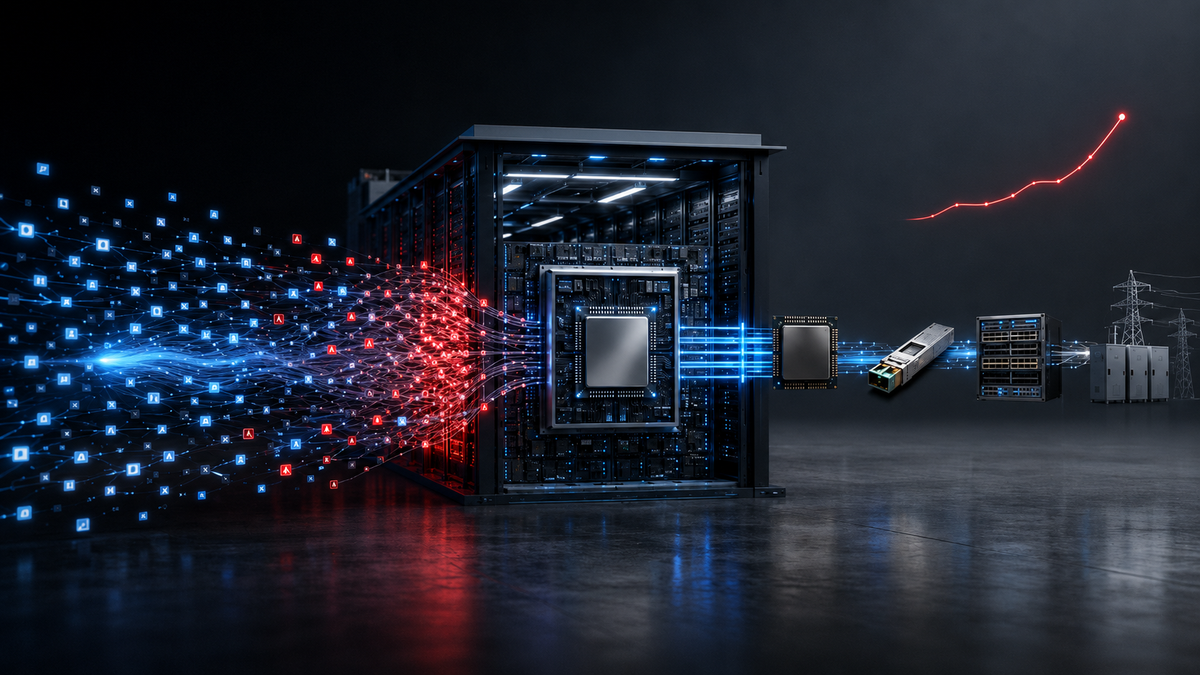
The economic logic connecting model pricing to hardware demand is straightforward: higher token revenue translates into greater willingness to invest in compute infrastructure, which flows from model companies to cloud providers, then to server manufacturers, optical transceivers, chip foundries, and equipment makers.
That logic is now showing up in financial results.
Optical transceivers: InnoLight reported H1 2026 revenue of ¥41.778 billion, up 182% year-on-year, with net profit of ¥13.651 billion, up 242%. Management noted that customer order cycles have extended from rolling three-month windows to contracts signed through 2027.
Chip foundry: Hua Hong Semiconductor posted Q2 2026 revenue of $717.5 million, a record high, with capacity utilization at 102.8%. Management attributed 60% of the growth to pricing and 40% to capacity expansion.
Semiconductor equipment: Advanced Micro-Fabrication Equipment reported H1 2026 revenue of ¥6.691 billion, up 34.89%, with net profit up over 300%.
At the macro level, TrendForce revised its 2026 global AI server shipment growth forecast upward from 28% to approximately 31% in early August. The nine largest global cloud providers are projected to increase combined capital expenditure by roughly 90% in 2026. Microsoft, Amazon, Alphabet, and Meta alone have guided for combined capex of $735–760 billion.
On the same day that compute hardware stocks sold off sharply in A-share markets — August 24 — Alibaba completed a HK$80 billion share placement, its first since its 2019 Hong Kong listing and the largest follow-on offering in Hong Kong Stock Exchange history. The proceeds are earmarked entirely for full-stack AI capabilities and infrastructure. The offering was oversubscribed nearly three times within an hour, with sovereign wealth funds and other long-term investors accounting for more than 40% of demand.
The divergence is instructive: short-term equity traders were selling compute hardware on valuation concerns, while long-duration institutional capital was simultaneously queuing to fund AI infrastructure at scale.
A Structural Shift in How Compute Gets Priced
Beyond the revenue numbers, a more consequential change is underway in how compute providers structure their contracts.
Historically, compute service providers charged fixed rental fees — per GPU, per hour. Revenue was predictable but capped, and the business was essentially a real estate model applied to hardware.
In late July 2026, a contract amendment filed by Xingyun Technology introduced a different structure. Its subsidiary renegotiated a five-year agreement with a major large model client — widely understood to be Moonshot AI — increasing the contract value from ¥1.014 billion to ¥3.053 billion and doubling the compute allocation from 128 to 256 units. Crucially, the new pricing mechanism was described as a token revenue-linked fixed service fee: the compute provider's fee is now tied to the client's actual token usage revenue.
This is reported to be the first time a token revenue-sharing clause has appeared in a major listed-company contract in China's A-share market.
The implications are significant. Under a fixed-rental model, compute is a cost center. Under a revenue-sharing model, compute becomes a productive asset with upside exposure to the value it helps generate. The same GPU rack represents two fundamentally different businesses depending on the contract structure.
CITIC Securities described this as a shift from fixed monthly fees to usage-based token billing. Galaxy Securities framed it more directly: from selling resources to selling output.
This transition is structurally dependent on inference demand being large, recurring, and growing — which is precisely the condition that DeepSeek's pricing data suggests is now in place. Training workloads are episodic capital expenditures. Inference is daily recurring revenue. Revenue-sharing models only make economic sense when the latter dominates, and the evidence suggests that threshold has been crossed.
What Could Slow or Reverse This Trajectory
Two constraints deserve close attention.
Demand elasticity. The pricing increase only holds if users do not migrate to alternatives. Notably, around the same time DeepSeek announced its price hike, Alibaba released its flagship Qwen3.8-Max model — a 2.4-trillion-parameter system — as open source. This was the first time a Max-tier flagship model had been made available for private deployment. Every percentage point of price increase widens the economic case for self-hosting, particularly for enterprise users with sufficient scale. The key metrics to watch are whether DeepSeek's call volumes decline, whether off-peak utilization rates increase (indicating successful demand shifting rather than demand loss), and whether the cache-hit price differential narrows.
Technology and trade policy risk. The hardware layer of the supply chain faces two distinct vulnerabilities. First, if AI architecture evolves in ways that reduce dependence on current optical interconnect designs — for example, through alternative scaling approaches or chip integration — companies whose revenue is concentrated in specific components face structural exposure. InnoLight derives 94.8% of its revenue from overseas customers. When reports emerged in early August that the U.S. Federal Communications Commission was drafting import restrictions on 800G and 1.6T optical transceivers, the stock nearly hit its daily circuit-breaker limit. Orders signed through 2027 do not insulate valuations from a technology or regulatory discontinuity.
The market's reaction to InnoLight's strong H1 earnings — a 7.44% decline in A-shares and over 12% in Hong Kong on August 24, the day after the results were published — illustrates a broader shift in investor behavior. The market is no longer pricing the narrative of AI infrastructure build-out; it is pricing the specific evidence of durable, defensible revenue. Strong results are now the baseline expectation, not a positive surprise.
The Structural Logic, Summarized
DeepSeek's pricing decisions are a useful lens for understanding the current state of China's AI compute economy because they compress several dynamics into a single observable signal.
Token prices rising means inference demand has become structurally scarce relative to supply. Scarcity means the economics of compute infrastructure investment now have a credible demand foundation. A credible demand foundation changes how capital is allocated — from speculative infrastructure bets to assets with visible revenue streams. And visible revenue streams enable new contract structures that allow compute providers to participate in the value they help create, rather than simply renting out capacity at fixed rates.
The price hike is, simultaneously, a supply-demand report, a business model announcement, and a capital allocation signal.
Whether those signals prove durable depends on two things that remain genuinely uncertain: whether demand holds at higher price points, and whether the specific technologies underpinning today's supply chain remain central to tomorrow's AI architecture.
Until those questions are answered, token pricing functions as the most real-time indicator available of where the AI compute supply chain stands — and where it is headed.
Related Coverage:
DeepSeek Posts 10x Revenue Surge, 82.9% API Margin as Valuation Nears $70B