
Why SERES Stock Has Fallen Two-Thirds Despite Record EV Sales
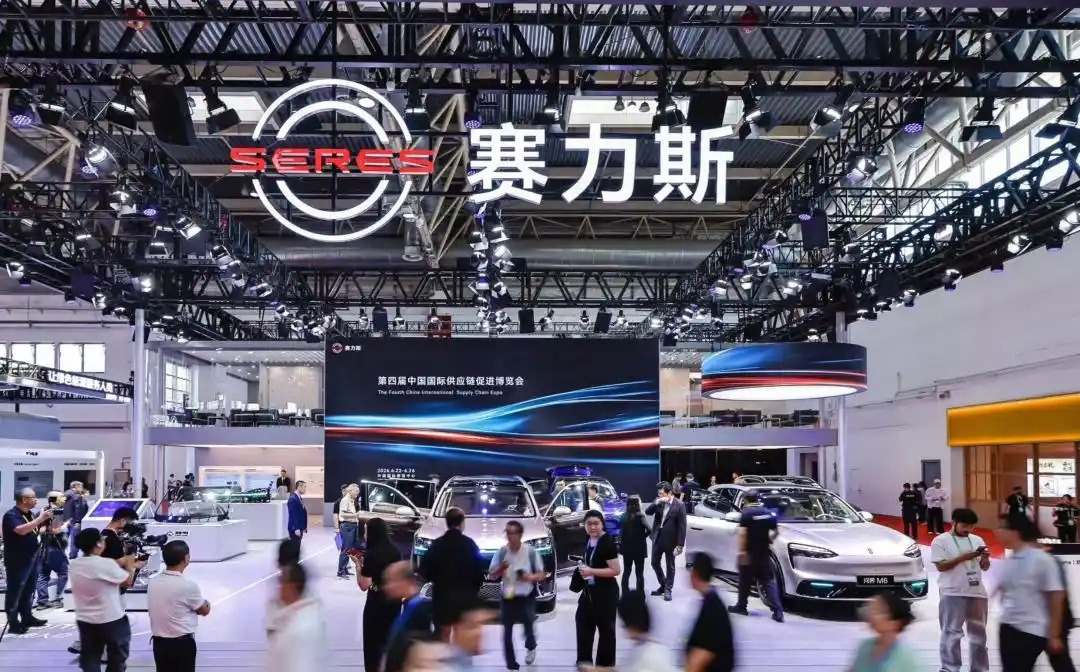
What the collapse in SERES Group's share price reveals about the structural economics of China's premium EV market
What Is SERES, and Why Does Its Stock Decline Matter?
SERES Group is a Chongqing-based automaker best known as the manufacturing partner behind the AITO brand of premium electric and hybrid SUVs, developed in deep collaboration with Huawei. For much of 2024, SERES was one of the most celebrated turnaround stories in Chinese automotive: after four consecutive years of losses, the company swung to a net profit of CNY 5.95 billion on revenue of CNY 145.2 billion.
The stock responded accordingly. On China's A-share market, SERES peaked intraday at CNY 174.66 on September 30, 2025. In November 2025, the company raised approximately HKD 14 billion through a Hong Kong IPO priced at HKD 131.5 per share.
On August 11, 2026, the H-share had fallen to HKD 42.74. The A-share had retreated to CNY 55.21. Measured from either the IPO price or the A-share peak, the drawdown is close to two-thirds.
The significance of this decline is not simply that a stock fell. It is that two separate investor bases—A-share retail and institutional investors, and Hong Kong's internationally oriented market—independently arrived at nearly identical conclusions about revised value. That convergence is worth understanding structurally.
What Drove the Original Rally?
To understand the correction, it helps to understand what the market was pricing in during the peak.
SERES's 2024 results were genuinely exceptional. New-energy vehicle (NEV) sales reached 426,900 units, up 182.8% year-on-year. Revenue grew 305% to CNY 145.2 billion. The company generated CNY 22.5 billion in operating cash flow. Gross margin on NEVs was 23.8%.
This was not one lucky model. The simultaneous ramp of AITO M7, M9, and related vehicles demonstrated that SERES could execute a full premium product cycle: scaling production rapidly, managing a complex supply chain, and sustaining delivery volumes in the CNY 250,000–500,000 price range where Chinese domestic brands had rarely competed successfully.
Markets rewarded this with growth-company multiples. Analysts applied PEG-based valuation frameworks, pricing in the assumption that the 2024 profit trajectory would continue to compound.
What Changed: The Product Cycle Problem
The core issue is structural, not accidental. It is a problem inherent to any automaker that competes on rapid technology iteration.
2025 financials showed the first signs of divergence. SERES NEV sales grew a further 10.6% to 472,300 units. Revenue reached a new record of CNY 165.1 billion, up 13.7%. But net profit attributable to shareholders grew by only CNY 11 million—effectively flat—despite the larger revenue base. For every additional CNY 100 of revenue, the company generated approximately CNY 0.06 of incremental net profit.
The explanation lies in cost structure. Selling expenses rose to CNY 24.2 billion (roughly 14.7% of revenue). R&D spending reached CNY 12.5 billion, up 77.4% year-on-year. Gross margin on NEVs actually improved by 2.75 percentage points to 26.6%—meaning the products themselves were more profitable per unit. The problem was that the investment required to sustain the brand, technology roadmap, and sales network was consuming the gains faster than revenue growth could replenish them.
By Q1 2026, the divergence widened. Revenue grew 34.5%, but non-recurring net profit fell from CNY 394 million to CNY 103 million. Operating cash flow showed a net outflow of CNY 20.95 billion, primarily because payments to suppliers exceeded collections from vehicle sales—a timing mismatch that can normalize, but which signals the working capital intensity of the transition period.
In July 2026, the company issued a profit warning forecasting a net loss of CNY 1.5–1.8 billion for the first half of the year. Two causes were cited: rising raw material costs (storage chips, industrial metals, lithium carbonate) and asset write-downs triggered by accelerating model transitions. The core subsidiary, AITO Automobile, was expected to lose CNY 1.9–2.15 billion in Q2 alone.
The day after the announcement, the A-share fell to its daily limit-down price of CNY 53.91. Citi downgraded the H-share from Neutral to Sell, cut its target price from HKD 63.7 to HKD 33.5, and switched its valuation methodology from PEG to price-to-sales—a signal that profit-based frameworks had become difficult to apply.
The Deeper Structural Tension: Consumer Electronics Pace, Heavy-Industry Economics
The asset write-downs point to a tension that is not unique to SERES but is particularly acute for companies competing at the frontier of Chinese EV technology.
Modern premium EVs incorporate intelligent driving hardware, cockpit chips, and electronic architectures that iterate on timescales closer to smartphones than traditional automobiles. A vehicle launched in one quarter may face a meaningfully better-equipped competitor within six to nine months.
But the manufacturing infrastructure supporting those vehicles operates on a different clock. Retooling a production line, recertifying a supply chain, redesigning tooling and dies, retraining a dealership network—these processes take months and carry costs that cannot be instantly written off. When a new model generation arrives before the previous one has fully amortized its fixed costs, the financial result is an accelerated write-down of assets that still have physical life but diminished commercial relevance.
SERES's July 2026 profit warning made this dynamic explicit. The company did not disclose which specific assets were written down—whether tooling, parts inventory, equipment, or other items—but the structural logic is clear: faster product cycles compress the window available to recover sunk costs.
The sales data illustrates the same pattern in real time. SERES vehicle sales grew 47.7% year-on-year in March 2026. By the end of June, cumulative H1 sales were up 5.6%. In July, monthly sales fell 50.9% year-on-year to 20,500 units, pulling the cumulative January–July figure to a 6.5% decline. The swing from growth to contraction within a single quarter reflects the gap between outgoing and incoming model generations—a normal feature of automotive product cycles, but one that is financially costly when fixed costs remain elevated throughout.
Why SERES's Cost Structure Amplifies the Cycle
Not all automakers are equally exposed to product-cycle volatility. SERES's selling expense ratio makes it more sensitive than most domestic peers.
In 2025, SERES reported selling expenses of CNY 24.2 billion on revenue of CNY 165.1 billion—a ratio of approximately 14.7%. Of that total, CNY 22.95 billion was attributed to advertising, flagship store construction, and service fees. For comparison, Changan Automobile reported selling expenses of CNY 9.99 billion on similar revenue of approximately CNY 164 billion (ratio: ~6.1%). Great Wall Motor's selling expense ratio was approximately 5.1%.
The comparison is imperfect—brand positioning, channel architecture, and business mix differ across companies. But the magnitude of the gap is meaningful. SERES's model requires maintaining a premium retail and brand presence that is cost-justified when sales volumes are high and growing. When volumes soften or a model transition creates a delivery gap, that fixed cost base does not contract proportionally.
This is the operational leverage problem in reverse: the same structure that amplifies profitability during an upswing amplifies losses during a downswing.
The Competitive Environment Is Tightening at the Margins
A separate structural pressure is emerging from below. In May 2026, SAIC-GM-Wuling launched the Huajing S—a large six-seat SUV developed in partnership with Huawei's Qiankun intelligent driving platform, priced from CNY 149,800. The vehicle includes Huawei's full intelligent driving suite, HarmonyOS cockpit, and cloud services at a price point roughly half that of entry-level AITO models.
The significance is not that Wuling is a direct competitor to AITO in the premium segment. It is that Huawei's intelligent technology stack—previously concentrated in vehicles priced above CNY 250,000—has now demonstrated the ability to reach the CNY 150,000 price tier through a different manufacturing and supply chain partner.
For SERES, this means the technology differentiation that justified AITO's premium pricing cannot be assumed to widen over time. Premium vehicles can continue to command higher prices through design, chassis engineering, brand equity, and service—but each of these dimensions requires continuous reinvestment. The window between a new model launch and the arrival of a credible, lower-priced alternative with comparable smart features appears to be shortening.
The Governance Transition: From Direction to Execution
In June 2026, SERES completed a management transition. Zhang Zhengping, son of founder Zhang Xinghai, became legal representative and chairman of the vehicle operating subsidiary. Zhang Xinghai retains the chairmanship of SERES Group at the holding company level.
The division of responsibilities reflects the nature of the challenge ahead. Zhang Xinghai's historical contribution was strategic reorientation: moving from auto parts to microvan manufacturing in 2003, pivoting to NEVs in 2016, and committing to the Huawei partnership. Each transition involved a bet-the-company directional decision, executed with the speed that concentrated family ownership enables. (As of end-2025, Xiaokang Holdings, controlled by Zhang Xinghai and his two brothers, held 22.99% of SERES.)
The questions now facing the company are operational rather than directional: how to sequence model transitions to minimize delivery gaps, how to manage inventory of outgoing models, when to cut prices on older variants, how to allocate selling expenses across a multi-model lineup, and how to maintain supplier payment terms without straining cash flow. These are the kinds of decisions that determine whether a correct strategic direction translates into durable profitability—and they are harder to execute through concentrated top-down authority than through deep operational management systems.
What the Market Is Now Testing
The repricing of SERES shares from peak to current levels reflects a shift in the question the market is asking.
During the 2024–2025 growth phase, the question was: Can SERES execute a premium EV strategy? The answer appeared to be yes, and the stock was priced accordingly.
The question now is different: Can SERES convert a successful product launch into a repeatable, multi-generation business with stable margins and predictable cash flow?
That is a harder question to answer, and it requires a different kind of evidence. Specifically, the market will be watching for:
- Whether the next AITO model generation can close the current sales gap and return monthly volumes to prior levels
- Whether non-recurring profit recovers as R&D spending stabilizes relative to revenue
- Whether asset write-down charges are a one-time reset or a recurring feature of rapid technology iteration
- Whether selling expenses can be rationalized as the brand matures, or whether the current ratio is structurally necessary to maintain AITO's market position
- Whether operating cash flow returns to positive territory on a sustained basis
The company has stated that it retains ample cash reserves and a sound balance sheet. Cumulative NEV sales through H1 2026 remained positive year-on-year. These are meaningful foundations. But automotive manufacturing is a long-cycle business: factories require continuous operation, tooling depreciates, channels must be maintained, and each model generation must be followed by another.
The transition from a growth story to a durable industrial business is the test that SERES—and much of China's premium EV sector—now faces.
Related Coverage:
SERES Rebrands Unit as Saido, Expanding ByteDance's AI Footprint in EVs