
XPeng’s New VLA Pushes Its Physical AI Ambitions Beyond Cars
XPeng has fundamentally restructured its autonomous driving AI by incorporating temporal reasoning into its core model architecture — a technical leap that narrows the gap between mass-market driver-assistance systems and full Level 4 autonomy, and signals the company's broader pivot from electric vehicle maker to physical AI platform.
At an event held August 27, 2026 in Guangzhou, XPeng unveiled the second-generation VLA (Vision-Language-Action) full version alongside its distilled variant, VLA Lite, with over-the-air rollout to customer vehicles scheduled for September. The announcements carried immediate strategic weight: the same day, XPeng confirmed its Robotaxi fleet — based on the XPeng GX prototype — had received Guangzhou municipal approval for driverless road testing without a safety driver in the front seat, clearing a critical regulatory threshold in China's most permissive autonomous vehicle testing corridor.
Market observers will note the timing. XPeng rebranded from "XPeng Automotive" to "XPeng Group" in Q1 2026, formally expanding its corporate mandate to cover electric vehicles, flying cars, Robotaxi services, and humanoid robots. The second-generation VLA is the unified AI foundation that makes that multi-vertical strategy technically coherent — or exposes it as overreach if the model fails to deliver at scale.
Shifting the AI Paradigm From 3D Space to 4D Spacetime
The architectural centerpiece of the upgrade is what XPeng's General Intelligence Center head Liu Xianming describes as the industry's first integration of time as a native model dimension. Prior autonomous driving models processed the world as a static three-dimensional snapshot — perceive, compute, output, repeat. The second-generation VLA operates across four dimensions: space plus continuous time.
Two proprietary sub-systems operationalize this concept. The Infini-VLA long-sequence architecture retains a rolling 30-second visual memory buffer, giving the model access to extended contextual history when making decisions — a meaningful advantage in ambiguous urban scenarios such as vehicles executing multi-point turns or pedestrians with unpredictable trajectories. The complementary X-Foresight world prediction model projects forward six seconds, enabling probabilistic inference on adjacent vehicle lane-change intent and lead-vehicle deceleration before those events occur.
The practical output, demonstrated live at the event, showed the system holding position while a lead vehicle completed a three-point turn — without creeping forward — then accelerating cleanly once the path cleared. That behavioral sequence requires both memory (the system must retain awareness of the ongoing maneuver) and prediction (it must anticipate when the obstruction will resolve), capabilities that serial "see-then-act" architectures structurally cannot replicate.
Parameter Scale and MoT Architecture Address the Compute Ceiling
Scaling model parameters while operating within the power and thermal constraints of onboard automotive chips is the central engineering tension in production autonomous driving. XPeng's solution combines aggressive parameter growth with a novel efficiency architecture.
The second-generation VLA full version carries 3.5 times more parameters than its predecessor, placing it at more than 1.5 times the parameter count of what XPeng characterizes as industry-mainstream VLA models. A separate source from the event cited the figure as 15 times the mainstream benchmark — a discrepancy that likely reflects different comparison baselines and warrants independent verification.
To prevent that parameter expansion from overwhelming onboard compute, XPeng introduced a Mixture-of-Transformers (MoT) architecture. Unlike the more widely adopted Mixture-of-Experts (MoE) design, MoT decomposes complete Transformer blocks into sub-towers that share global attention weights while exchanging information laterally. XPeng engineers claim this reduces load-balancing overhead relative to MoE, though independent benchmarking has not yet been published.
Streaming autoregressive inference — running perception, reasoning, and action generation in parallel rather than sequentially — delivers a 300% improvement in end-to-end response latency, according to XPeng's internal measurements.
Fleet Data Flywheel Feeds Training at 10x Prior Throughput
Model capability is a function of both architecture and training data quality. XPeng's data infrastructure has scaled commensurately: single-run training data throughput has increased tenfold compared to six months prior, drawing on what the company describes as a fleet of one million vehicles and a dataset exceeding one billion data points. The model incorporates active data distribution optimization, automatically identifying anomalous inputs and mining long-tail edge cases — the low-frequency, high-stakes scenarios that most commonly expose autonomous driving failures.
This data flywheel is a structural competitive asset. XPeng's vehicle sales trajectory over the past two years has built a data collection base that smaller domestic rivals and most international entrants cannot replicate at equivalent scale or cost.
Robotaxi Clearance Opens a Commercial Validation Window
Beyond the consumer vehicle rollout, the Guangzhou driverless testing permit represents a tangible commercial milestone. XPeng's Robotaxi fleet, which has operated in Guangzhou for approximately five months as of the announcement, can now conduct principal-seat-unoccupied road tests across the city's first-, second-, and third-tier test routes. XPeng states the testing has "fully validated" the second-generation VLA's L4 capability — language that will face scrutiny as the driverless phase accumulates safety data.
The regulatory clearance also positions XPeng in direct competition with Baidu Apollo and Pony.ai, both of which have operated driverless commercial Robotaxi services in Chinese cities. XPeng's differentiation is vertical integration: the same AI stack running its Robotaxi also powers consumer L2+ vehicles and, via the Turing AI chip, the Iron humanoid robot.
Master Agent Fuses Cabin and Driving Intelligence Into a Single Layer
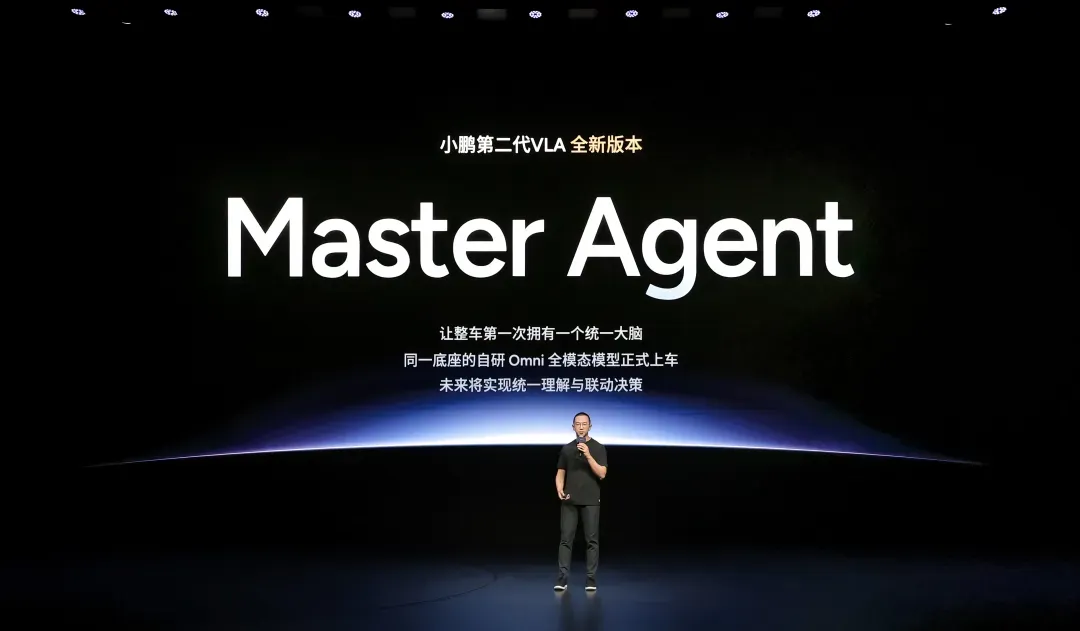
A secondary but commercially significant announcement was the introduction of Master Agent, an in-vehicle AI layer that merges VLA (driving action) with VLM (vision-language model) capabilities under a single Omni multimodal model. Users can issue natural-language voice commands — including ambiguous or colloquial phrasing — to execute parking, navigation, and waypoint insertion without manual interface interaction.
This VLA-plus-VLM fusion architecture mirrors approaches being developed in consumer robotics and reflects XPeng's stated intent to treat the vehicle as a mobile robotic platform rather than a transportation appliance. The Turing AI chip, which powers the Iron humanoid robot with three units per unit and achieves inference speeds exceeding 20 tokens per second on a single chip, runs the same underlying model framework — XLLM — as the vehicle system.
Deployment Timeline and Vehicle Compatibility
The second-generation VLA full version will begin OTA distribution in September 2026, targeting Ultra and Ultra SE vehicle variants. The distilled VLA Lite version, optimized for single-Turing-chip Max variants through learned token compression and distillation training, will roll out on the same schedule. The XPeng G9L will serve as the launch vehicle for both versions.
XPeng explicitly characterizes the Lite version as a capability-preserving distillation rather than a feature-reduced variant — a positioning choice designed to protect average selling price integrity across the model lineup.
Related Coverage:
XPeng’s EV Growth Hits a Supply Wall as Its Physical AI Bet Gains Momentum