
XPeng's Paris Pivot: China's EV Tech Licensing Model Faces Its First Real Commercial Test
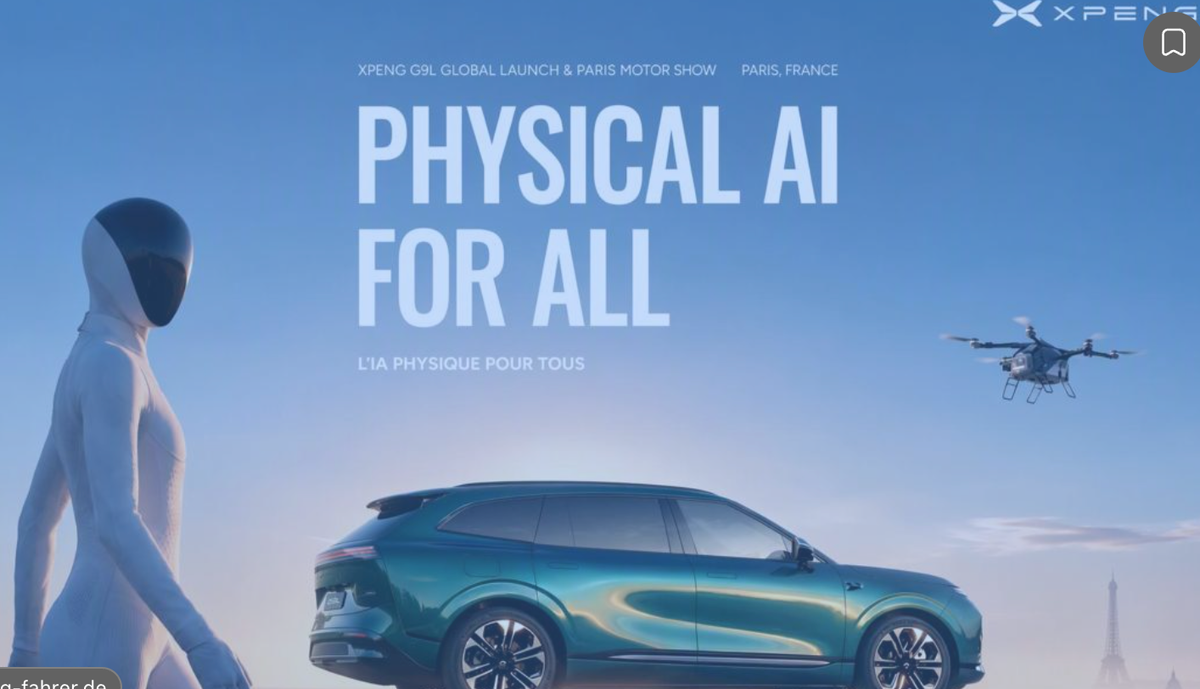
As XPeng Motors opens its full technology stack to global partners, the company is betting that software margins—not vehicle sales—will define the next chapter of Chinese EV competitiveness.
XPeng used the Paris Motor Show on October 14 to announce the broadest technology licensing offer yet from a Chinese electric vehicle manufacturer, spanning vehicle platforms, electronic-electrical architecture, autonomous driving systems, the in-house Turing AI chip, battery and powertrain modules, engineering toolchains, and emerging categories including Robotaxi and humanoid robotics. The announcement marks a structural inflection point: Chinese automakers are no longer just exporters of finished vehicles—they are attempting to become technology vendors to the global automotive industry.
The commercial validation already exists. XPeng's service and other revenue reached RMB 8.341 billion (US$1.16 billion) in 2025, up 65.6% year-on-year, carrying a gross margin of 68.2%—dwarfing the 12.1% gross margin on vehicle sales recorded in the same period. In Q2 2026, that service revenue line hit RMB 2.70 billion (US$375 million), accelerating to 93.9% year-on-year growth with margins expanding further to 75.1%. The numbers make the strategic logic self-evident: a single R&D investment, once amortized across XPeng's own vehicle lineup, can be re-monetized at near-zero marginal cost when licensed to external partners.
Volkswagen Deal Validates the Cross-Enterprise Delivery Model
XPeng's technology commercialization story did not begin in Paris. In July 2023, Volkswagen AG injected approximately US$700 million for a ~4.99% equity stake, initiating co-development of two China-market EVs. By April 2024, the two companies had jointly developed a China Electronic Architecture (CEA) based on a central-computing plus zonal-control topology that Volkswagen disclosed reduces electronic control unit (ECU) count by up to approximately 30%. In 2026, the collaboration entered mass production, with the ID. Yu 07 serving as a key CEA platform vehicle and the ID. Yu 08 rolling off the line.
Volkswagen's public disclosure that CEA went from concept to mass production in approximately 18 months is the single most commercially potent data point in XPeng's licensing pitch. For a multinational OEM managing multi-year platform cycles across dozens of nameplates, compressing development time by 18 months is not an engineering metric—it is a revenue metric. A large OEM selling 500,000 units per year that brings a new platform to market one year earlier, and simultaneously reduces per-vehicle hardware and wiring costs by RMB 1,000 (US$139) through ECU consolidation, captures approximately RMB 500 million (US$69 million) in annual cost improvement. That is the economic case XPeng is now presenting to every prospective partner.
Dissecting What XPeng Is Actually Selling—and Where Margins Live
The Paris announcement is best understood as a three-layer commercial offering, each with distinct margin and customer-fit profiles.
The foundational layer—vehicle platform architecture and EEA—is the highest-ticket item and the hardest to sell. It requires the buyer to commit early in a program cycle and accept deep interdependency with the licensor's design philosophy. One-time licensing fees are the primary revenue mechanism here. The Rivian (Rivian Automotive)-Volkswagen joint venture for EEA, announced in 2024 with a potential deal value of up to US$5.8 billion and an initial IP license payment of approximately US$1.295 billion per Rivian's SEC filings, establishes a credible market reference for what mature architecture IP can command.
The middle layer—autonomous driving software, AI BOX, the Turing AI chip, and battery and e-drive modules—blends per-vehicle royalties, engineering development fees, and hardware supply. This is where per-unit economics scale. A conservative model: if XPeng licenses EEA and base software at RMB 2,000 (US$278) per vehicle to an overseas partner producing 300,000 units annually, that generates RMB 600 million (US$83 million) in licensing revenue. At a 60% project-level margin, that is approximately RMB 360 million (US$50 million) in gross profit—from a single customer. If the platform reaches 1 million cumulative annual units across multiple brands and nameplates, the top-line reaches RMB 2 billion (US$278 million) with roughly RMB 1.2 billion (US$167 million) in gross profit. The ceiling is determined entirely by how many vehicles ultimately run the platform.
The third layer—the engineering toolchain, including remote XCP calibration tools, end-of-line (EOL) production testing tools, and AI-driven diagnostics—is the most underappreciated commercial opportunity. Unlike a one-time platform license, toolchain contracts generate recurring revenue across the full product lifecycle: development, manufacturing ramp, and aftersales. Engineering tools attach to programs regardless of which OEM ultimately builds the vehicle. This layer requires the least customer risk tolerance and the most straightforward procurement decision.
Mapping the Competitive Landscape Among Chinese Tech Suppliers
XPeng is not operating in a vacuum. The Chinese automotive technology supply market is consolidating around meaningfully different business models.
Leapmotor chose a capital-partnership route with Stellantis NV, exporting its high vertical-integration, low-cost platform philosophy through an equity structure that gives Stellantis distribution rights and manufacturing access outside China. Leapmotor's licensing revenue is structurally embedded in its Stellantis relationship—broad market licensing is not its current model.
Huawei Technologies operates at a different scale entirely. Its Intelligent Automotive Solution business generated RMB 45.018 billion (US$6.25 billion) in 2025, up 72.1% from RMB 26.158 billion (US$3.63 billion) in 2024. Crucially, Huawei's revenue encompasses automotive electronics hardware, software, and full-system solutions—it is not a pure-play IP licensor, and Huawei does not rely on proprietary branded vehicles to amortize its R&D base. Its scale advantage means it can absorb cross-subsidization across hardware and software in ways smaller platforms cannot.
XPeng's position is the most structurally complex: it must simultaneously scale its own branded vehicle business to maintain the R&D velocity that keeps its licensed technology competitive, while licensing that same technology to OEM partners who may be direct competitors in overlapping segments. A technology that differentiates XPeng's own vehicles loses that differentiating function once it powers a competitor's product. Managing this tension—deciding which capabilities to license, at what scope, with what IP protection and contractual constraints on downstream use, portability, and third-party maintenance—is the central governance challenge of XPeng's technology commercialization strategy.
Structural Risks Cap the Addressable Market
The customer pool for automotive platform technology is inherently constrained. Global OEMs capable of and willing to purchase Chinese EEA and software fall into a limited set of categories: legacy European or Japanese manufacturers facing software transformation pressure (Volkswagen being the template case), emerging-market OEMs without independent platform resources, and niche players seeking cost-effective electrification infrastructure.
Regulatory complexity compounds the challenge. European type-approval requirements, UN Regulation No. 155 (cybersecurity) and No. 156 (software updates), and General Data Protection Regulation (GDPR) compliance create certification and liability boundaries that must be allocated between licensor and licensee through contract. Autonomous driving systems additionally implicate training data provenance, map licensing, algorithmic update obligations, and multi-jurisdiction homologation—each adding negotiation complexity and implementation cost that narrows the set of commercially viable licensing deals.
The contractual terms that determine long-term value retention are also unresolved at the public disclosure level: ownership of jointly developed code, customer rights to port technology to alternative hardware, licensor rights to restrict use outside agreed geographies, and whether the licensee acquires rights to iterate independently. The Volkswagen-XPeng CEA collaboration's long-term sustainability has yet to be fully demonstrated at commercial scale—the 2026 production launches provide initial evidence, but the multi-year partnership dynamics remain under observation.
The Margin Story Drives the Strategic Imperative
The financial arithmetic ultimately explains why XPeng—and other Chinese OEMs with comparable technology depth—will continue expanding technology licensing efforts regardless of the execution risks. Vehicle gross margins across the Chinese EV industry remain structurally compressed by battery costs, price competition, and scale disadvantages relative to BYD. Technology licensing, by contrast, monetizes sunk R&D costs at 65–75% gross margins. For an industry where conventional vehicle economics rarely exceed 15% gross margin, the licensing model represents a potential structural re-rating of earnings quality.
The critical variable is whether XPeng—or any Chinese OEM pursuing this path—can build a customer base broad enough to move licensing revenue from a meaningful supplement to vehicle sales into a primary profit driver. At RMB 2.70 billion (US$375 million) in Q2 2026 service revenue alone, XPeng's technology business has already achieved a run rate that commands independent analytical attention. The Paris announcement is the company's signal that it intends to accelerate that trajectory globally.
Related Coverage: