
ZERON's IPO Reveals a Dual-Track Bet on Smart Trucking
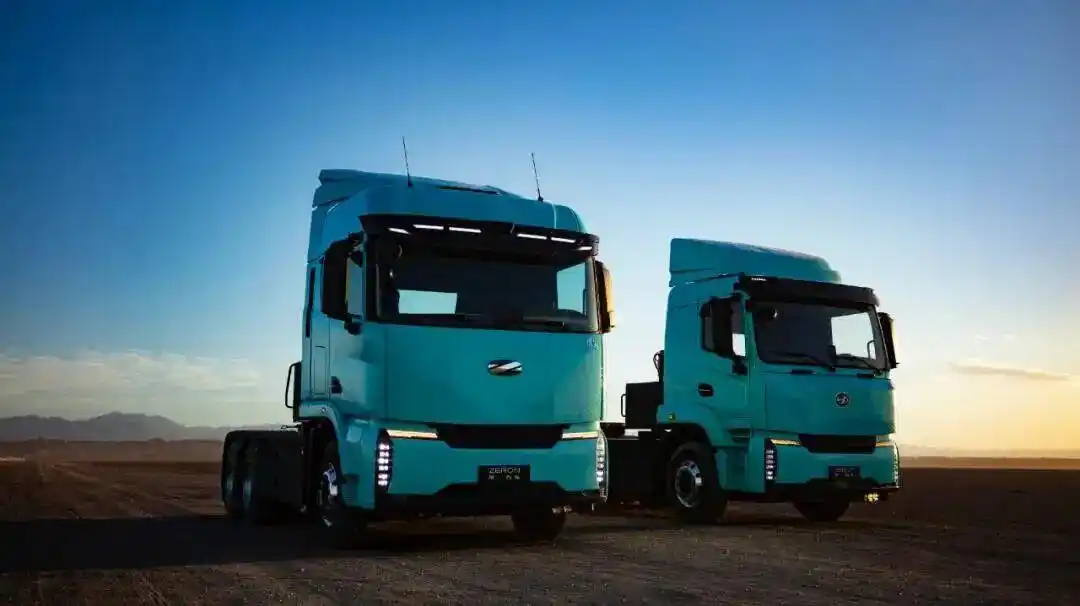
China's autonomous heavy-truck startup ZERON has filed for a Hong Kong listing after posting RMB 522 million (US$72.5 million) in 2025 revenue — a 320.8% year-on-year surge — but its prospectus reveals a company simultaneously sprinting toward gross-profit breakeven while widening its net loss, a tension that will define how capital markets ultimately value the business.
The filing marks a critical inflection point for a sector long dismissed as commercially unviable. ZERON, founded just three years ago, delivered 1,176 new-energy intelligent heavy trucks in 2025, more than four times the 272 units shipped in 2024, vaulting it past the scale threshold that has stalled most peers. The market's initial read: a credible path to hardware profitability exists, but the higher-margin autonomous-driving software layer — the narrative that would command a technology-company valuation multiple — remains subscale.
The timing is deliberate. China's new-energy heavy-truck market is consolidating rapidly after a bruising 2024 price war that slashed per-unit selling prices by RMB 100,000–200,000 (US$13,900–27,800) within twelve months, squeezing startups that had not yet achieved volume production. ZERON's decision to list now, while gross margins are still marginally negative, suggests management is racing to secure public-market capital before the window narrows further.
Choosing Hardware Over Algorithms Separates ZERON From Fallen Peers
When ZERON co-founder and CEO Huang Zehua incorporated the company, investors repeatedly urged him to replicate the asset-light playbook of TuSimple — develop autonomous-driving software, raise capital, list quickly. He declined, opting instead to manufacture trucks from scratch.
That contrarian call now looks strategically astute, if financially costly. By owning the full vehicle stack — including a proprietary electric-drive axle, thermal management system, and vehicle control unit — ZERON built in cost levers that pure-software rivals cannot access. Insiders familiar with the company's engineering told Leiphone's New Smart Drive that certain ZERON models are approximately one metric ton lighter than comparable products and consume 15%–20% less energy, a meaningful advantage in the short-to-medium-haul segments — ports, logistics parks, industrial campuses — that the company deliberately targeted instead of chasing the more glamorous but operationally complex long-haul intercity market.
The prospectus data validates the strategy at the gross-margin level. ZERON's gross loss rate compressed from 287.2% in 2023 to 34.7% in 2024 and then to 2.5% in 2025. Three drivers explain the trajectory: scale economics that improved procurement leverage on batteries and drive components; iterative platform development, with its second-generation electric-drive axle already in mass production and a third generation in development; and the first revenue contribution from its unmanned-truck solution segment, which recorded a positive gross margin of 4.3% in 2025.
Revenue Concentration Exposes Near-Term Vulnerability
The prospectus lays out a business that remains overwhelmingly dependent on vehicle sales. In 2025, new-energy intelligent heavy-truck revenue reached RMB 507 million (US$70.4 million), representing 97.2% of total revenue. The flagship "Xiaoman" model contributed RMB 306 million (US$42.5 million), or 58.7% of total revenue, while the "Jingzhe" model generated RMB 201 million (US$27.9 million), accounting for 38.5%.
The unmanned-truck solution segment — the business line that capital markets will scrutinize most closely — generated only RMB 8.1 million (US$1.1 million), or 1.5% of total revenue in 2025. As of end-2025, cumulative deliveries of autonomous-capable trucks stood at just 15 units, though the company added 41 more in the first four months of 2026, suggesting an acceleration.
The strategic importance of that segment exceeds its current revenue share. Unlike one-time hardware sales, the unmanned-truck solution model is designed to generate recurring technology service fees, operational service fees, and software upgrade revenue — a SaaS-adjacent structure that, if it scales, would fundamentally re-rate ZERON's valuation away from a manufacturing multiple toward a technology-platform multiple. The pace of that transition is the central variable investors must price.
Widening Net Losses Signal a Deliberate Investment Cycle, Not Deterioration
The headline loss figures demand context. Net losses widened from RMB 114 million (US$15.8 million) in 2023 to RMB 241 million (US$33.5 million) in 2024 and RMB 281 million (US$39.0 million) in 2025, while operating cash flow remained negative throughout the period. At first glance, a company posting larger losses as revenue quadruples may appear structurally challenged.
The explanation lies in research and development intensity. ZERON's R&D expenditure rose from RMB 71.42 million (US$9.9 million) in 2023 to RMB 116 million (US$16.1 million) in 2024 and RMB 126 million (US$17.5 million) in 2025, equivalent to 24.1% of 2025 revenue. That ratio is abnormally high for a heavy-truck manufacturer and reflects the company's dual mandate: funding both vehicle-platform engineering and a parallel autonomous-driving technology stack that encompasses end-to-end multimodal large models, training infrastructure, and unmanned-truck operating systems.
The analogy to early-stage Chinese electric-vehicle makers is imperfect but instructive. Companies such as NIO, Li Auto, and XPeng each sustained extended periods of gross-margin compression and net losses before scale economics and software monetization shifted the financial profile. ZERON is attempting a compressed version of that journey in a market — commercial heavy trucks — where the total addressable opportunity is large but the autonomous-driving regulatory and operational environment is less mature than passenger-vehicle equivalents.
Hong Kong Listing Tests Investor Appetite for a Hybrid Hardware-Software Story
The Hong Kong IPO filing positions ZERON at a moment when the exchange has become the preferred venue for Chinese technology and smart-vehicle companies seeking international capital. The offering will test whether public-market investors are willing to assign a technology premium to a company that currently derives 97% of revenue from manufacturing, on the basis of a software-and-services pipeline that is real but nascent.
The bear case is straightforward: gross margins remain slightly negative, net losses are growing, cash burn is structural, and the autonomous-freight operating model has yet to demonstrate unit economics at scale anywhere in China. The bull case rests on the speed of gross-margin improvement — from -287% to -2.5% in 36 months — as evidence that the cost curve is bending sharply, and on the argument that 56 cumulative autonomous-capable truck deliveries by April 2026 represent a genuine, if early, commercial foothold.
What is not in dispute is that ZERON has already cleared the bar that eliminated most of its cohort: it survived long enough to achieve meaningful volume, and it did so without abandoning its technology ambitions. Whether the next phase — converting accumulated data, algorithms, and operational experience into a higher-margin autonomous-freight business — can be executed before the company's capital runway expires is the question the Hong Kong IPO is designed to answer.
Related Coverage:
‘China’s Trucking Tesla’ Zeron Files for Hong Kong IPO After Revenue Surges 450-Fold