
After The Hype: Deutsche Bank Warns Pop Mart's Volume-Driven Model Faces "Fashion Fatigue"
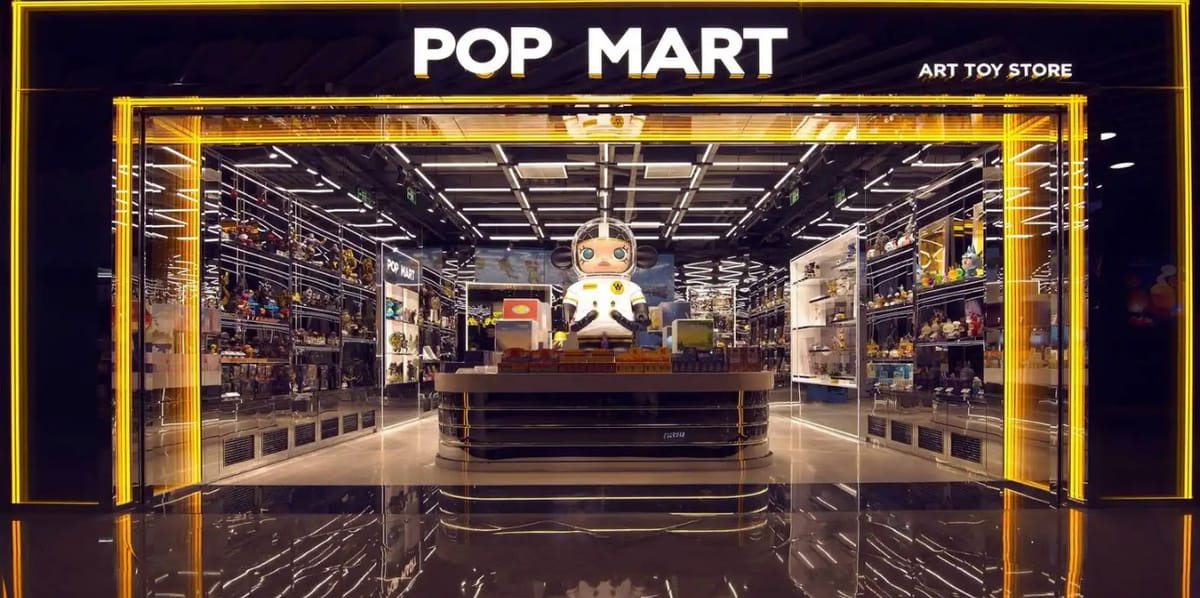
Deutsche Bank downgraded Pop Mart International Group to "Hold" from "Buy" on December 6, slashing its target price to HKD 228 from HKD 303 and warning that the Chinese toy collectibles phenomenon may be hitting peak popularity. Following a spectacular 2025 rally that saw shares surge over 200% before collapsing nearly 50% from October highs, the investment bank's sobering assessment arrives as the company's signature Labubu products flood global markets—eliminating the scarcity that fueled collector frenzy.
The report, published December 16, matters because it dissects a business model entirely dependent on maintaining "consistently high" transaction volumes to justify operating margins that rival luxury brands. With an estimated 145 million Labubu units already sold worldwide and secondary market prices collapsing, the question is whether Pop Mart can sustain its meteoric growth—or if it's destined to follow the boom-bust cycles of IP-driven predecessors like Sanrio's Hello Kitty.
The Volume Trap
Deutsche Bank analyst Sammi Xu identifies the core vulnerability: Pop Mart's business model requires approximately 63 transactions per hour globally and 34 per hour in China just to maintain current store productivity. This is only achievable, Xu argues, "when there are significant customer queues"—a phenomenon that has largely disappeared.
"Since mid-October 2025, increased production capacity (i.e. from 10mn to 50mn per month) has eliminated product shortages," the report notes. "This strategy has also reduced the perceived scarcity of its products, leading to a decline in collector enthusiasm."
The bank's meticulous tracking of inventory availability across major markets tells the story. Previously hard-to-find Labubu products are now readily available on Pop Mart's website and Amazon in the US, UK, Canada, Australia, and across Asia. Secondary market prices have crashed—Labubu 2.0 items that traded at RMB 126 versus an original price of RMB 99 (approximately US$14-18) have normalized, while the mini Labubu series launched to lackluster reception.
Store observations paint an even grimmer picture. "There are no more queues" in most overseas markets including Bangkok, Singapore, Seoul, and many US cities, Deutsche Bank reports. High traffic persists only in newly opened stores like Madrid or select cities like Tokyo—classic signs of geographic arbitrage rather than sustained brand momentum.
Operating Leverage Works Both Ways
The implications for profitability are stark. Pop Mart achieved an estimated 34.4% adjusted net profit margin in 2025, up from 26.1% in 2024, driven largely by high foot traffic and overseas expansion. But these margins assumed consistently packed stores with cashiers "constantly busy" serving queuing collectors.
Pop Mart's store productivity metrics are genuinely impressive—comparable to global retail leaders. Based on 2025 estimates, overseas stores generate approximately US$10 million in annual sales per location versus US$2 million for Five Below and US$11 million for Lululemon US stores. On a sales-per-square-foot basis, Pop Mart achieves US$6,524 compared to US$3,785 for Five Below.
But maintaining this requires relentless transaction velocity at relatively low average ticket prices. As traffic normalizes and the "fashion fatigue" Deutsche Bank warns about takes hold, the operating leverage that powered margin expansion will reverse with equal force.
The Sanrio Warning
Perhaps most ominously, Deutsche Bank draws extensive parallels to Sanrio's Hello Kitty cycles—a sobering historical precedent for "super IP" lifecycles. The Japanese company experienced two distinct boom-bust patterns:
The 2000s cycle saw Sanrio's stock peak in September 1999 following Hello Kitty's explosion in US and European markets, fueled by celebrity endorsements and perceived "emotional value" during Japan's Lost Decade. What followed was a three-year collapse and seven years of stagnation as domestic "Hello Kitty fatigue" set in and the brand became diluted through massive licensing expansion.
The 2010s cycle repeated the pattern. After peaking in March 2014 on strong overseas sales, Sanrio entered another seven-year downturn as Disney's "Frozen" and Pokémon displaced Hello Kitty from retail shelves and the company's 70% revenue concentration in a single IP proved catastrophic.
"The trajectory of an IP is not linear; it is often characterized by price premiums and extreme undersupply during upswings, followed by a downcycle of several years after its popularity peaks," Deutsche Bank concludes.
Near-Term Catalysts vs Long-Term Valuation
Trading at 15x one-year forward P/E following its de-rating, Pop Mart now faces two critical tests. First, the company must deliver on its guidance of approximately RMB 8 billion (US$1.1 billion) in US sales for 4Q25, requiring sequential acceleration. Second, the next Labubu series expected in 1H26 needs to recapture collector enthusiasm—a significantly higher bar after 145 million units saturated the market.
Deutsche Bank makes clear that long-term valuation hinges on Pop Mart's ability to "continuously create popular IP" and deliver "another blockbuster IP." If near-term revenue growth comes through expanded production at the expense of waning popularity—essentially the path it's currently on—the valuation could suffer further.
The company generated RMB 41.6 billion (US$5.7 billion) in sales for 2025 with operating margins of 43.9%, according to Deutsche Bank estimates. But those figures assume conditions that may no longer exist: product scarcity, multi-hour queues, and collector frenzy that justified premium secondary market pricing.
As inventory normalizes and Google search interest declines, Pop Mart faces the fundamental challenge confronting every fashion-driven business: what happens after the hype?