
Agibot Breaks Mass Production Barrier with 5,000th Unit as Manufacturing Costs Halve
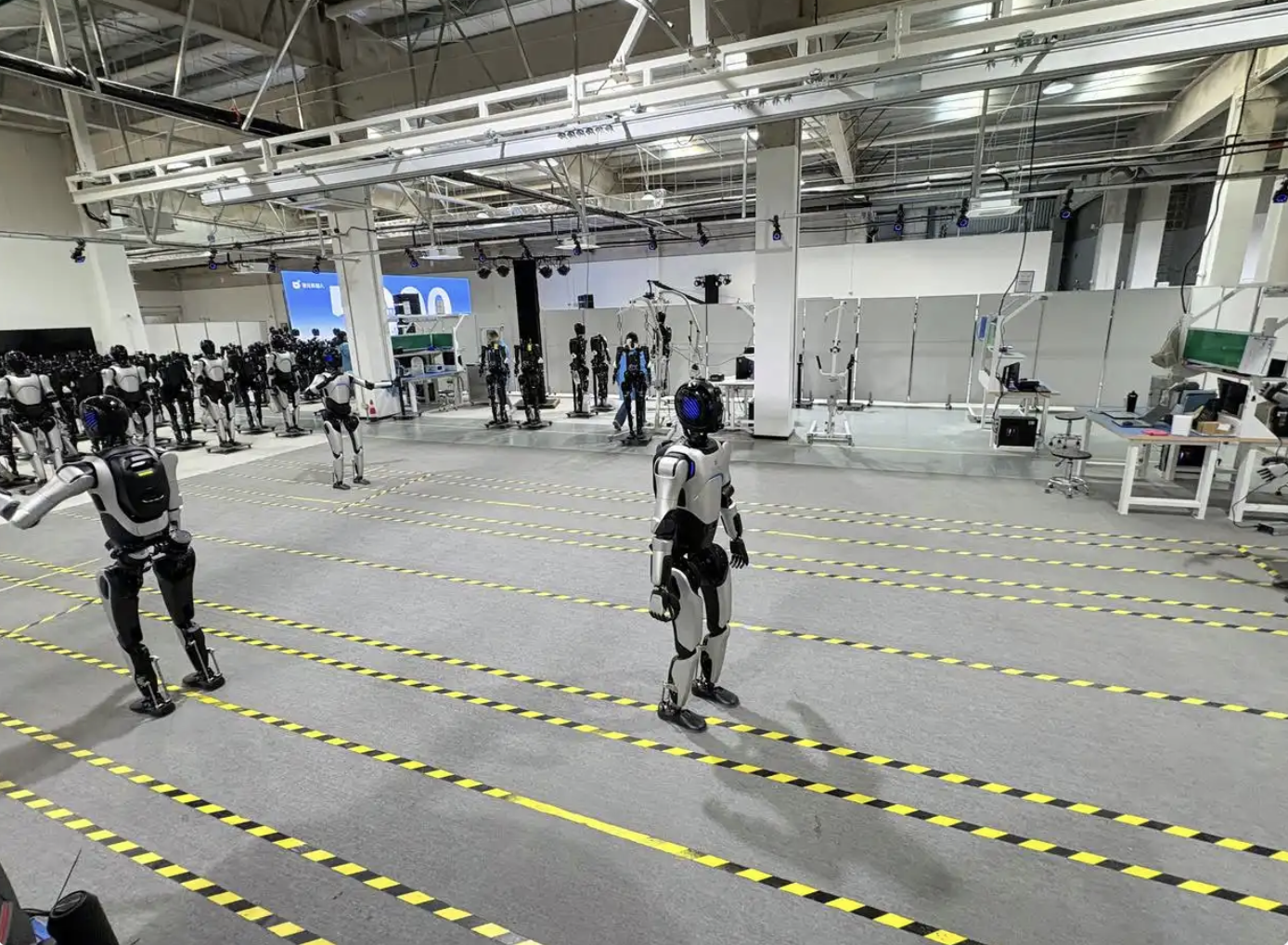
Agibot rolled out its 5,000th general-purpose embodied robot at its Shanghai facility on December 8, marking a significant operational milestone in the nascent humanoid robotics sector. By crossing this volume threshold, the company has effectively navigated the critical transition from prototype development to scaled manufacturing, validating its supply chain resilience, quality control systems, and assembly consistency.
This production volume places Agibot ahead of many domestic and international competitors, who typically report shipment figures ranging between 500 and 1,000 units. The achievement signals a maturity in production capabilities that allows for a shift in focus toward commercial deployment and market penetration. Industry observers note that reaching the 5,000-unit mark is essential for proving that humanoid robots can be mass-produced with reliable standards rather than remaining laboratory novelties.
The realization of economies of scale has had an immediate impact on the company’s cost structure. According to Agibot management, the production cost for its Expedition A2 series has dropped by approximately 50% compared to the beginning of 2025. This dramatic reduction in unit costs is expected to accelerate the commercial viability of humanoid robots in industrial and service applications, making adoption more attractive for enterprise clients.
Following the ramp-up in production, Agibot has secured significant commercial orders from major listed entities, including communication giants and automotive component manufacturers. With the supply chain now stabilized, the company’s strategic priority is pivoting toward ensuring long-term operational stability in real-world scenarios, moving beyond initial pilot programs to sustained industrial and commercial integration.
Scaling Up Amidst Tight Competition
The 5,000-unit output comprises a mix of Agibot’s product lines, including 1,742 units of the Expedition A1 and A2 series, 1,846 units of the Lingxi X1 and X2 series, and 1,412 units of the Genie G1 and G2 series. This volume outpaces several key players in the market. For context, Ubtech Robotics has projected approximately 500 industrial humanoid robot deliveries for the full year of 2025, with a total annual capacity of 1,000. Similarly, Unitree Robotics shipped roughly 1,400 units last year, while U.S.-based Figure AI is projected to produce around 1,000 units in 2025. Tesla Inc. is reportedly still in the process of installing its first-generation bulk production line for the Optimus robot.
Wang Chuang, Partner and Senior Vice President at Agibot, emphasized that hitting volume targets like 200 and 1,000 units represents distinct hurdles in industrialization. The first 200 units challenge a company to establish a qualified supply chain and define quality standards where none previously existed. By the time production hits 1,000 units, the manufacturing process must operate independently of the R&D team, relying instead on standardized assembly and testing protocols. Surpassing 5,000 units indicates that the company has successfully thoroughly tested its supply chain stability and yield rates.
Commercial Integration and Market Demand
As production rapidly expands, Agibot is simultaneously refining its application scenarios through active commercial partnerships. In 2025, the company secured orders ranging from tens of millions to over RMB 100 million yuan (US$13.7 million) from prominent corporations. Key clients include China Mobile, Longcheer Technology, Joyson Electronics, and Mianyang Fulin Precision Machining.
These deployments cover a diverse range of functions, from customer service and guidance in business halls to data collection and automotive parts production in factory settings. The feedback loop from these clients has directly influenced product development. For instance, while initial models were designed for indoor use, client demand for outdoor operability led Agibot to standardize 5G capabilities across its lines, allowing for independent network operation.
Operational Stability and Software Ecosystem
To ensure robots can withstand the rigors of daily operation, Agibot has implemented stringent testing protocols comparable to "robotic weightlifting." Post-assembly validation includes automated repetitive positioning tests for upper limbs and heavy-load rotation and squat tests for lower limbs to verify consistency and structural integrity. The goal is to ensure that robots can not only be delivered but also retained in their designated scenarios for the long term, rather than serving merely as demonstration units.
Currently, entertainment and commercial guidance remain the most widespread applications. To facilitate broader adoption, Agibot launched its "Lingchuang" and "Lingxin" platforms in late 2025, enabling users to customize robot actions and personas via zero-code interfaces. This flexibility was demonstrated by the newly rolled-out Lingxi X2, which features tailored interaction capabilities. Looking ahead to 2026, the competitive landscape is expected to shift from hardware volume to software ecosystems and the depth of application development, determining which companies can sustain long-term value in real-world environments.