
AI Glasses Sales Surge 2,500% as Tech Giants Race for Next Consumer Interface
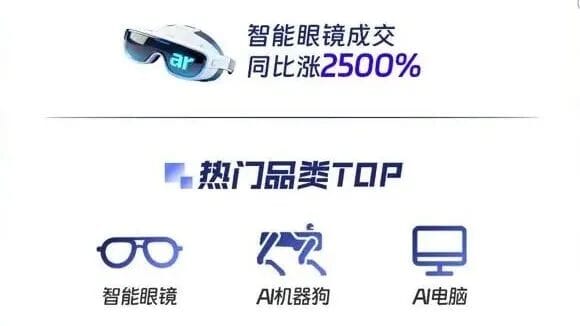
AI-powered smart glasses have emerged as the fastest-growing consumer electronics category in China's 2025 Singles' Day shopping festival, with sales exploding as major technology companies compete to establish the devices as the next-generation human-computer interaction platform. The surge marks a pivotal shift in the wearable technology market, driven by the integration of large language models and expanding practical applications beyond entertainment.
Tmall reported a 2,500% year-on-year increase in smart glasses sales during this year's Singles' Day period, with Rokid products jumping over sevenfold and Rayneo Innovation growing more than 80%. JD.com saw similar momentum, with smart glasses transaction value soaring 346% on November 11, making it the fastest-growing category within consumer electronics.
The retail performance extends a broader market expansion. Global smart glasses shipments reached 4.065 million units in the first half of 2025, up 64.2% year-on-year, according to IDC. The research firm projects global shipments will exceed 40 million units by 2029, with China's market experiencing a compound annual growth rate of 55.6% from 2024 to 2029, the highest globally.
The sales boom reflects intensifying competition among Chinese technology giants seeking consumer-facing applications for their AI models, as smart glasses increasingly integrate advanced language models to enable real-time translation, object recognition, navigation, and payment functions previously confined to smartphones.
AI Integration Drives Consumer Demand
The current wave of smart glasses differs fundamentally from earlier augmented reality devices focused primarily on gaming and entertainment. Products from XREAL and Rayneo Innovation's Air series have traditionally emphasized immersive visual experiences, marketed as "wearable televisions" for gaming and video consumption.
The market shifted following Meta's introduction of Ray-Ban Meta smart glasses, which initially launched in late 2023 with basic photography and audio features before integrating Meta's Llama large language model in April 2024. Sales exceeded one million units by year-end 2024, with Ray-Ban Meta revenue growing over 200% year-on-year in the first half of 2025, according to parent company Essilor Luxottica.
Chinese manufacturers rapidly followed suit. Xiaomi's first AI glasses, launched in June 2025 and directly benchmarked against Ray-Ban Meta, sold out online within 30 minutes. The device incorporated both Xiaomi's XiaoAi assistant and SenseTime's multimodal AI model.
Alibaba's Quark division opened pre-sales for its S1 AI glasses on October 24, marketing the device as a "personal super AI assistant" integrated with Amap navigation and Alipay payment systems. The product immediately topped Tmall's XR device sales rankings. Lingban Technology's Rokid series, featuring similar translation, recognition, and navigation capabilities, ranked second.
Tech Giants Compete for Hardware Foothold
AI glasses represent a strategic priority for Chinese internet platforms seeking consumer applications for their language models. While major smartphone manufacturers including Huawei and Xiaomi have developed proprietary models, limited third-party access to mobile operating systems has pushed AI developers toward alternative hardware platforms.
Alibaba has positioned Quark as its "AI flagship application," with the S1 representing the company's first consumer AI hardware device. The platform launched an AI dialogue assistant powered by Tongyi Qianwen's latest closed-source model one day before opening glasses pre-orders, incorporating advanced search, image recognition, writing assistance, and translation functions that align with smart glasses capabilities.
Baidu released its Xiaodu AI Glasses Pro during the Singles' Day period and partnered with Lexiang Technology to launch Dpvr AI glasses, both utilizing Baidu's Qianfan large model platform and computing infrastructure. Tencent, while not yet releasing products, has collaborated with Inmo Technology on the INMO AIR3, developed in partnership with Tencent's AppStore.
The competitive intensity has driven significant capital flows into the sector. More than 20 financing rounds for smart glasses companies have closed in 2025, with Rayneo Innovation completing four rounds and XREAL securing RMB 200 million yuan in funding. Inmo Technology raised RMB 150 million yuan.
Market Valuations Reflect Growth Expectations
Public market valuations for related companies have surged. Spatial Information Technology, Dongshan Precision Manufacturing, and Changying Precision Technology have all posted triple-digit percentage gains in 2025.
Spatial Information Technology climbed as much as 657% this year after announcing in October plans to acquire 100% of Shenzhen Jiahejinwei Electronics Technology, a domestic memory manufacturer. The target company's expertise in DRAM production positions it to benefit from AI computing demands. The stock recorded six consecutive daily limit-ups following the announcement.
IDC forecasts China's smart glasses market will ship 2.846 million units in 2025, with AI glasses accounting for 2.202 million units, representing 183.2% year-on-year growth and substantially outpacing AR entertainment devices.
Technical Challenges Remain
Despite rapid market expansion, manufacturers face persistent user experience issues. Consumer feedback frequently cites discomfort from prolonged wearing, visual artifacts including double images, limited battery life, and lack of water resistance as areas requiring improvement.
Companies are addressing comfort concerns through partnerships with traditional eyewear manufacturers. Blog Eyeglasses has established collaborations with Meizu Technology, Rayneo Innovation, Rokid, and Huawei to provide professional lens fitting services. Bolon, BrightStar, and other established optical retailers have similarly entered the smart glasses market.
Meta's July 2025 acquisition of approximately 3% of Essilor Luxottica for roughly EUR 3 billion ($3.3 billion) demonstrates the strategic value of combining optical expertise with AI capabilities. The French-Italian eyewear conglomerate merged lens manufacturer Essilor with frame producer Luxottica, creating a vertically integrated optical technology platform.
Industry participants increasingly expect convergence between AI and AR capabilities. Rayneo Innovation CEO Li Hongwei indicated in October that the company's latest financing round, completed in November as a C+ extension, reached approximately RMB 800 million yuan ($110 million), setting a domestic record for AI-AR glasses funding. The company stated proceeds would accelerate research and ecosystem development for combined AI-AR devices, reflected in products like the X3 Pro that integrate Tongyi AI model functionality with advanced display technology.