
AI Robot Maker MirrorMe Secures Funding, Pivots From Speed to Companionship
MirrorMe Technology, an embodied AI startup with deep ties to Zhejiang University, has secured tens of millions of yuan in Series A financing, a move that signals a strategic pivot toward the consumer market despite the company’s origins in developing record-breaking high-performance robots.
The funding round was exclusively led by Ivy Capital, MirrorMe announced in early October. The company, founded in May 2024, stated the fresh capital will be used to advance its research and development, accelerate mass production, and scale the market delivery of its consumer and industrial-grade robots.
This investment comes as MirrorMe Technology (Shanghai) shifts its visible focus from raw mechanical prowess to niche applications. The firm, which first gained attention for a quadruped robot that set a world speed record, is now heavily promoting its new companion robot, “BAOBAO,” through a series of high-profile partnerships.
The strategic shift highlights a central question facing the burgeoning embodied AI sector: whether to prioritize long-term technological supremacy or pursue more immediate, practical market applications. For investors, MirrorMe’s pivot underscores a pragmatic turn toward commercialization, even at the cost of leveraging its most advanced technical achievements.
Forging Alliances for a Consumer Niche
MirrorMe has spent recent months building a partner ecosystem around its BAOBAO robot, targeting specific consumer-facing scenarios. This product, designed as a “future family smart entity,” is being positioned for home life, elder care, and mental wellness.
In September, the company signed a strategic agreement with Arcsoft Technology and Zhejiang Radio & TV New Media to jointly launch a new family robot. The collaboration leverages Arcsoft’s low-latency remote control technology, enabling stable, high-definition control over 4G, 5G, and Wi-Fi networks.
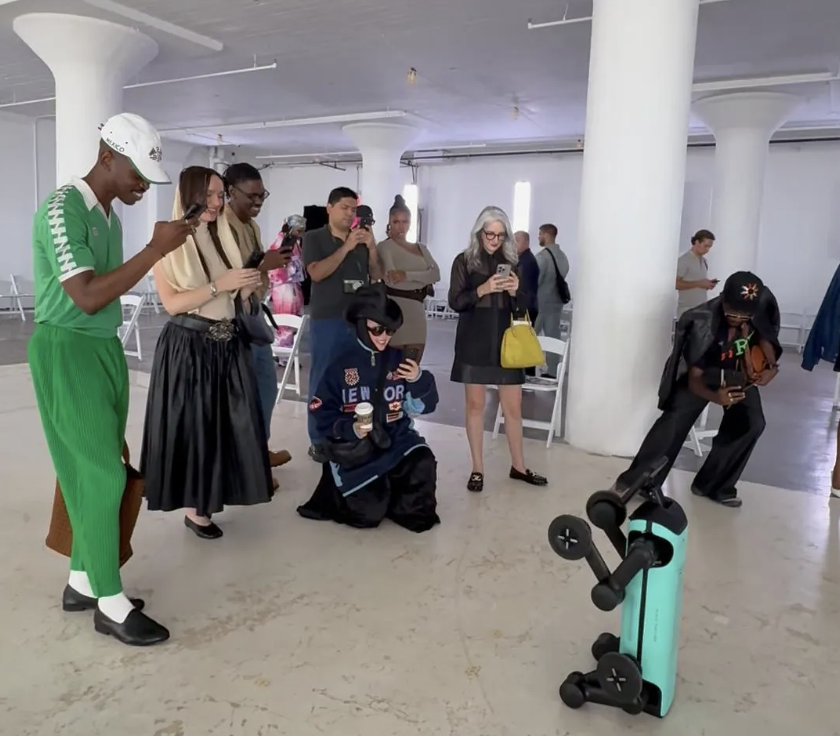
That same month, MirrorMe partnered with Caring Inc., a South Korean elder care “unicorn” that manages over 42,000 caregivers. The deal aims to integrate MirrorMe’s robotics into smart senior care solutions. In August, during the 2025 World Robot Conference, MirrorMe also joined forces with Yidianling, a leading Chinese online psychological services platform, to explore applications in AI-assisted therapy. To boost brand visibility, the BAOBAO robot also appeared on the runway at the 2026 Spring/Summer New York Fashion Week, an effort to build its own intellectual property distinct from traditional co-branding.
From Record-Breaking Speed to Diverse Applications
The company's current focus on companionship marks a departure from its initial claim to fame. MirrorMe first entered the public eye in January 2025 when its Black Panther 2.0 quadruped robot, co-developed with Hangzhou Kairda Welding Robot and a Zhejiang University innovation center, was featured on state television. At the 2025 CMG World Robot Skills Competition, the robot clocked a speed of 10.3 m/s, officially breaking a decade-old record of 8.89 m/s held by Boston Dynamics’ WildCat.
Despite holding this performance benchmark, MirrorMe launched two new, strategically different robots in August 2025:
- BAOBAO: A consumer companion robot capable of switching between a bipedal-like and quadrupedal form. Its core function is emotional interaction and lifestyle assistance, including serving as a mobile karaoke machine or home assistant, rather than performing complex physical tasks.
- Apollo: A modular industrial quadruped robot. Evolved from a previous record-holder, this machine boasts a peak speed of 8 m/s, can carry a continuous load of over 40 kg, and has an operational endurance of up to five hours.
The broad spectrum of applications—from a research-grade speed demon to an industrial workhorse and a home companion—is unusual for an early-stage robotics firm.
An Ambitious Roadmap Raises Questions
MirrorMe’s recent emphasis on BAOBAO at the expense of its more technologically advanced robots has raised questions about its strategy. While partnerships for the companion robot have been widely publicized, the industrial Apollo robot has received significantly less attention, prompting speculation about whether the company’s technical advantages have yet to find clear market traction.
The introduction of BAOBAO itself appears to be a deviation from the company’s product plan outlined in June 2024, which detailed an A-series (Apollo), P-series (Black Panther), and an I-series general-purpose humanoid robot. BAOBAO was not part of that original blueprint.
Furthermore, MirrorMe has laid out an aggressive timeline for future development. In March 2025, it set a goal to achieve a 10 m/s running speed for a bipedal robot by 2026, launch a humanoid robot for flexible manufacturing by 2027, and release a humanoid personal assistant by 2030. This path would see the startup simultaneously developing quadruped, dual-form, and humanoid robot lines.
For observers and investors, this ambitious agenda invites scrutiny. It remains to be seen whether the plan is an achievable blueprint for a future robotics powerhouse or an overly optimistic vision designed for the capital markets, reflecting the difficult choice between market-driven pragmatism and technology-led ambition that defines the current state of the embodied AI industry.