
Alibaba Launches HappyHorse 1.1 Ahead of ByteDance’s Seedance 2.1 in AI Video Race
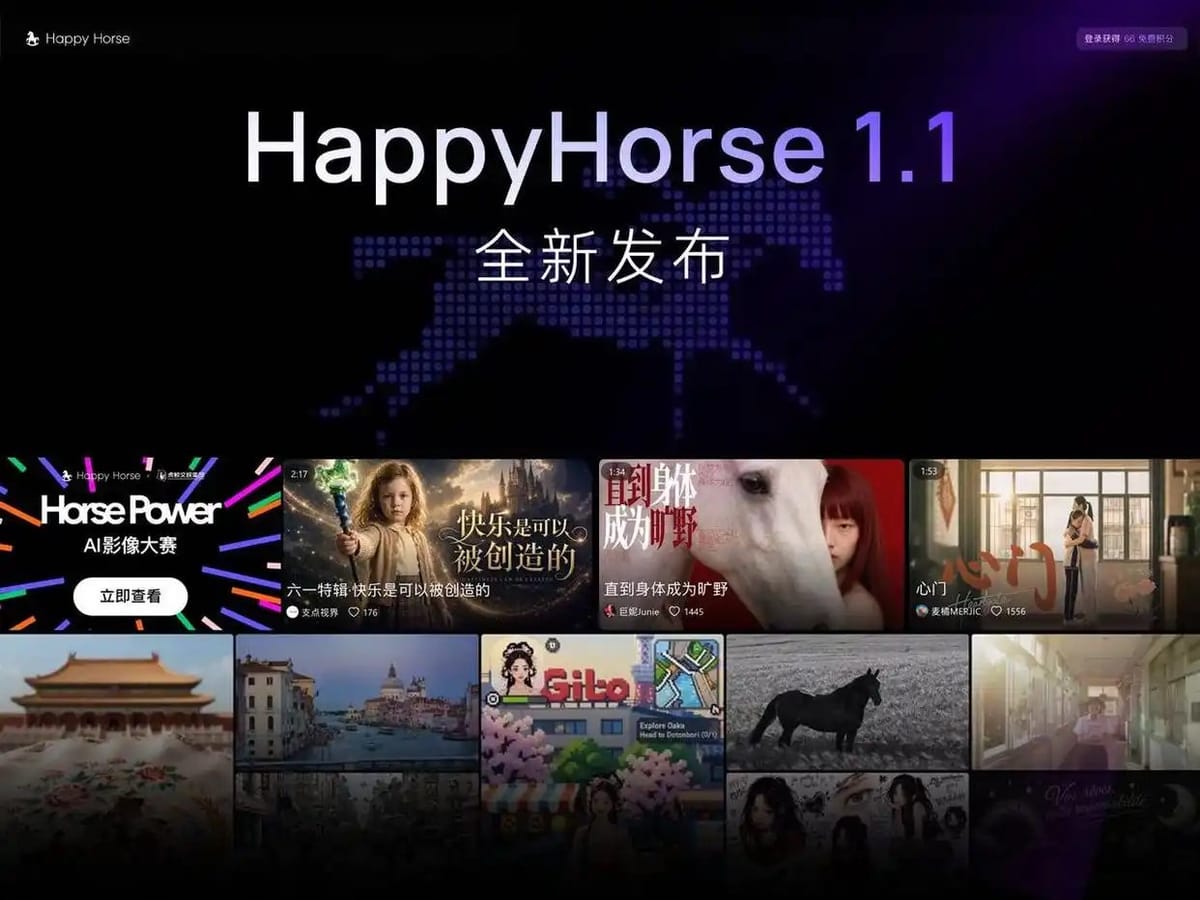
Alibaba fired a preemptive shot in China's intensifying AI video generation market on June 22, 2026, releasing HappyHorse 1.1 — a five-point upgrade to its video synthesis model — hours before ByteDance was set to showcase its competing Seedance platform at the Volcano Engine Force Conference.
The timing was deliberate. ByteDance's Seedance 2.1, which industry tracker Pandaily had flagged as imminent, reportedly delivers approximately 20% generative quality improvement over its predecessor, with breakthroughs concentrated in temporal consistency and physics simulation. By going live the evening prior, Alibaba seized the news cycle before its rival could define the narrative — a calculated move that reflects how fiercely the two internet giants are contesting what analysts increasingly view as a foundational layer of China's next-generation content economy.
Market observers noted the dual-track launch structure: a model upgrade targeting enterprise and developer workflows, paired with a creator competition offering commercial incentives. Together, they signal Alibaba's intent to win on both the technology and ecosystem fronts simultaneously.
Five Upgrades Target Creators' Core Pain Points
HappyHorse 1.1 maintains the same technical specifications as its predecessor but delivers targeted refinements across five dimensions that directly address friction points cited by professional short-drama and advertising producers.
Motion modeling received the most structurally significant update. The new version improves temporal consistency in high-kinetic sequences — fight choreography, rapid camera movements — areas where earlier generative models frequently produced frame-to-frame artifacts that rendered footage commercially unusable.
Subject consistency now supports simultaneous input of up to nine character reference images, enabling stable multi-character, multi-scene compositions with consistent brand elements and product details. This capability is particularly relevant for e-commerce advertisers who require rigid visual identity standards across generated footage.
Instruction following has been extended to handle both terse and complex prompts with greater fidelity. According to Alibaba's release documentation, brief descriptors for high-intensity action scenes now produce coherent outputs, while multi-scene, multi-character narratives driven by extended prompts maintain stable cinematographic sequencing.
Visual realism now preserves granular skin texture — pores, expression lines, minor blemishes — a specification that short-drama producers have long demanded to avoid the "uncanny valley" effect that undermines viewer immersion.
Audio generation introduces dynamic prosody adjustment, allowing speech cadence, pause patterns, and tonal register to shift in response to scene context and emotional beat. Users can additionally specify ambient soundscapes through prompt descriptors.
HappyHorse 1.1 is now live across Alibaba's official portal, Alibaba Cloud's Bailian platform, and Qianwen Cloud, with full API access available for enterprise integration.
Competition Prize Pool Deploys Ecosystem Lock-In Strategy
Concurrent with the model launch, Alibaba and Huhu Entertainment Group jointly activated the "HorsePower · AI Image Competition," a structured creator acquisition campaign running through August 20, 2026.
The incentive architecture is multidimensional. At its apex, the competition offers official one-on-one facilitation of commercial brand deals worth up to RMB 1 million (approximately US138,900). The cash and compute prize pool exceeds RMB 300,000 (approximately US$41,700) plus 3.1 million platform credits, with individual maximum awards reaching US$6,000 and 300,000 credits, with individual maximum awards reaching US$6,000 and 300,000 credits.
Beyond direct financial incentives, winners gain priority access to Huhu Entertainment's "Spring Seedling Screenwriter Program," entry into the "Haina International Young Director Development Program," and co-creation credits on director Zhang Jizhong's upcoming production Jinghua Qiyuan. Winning works will be distributed globally through Youku and eligible for international film festival submission.
Eligibility requires that submitted works comprise at least 70% AI-generated footage overall, with no less than 50% generated specifically by HappyHorse — a threshold designed to deepen model adoption rather than simply attract peripheral AIGC practitioners.
The competition spans three open tracks — free-form creative, brand commercial, and cinematic narrative — plus a special track co-curated by Zhang Jizhong, drawing on the Qing Dynasty novel Jinghua Yuan as source material for Eastern fantasy storytelling.
Diverging Technical Philosophies Define the Competitive Fault Line
A direct comparison of HappyHorse 1.1 and the forthcoming Seedance 2.1 reveals two distinct strategic philosophies rather than a straightforward quality contest.
HappyHorse 1.1 prioritizes production workflow utility: subject consistency, prompt compliance, and audio-visual polish that makes generated footage immediately deployable in commercial contexts. Seedance 2.1, by contrast, is targeting physical realism at the rendering layer — frame-to-frame coherence and physics simulation that would give it an advantage in visually complex, long-form generative sequences.
The two approaches are not mutually exclusive, but they do imply different near-term customer bases. HappyHorse's upgrades speak most directly to short-drama studios and brand advertisers operating under tight production timelines; Seedance's trajectory suggests a push toward higher-budget cinematic applications where physical plausibility is non-negotiable.
Neither model, however, operates in a bilateral vacuum. The competitive set includes Kuaishou's Kling AI, Minimax, and internationally, Google's iterating Veo series — all of which are actively compressing the quality gap that once separated frontier models from the field.
Creator Retention Remains the Unresolved Variable
The competition's incentive structure can be read as a sophisticated ecosystem capture play: draw in high-quality creators with near-term commercial upside, then convert them into long-term HappyHorse power users through ongoing compute credits and early model access.
The logic is sound, but execution risk is real. Creator loyalty in the AIGC space has proven transactional — practitioners migrate rapidly toward whichever tool delivers the most reliable commercial output. If HappyHorse's iteration cadence slows or a competitor closes the quality gap, the creators recruited through this campaign face minimal switching costs.
The broader market context reinforces this caution. AI video generation remains in an early commercial phase, with all major models — including HappyHorse — exhibiting inconsistencies that preclude fully industrialized production pipelines. The window between "technically impressive" and "production-stable" remains wide, and the company that closes it first will likely define the category's next competitive equilibrium.
Alibaba has secured the first-mover advantage in this news cycle. Whether that translates into durable market share depends on whether HappyHorse 1.1's practical improvements compound into a sustained capability lead — or whether ByteDance, Google, or a domestic challenger resets the benchmark before the next iteration arrives.
Related Coverage: