
Alibaba's Chip Unit T-Head Reportedly Eyes IPO as AI Push Intensifies
Alibaba is reportedly planning to take its chip subsidiary T-Head Semiconductor public, marking a significant shift in China's semiconductor landscape. The potential listing sent Alibaba's U.S.-traded shares surging more than 5% in pre-market trading on January 22, as investors bet on the value of the company's homegrown chip capabilities amid intensifying competition in artificial intelligence hardware.
The move would separate T-Head's operations from Alibaba's core e-commerce business, potentially unlocking value in a unit that has developed what was claimed to be the world's most powerful AI chip just one year after its founding. Alibaba has not responded to requests for comment on the listing plans.
The potential spinoff comes as Chinese tech giants race to develop proprietary chip technologies, with Baidu's AI chip unit Kunlun already selecting underwriters for its own IPO. T-Head's commercialization efforts gained visibility in September 2025 when partner Dingxin Communication disclosed it was using T-Head's CK802 32-bit core architecture under a comprehensive technology licensing agreement.
The development underscores how China's largest technology companies are betting that in-house semiconductor capabilities will become critical competitive advantages, particularly as AI workloads demand specialized computing architectures.
Rapid Development Timeline
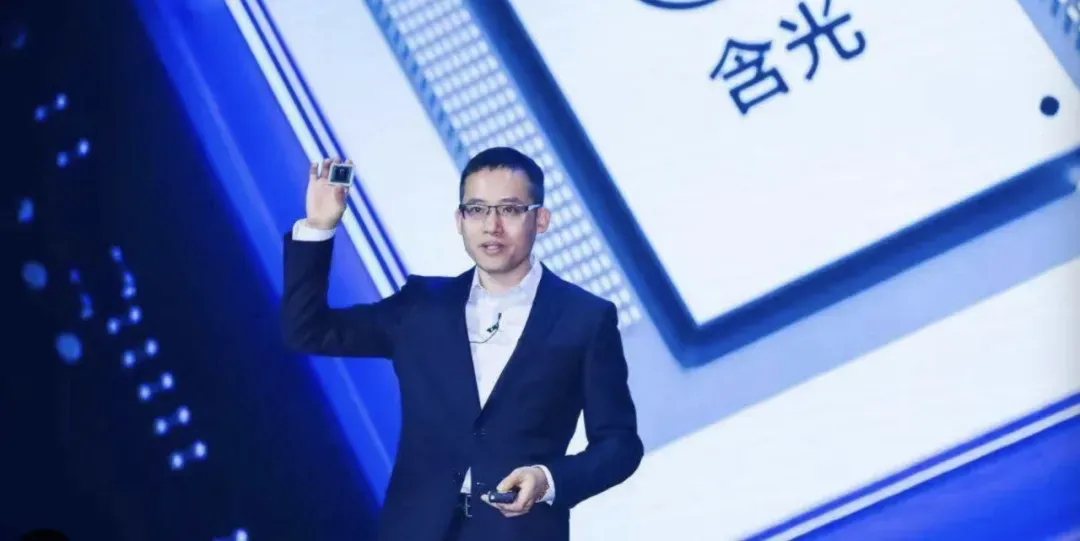
T-Head, established in September 2018 as Alibaba's wholly-owned semiconductor chip business entity, has demonstrated unusually rapid product development. On September 25, 2019, barely one year after its founding, the company unveiled the Hanguang 800 AI chip at Alibaba's Apsara Conference in Hangzhou.
Zhang Jianfeng, then president of Alibaba's DAMO Academy, presented the chip as achieving 78,563 IPS in the industry-standard ResNet-50 test—reportedly four times the performance of the best AI chips available at the time. The chip's energy efficiency reached 500 IPS/W, claimed to be 3.3 times that of the second-best performer.
"In the global chip field, Alibaba is a newcomer. Xuantie and Hanguang 800 are T-Head's first steps in a long march, and we still have a long way to go," Zhang said at the conference.
Product Portfolio Expansion
T-Head has since developed an end-to-end product portfolio spanning data center and edge computing applications. In the data center segment, the company offers the Yitian 710 server chip, Hanguang 800 AI inference chip, PPU AI chip, and Zhenyue 510 SSD controller chip, with network chips reportedly under development.
The PPU AI chip received prominent exposure in September 2025 when China Central Television's flagship evening news program featured it in a report on China Unicom's Sanjiangyuan green energy intelligent computing center project.
For edge computing and Internet of Things applications, T-Head's Xuantie series of RISC-V processors and Yuzhen IoT chips have achieved shipments of several hundred million units, demonstrating commercial traction beyond Alibaba's internal operations.
Commercial Deployment Gains Momentum
Within just over a year of its launch, the Hanguang 800 began deployment in Alibaba's core businesses, processing nearly 78,000 images per second. In Hangzhou's City Brain traffic management system, four Hanguang 800 chips replaced 40 traditional GPUs while reducing latency from 300 milliseconds to 150 milliseconds, according to demonstrations at the 2019 Apsara Conference.
For Alibaba's Pailitao visual search service, which adds one billion new product images daily to its database, the Hanguang 800 reduced recognition processing time from one hour using traditional GPU computing to five minutes.
The chip's performance breakthrough stemmed from hardware-software co-design: proprietary chip architecture addressed performance bottlenecks through inference acceleration techniques, while integrated DAMO Academy algorithms optimized computation and storage density for convolutional neural networks and computer vision algorithms, enabling large network models to run on a single neural processing unit.
Alibaba Cloud began offering AI services based on the Hanguang 800 on the day of its announcement, claiming a 100% improvement in price-performance ratio compared to traditional GPU computing.
Broader Industry Context
T-Head's reported listing plans follow similar moves by other Chinese tech companies seeking to capitalize on AI chip development. Baidu's Kunlun chip unit has selected China International Capital Corporation, CITIC Securities, and Huatai Securities as lead underwriters for an IPO that could raise approximately $1 billion, with CITIC Securities also participating in potential offering plans.
The wave of chip unit spinoffs reflects both the strategic importance of semiconductor capabilities and investor appetite for pure-play exposure to AI infrastructure providers. For Alibaba, a successful T-Head listing could validate years of investment in semiconductor technology while providing capital for continued development independent of the parent company's financial performance.
With the Hanguang 800 launch, T-Head completed an initial end-to-end product lineup covering processor intellectual property, an integrated chip design platform, and AI chips—achieving full coverage of the chip design chain within its first year of operation.