
Alibaba’s Qianwen Go Pushes AI Agents Into Everyday Life
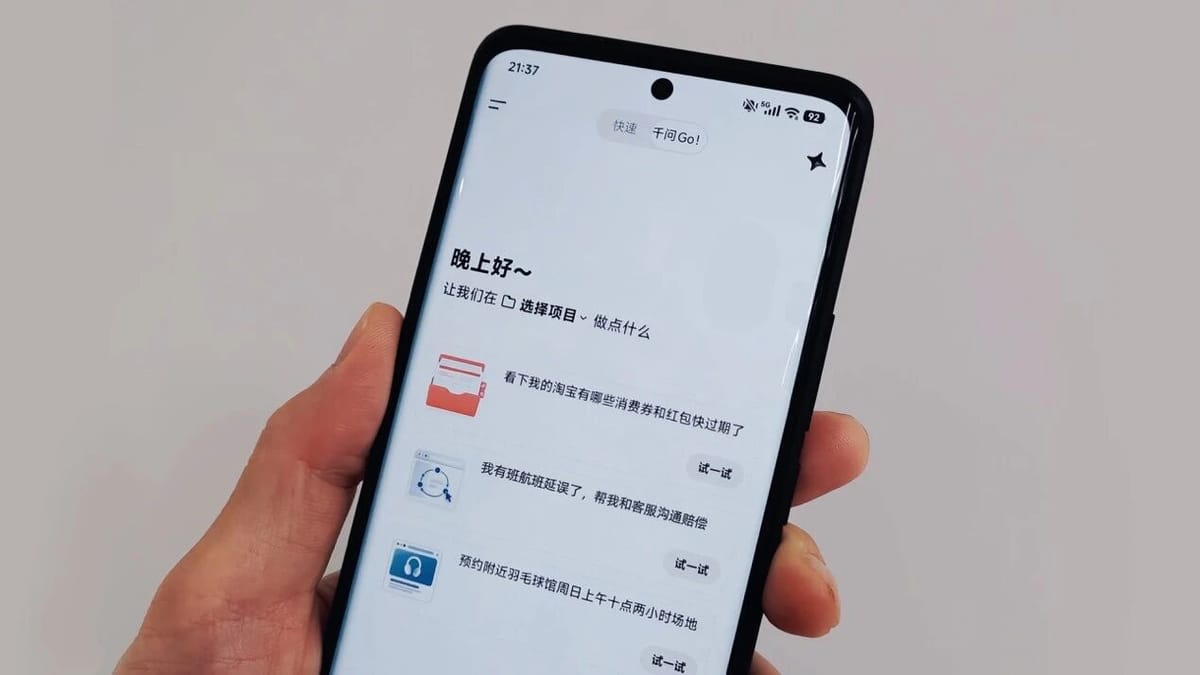
Alibaba Group is preparing to launch Qianwen GO, a personal AI agent that autonomously navigates third-party apps, engages customer service representatives, and recovers cash for users — marking a structural expansion of consumer-facing agentic AI beyond the coding vertical.
The imminent product launch arrives as viral demonstrations of the agent securing a RMB 70 (US$9.72) cash compensation from an airline and reclaiming a RMB 52 (US$7.22) price-protection refund on Taobao are circulating in Chinese technology communities, providing the first concrete evidence of multi-step, adversarial task execution in a live commercial environment. The timing is deliberate: Meta's Muse, which operates via a cloud-hosted browser and continues working after users close the app, has reset market expectations for what a personal agent must accomplish to achieve adoption.
For investors tracking Alibaba's AI monetization runway, the signal is consequential. The company controls the full transaction stack — from natural-language intent capture through Qianwen to order settlement across Taobao, Tmall, and Alipay — a closed-loop architecture that no standalone agent provider can replicate at equivalent scale.
Qianwen Go Attacks the Tasks Users Abandon
The product's commercial thesis rests on a behavioral insight: low-value but high-friction service tasks — delayed-flight claims, price-protection filings, maintenance quotes — are routinely abandoned not because users lack entitlement, but because the operational cost of completion exceeds the perceived reward.
In the airline compensation case documented in early user footage, a passenger issued only a vague instruction: locate a Lanzhou-Hangzhou round-trip booking that experienced a departure delay and pursue compensation. Qianwen Go, running in a cloud environment, logged into the booking platform, audited four separate orders across four carriers, and identified China Eastern Airlines (中国东方航空) flight MU2445 as the qualifying service failure — without any order number from the user.
The subsequent negotiation illustrates the agent's adaptive routing logic. An initial outbound call was blocked by the carrier's interactive voice response system. Rather than halting, Qianwen Go returned to the order interface, located a live-agent chat entry point, and initiated text-based negotiation. When the carrier offered RMB 70 in travel vouchers, the agent explicitly rejected the proposal on the user's behalf and continued pressing for cash settlement. The funds were ultimately transferred directly to the user's Alipay account.
A parallel task on Taobao demonstrates the same pattern in e-commerce. Without knowing which orders qualified or where the price-protection portal was located, the user delegated the entire process. Qianwen Go identified a Sanhe titanium cookware purchase that had fallen in price post-checkout and recovered the RMB 52 differential automatically.
Expanding the Agent's Operational Envelope
Qianwen already provides task-execution capabilities anchored in Alibaba's ecosystem, handling short-chain, goal-defined requests — hailing a ride, ordering lunch, filtering seasonal apparel — within defined parameters and at speed. Qianwen Go represents an architectural upgrade, not an incremental feature release.
The distinction is task topology. Standard agentic flows assume complete information and predictable system responses. Qianwen Go is explicitly engineered for incomplete inputs, interrupted channels, and adversarial counterparties. Its decision logic is path-dependent: when an entry point fails, it reroutes; when a settlement offer is substandard, it escalates; when platform rules conflict with coupon eligibility, it resolves the contradiction before proceeding.
This mirrors the cloud-execution model disclosed for Meta's Muse, which maintains a dedicated cloud computer and browser instance, persisting through user session interruptions. Task completion rate in this architecture is a direct function of what engineers internally call "rerouting capability" — the agent's ability to substitute channels, methods, and interfaces without losing context or goal state.
Initial commercial scenarios beyond airline and e-commerce claims will include automotive maintenance quote requests, sports-facility bookings, and appliance purchase calculations that factor in government subsidies, trade-in valuations, and delivery fees.
Sizing the Commercial and Compute Dividend
Wall Street research frames the addressable market in terms that justify infrastructure investment. Morgan Stanley projects China's consumer-oriented AI monetization market at approximately RMB 300 billion (US$41.7 billion) by 2030, scaling to RMB 1.6 trillion (US$222.2 billion) by 2040, with advertising and transaction commissions constituting the primary revenue streams. Bank of America, in an October 7 research note, argued that agents enabling smoother task and purchase completion would structurally expand aggregate online activity volumes.
Neither figure is imminent. Both are contingent on product adoption curves and commercial model validation that remain unproven at scale in 2026. The more immediate calculus is compute intensity.
Citi, in an October 6 research note, upgraded its global CPU market forecast, projecting expansion from US$29 billion in 2025 to US$300 billion in 2030, citing the execution and orchestration load generated by personal agents as a primary demand driver. Each Qianwen Go task cycle — page parsing, model inference, state evaluation, cloud environment maintenance — compounds GPU and CPU demand in ways that differ materially from single-turn large language model queries.
Alibaba's structural advantage is the convergence of model capability, cloud infrastructure through Alibaba Cloud, and transaction platforms under a single corporate entity. The agent does not need to hand off to a third-party payment or logistics layer; conversion from expressed intent to completed transaction is endogenous.
The Unanswered Variable: User Delegation Willingness
The commercial case for Qianwen Go resolves, ultimately, to a behavioral question that no forecast can settle in advance: how much of their daily operational friction will users consent to delegate to an AI agent operating autonomously on their accounts?
Early adoption evidence from the airline and Taobao demonstrations suggests the threshold is lower than previously assumed when outcomes are tangible, fast, and measurable in renminbi. A RMB 70 cash deposit and a RMB 52 refund are not abstract AI capability benchmarks — they are concrete financial outcomes that users can verify.
The degree to which Qianwen Go can systematically replicate that outcome fidelity across millions of heterogeneous service interactions — against platforms with varying API accessibility, customer service quality, and authentication friction — will determine whether personal AI agents in China generate the commercial and compute increment that analysts are pricing into long-range projections.
Model cost and cloud unit economics set the floor for per-task profitability. User willingness to delegate sets the ceiling for market size.
Related Coverage:
Qwen Office and the Enterprise AI Agent Race: How Alibaba Is Betting Its Entire B2B Stack
Tencent, Alibaba Wage AI Context War as Agent Harnesses Emerge as China's Next Platform Battleground