
Zunjie V800 Brake Test Passes, but Critics Question Its Relevance
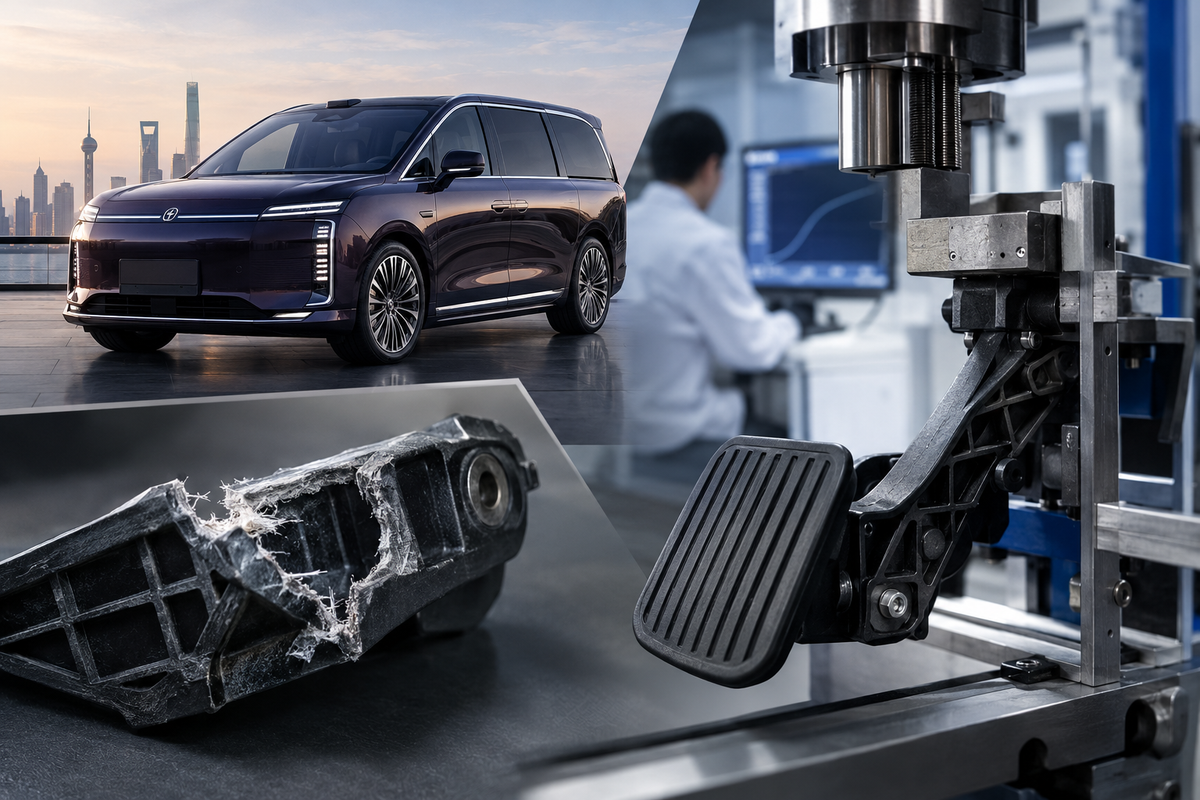
Third-party test results published Monday cleared the ZunjieV800's brake pedal assembly of any standard violation—yet the data left unanswered the question that sparked the controversy in the first place: why did brake pedal brackets snap on three separately tested vehicles five days ago.
Zunjie Automobile released itsBrake Pedal Inspection Disclosure on October 13, 2026, confirming that pedal samples withstood loads up to 3,000 newtons without cracking or visible damage under testing conducted by China Automotive Engineering Research Institute. The announcement triggered an immediate market reaction: shares of JAC Motors surged 8.57% to RMB 23.94 (US$3.32) by the midday close, recovering a portion of losses accumulated since the fracture footage emerged on automotive media platform Dongchedi on October 8.
Despite the stock bounce, the disclosure drew sharp pushback from the automotive engineering community within hours of publication, raising a structurally more difficult question for the joint-venture brand—one that a static compliance test is methodologically ill-equipped to resolve.
Reading the Fine Print Reveals a Narrow Test Scope
The CAERI report covered two test groups conducted on October 11. The first applied 1,500 newtons of longitudinal force across four pedal samples for five seconds per cycle, repeated five times each, per industry standard QC/T 788-2018. All four samples passed the permanent deformation threshold of 5 millimeters; the worst-performing sample recorded 4.07mm—compliant, but within 7% of the allowable limit.
The second, self-described "enhanced" group used 14 samples across nine load increments ranging from 2,000N to 3,000N. Critically, only two of the 14 samples were actually tested at the headline-grabbing 3,000N ceiling. Load increments between 2,250N and 2,500N were each tested on a single sample—a sample size insufficient to derive statistical significance.
Both groups used a loading rate of 20 millimeters per minute, a deliberately controlled quasi-static condition. Emergency braking events, by contrast, involve near-instantaneous force application that can generate dynamic stress concentrations several multiples higher than equivalent static loads—a distinction well-established in materials fatigue literature and directly relevant given that the V800's pedal bracket is manufactured from glass fiber-reinforced plastic (GFRP), a composite whose failure behavior is highly sensitive to load rate and directional variance.
Dongchedi Test Chief Fires Back, Citing Transparency Gaps
Dongchedi test director Dongmen Jiannan publicly rejected the report's sufficiency, posting that the submission "just barely clears the threshold limit—and this is supposedly a hand-picked sample." He listed four specific evidentiary gaps: no pre- and post-test sample photography, no video record of the testing process, no confirmation that the submitted components match the production specification of currently delivered vehicles, and no disclosure of bracket wall thickness or bracket geometry.
CAERI confirmed to Securities Times that the inspection was conducted on samples supplied by the manufacturer, not drawn independently from retail inventory or from the three vehicles at the center of the original dispute. The provenance chain between those fractured vehicles and the tested samples therefore remains unestablished in any publicly available documentation.
An industry engineer interviewed by LatePost articulated the consumer-side standard succinctly: "Regardless of how the driver presses, a brake pedal bracket should never fracture." The observation is particularly pointed in the context of the V800's market positioning—a seven-seat luxury MPV priced above RMB 1 million (US$138,900) for which safety is a primary commercial proposition.
Upgrade Commitment Survives a Passing Grade
In what may be the most commercially telling detail of the week's disclosures, Zun界has not rescinded its earlier pledge to offer free brake pedal component upgrades to existing owners, notwithstanding the test certification. The coexistence of a compliance certificate and a voluntary retrofit program creates an implicit acknowledgment that meeting the current standard and meeting customer safety expectations are not identical objectives.
Regulators have not announced a formal investigation as of publication. The State Administration for Market Regulation and the Ministry of Industry and Information Technology have not issued public comment on the incident.
For investors, the 8.57% intraday recovery in JAC Motors stock reflects relief that no immediate recall mandate appears imminent. But the unresolved fracture causation—whether attributable to dynamic loading conditions, geometric stress concentration in the GFRP bracket, or batch-level manufacturing variance—represents a residual liability that a static test report alone cannot quantify.
Until Zun界publishes root-cause findings from the original three vehicles, the gap between regulatory compliance and engineering accountability will continue to define the public narrative around the V800.
Related Coverage: