
Huawei-Backed Zunjie V800 Brake Failures Spark Safety Row
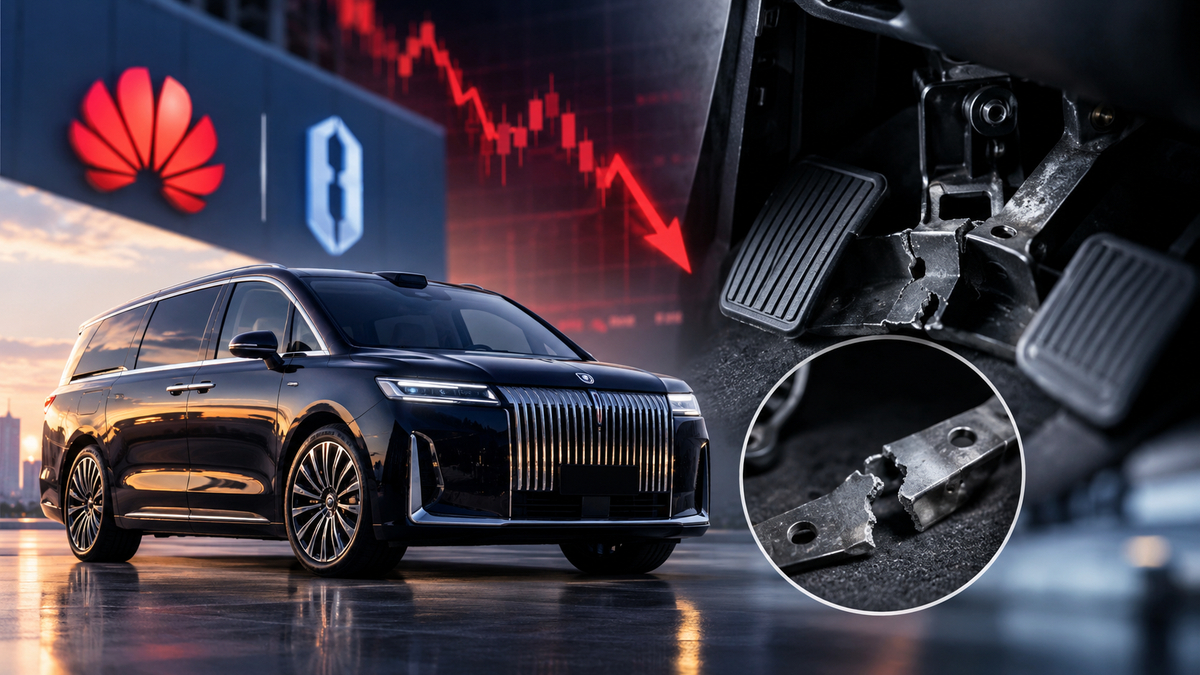
Three consecutive test failures on a vehicle endorsed by Huawei's Richard Yu expose a structural design question that RMB 760,000-plus buyers and regulators cannot easily dismiss.
The brake pedal bracket of the ZunjieV800 — a super-luxury MPV jointly developed by Huawei and JAC Motors — fractured in all three vehicles subjected to high-intensity emergency braking tests published by automotive platform Dongchedi on October 8, 2026, triggering a public safety debate that has already erased orders, punished JAC's share price, and forced the brand into a rare public acknowledgment within 24 hours.
The incident is not simply a product recall story. At its core, it raises a harder question: whether a brand that commands RMB 766,000–1.016 million (approximately US$106,400–US$141,100) per vehicle, and whose technology partner's consumer chief has repeatedly declared it "the world's most premium MPV," applied engineering rigor commensurate with that positioning — or whether compressed development timelines carried a critical structural flaw all the way to the assembly line.
Three Vehicles Failing in Identical Fashion Rules Out Coincidence
Dongchedi's test protocol placed three production V800 units — two manufactured in August 2026, one in September — through repeated 100 km/h-to-zero emergency stops. The bracket fractures occurred on the second, third, and fourth braking attempts respectively across the three cars. Critically, fracture location and break morphology were described as "highly consistent" across all three vehicles.
The peak pedal force recorded at the moment of fracture on the third test vehicle was 1,612 newtons. China's mandatory standard for brake pedal assemblies requires the component to withstand 2,000 newtons sustained for five seconds without failure — a threshold the V800's bracket did not approach before giving way. Once the bracket broke, the test driver reported that effective braking was lost; the vehicle could only be arrested via the P-gear park brake, and stopping distance ballooned from approximately 38 meters under normal braking to roughly 140 meters.
Zhang Xiang, a visiting professor at Huanghe Science and Technology College, told industry outlet Cishidai Cheyansuo that the V800's large body mass intrinsically demands higher pedal bracket strength than lighter vehicles, making structural under-engineering more consequential. More pointedly, he argued that three vehicles failing in the same mode "eliminates the possibility of an isolated fault" and constitutes "a serious safety defect." His working hypothesis: Zunjie likely transplanted a pedal bracket design from an existing, lighter platform rather than engineering one from scratch for the V800's specific load profile — a shortcut he attributes to the brand's notably compressed development and launch schedule.
Zunjie Acknowledges the Issue While Stopping Short of a Recall
Late on October 8, Zunjie published a statement on Weibo acknowledging "concerns raised by the video" and asserting that its brake system was developed and validated to standards exceeding both the national standard (GB 21670-2025 / GB 7258-2026) and the industry standard (QC/T 788-2018). The brand stated that no pedal bracket fracture had occurred in real-world customer use since deliveries began in September 2026, and framed the test as a "non-standard extreme condition."
Notably, the statement stopped well short of a formal recall. Instead, it offered delivered customers a "free upgrade option" for the component and committed to a "systematic review" of design validation, test boundaries, and production quality management. JAC Motors' investor relations department, when contacted separately, said only that the matter had been "reported to relevant departments" and that production and operations remained normal.
The distinction between a voluntary upgrade and a mandatory recall carries regulatory weight. Under China's defect product recall regulations administered by the State Administration for Market Regulation, automakers are required to initiate a recall when a common defect poses safety risks. Whether the brake bracket issue clears that threshold — given that no on-road fracture has been reported — is likely to become the next focal point for both regulators and consumer advocates.
The Huawei Endorsement Amplifies Reputational Stakes
The V800's controversy is inseparable from the profile of its most visible backer. Huawei Executive Director and Terminal BG Chairman Richard Yu has been the face of the Zunjie brand: he used the June 2026 HarmonyOS Intelligent Driving Zunjie Brand Gala to declare the V800 "absolutely the world's most premium MPV," and reprised the superlatives at the August 5 V800 launch with the phrase "epoch-defining, comprehensively leading." His WeChat profile picture features a photo with the V800, and during the National Day holiday he was photographed handing over a V800 to Fok, CEO of Henry Fok Group, in a widely circulated delivery ceremony image.
That visibility creates a brand-risk feedback loop. Consumer trust in Zunjie is substantially anchored to Huawei's technology credibility, even though the hardware engineering and manufacturing responsibility lies with JAC Motors. When a structural component fails at forces below the national safety standard, the reputational spillover touches Huawei's broader automotive ecosystem — which includes the Aito, Luxeed, and Stelato brands operating under the HarmonyOS Intelligent Driving umbrella.
A Fangzheng Securities research note previously reported that combined pre-sales of the V800 and the V680 broke 10,000 units within 23 days of opening, with the V800 accounting for roughly 80% of that figure. The primary buyer profile — corporate executives and business owners aged 35–60 — is precisely the segment most sensitive to reputational signals about safety.
Orders Begin to Crack as the Controversy Spreads Beyond Social Media
The incident's commercial impact is already visible at the individual order level. At least one confirmed V800 reservation holder publicly stated he cancelled his order immediately after viewing the test footage, declaring he was willing to forfeit his deposit. "If a critical component like the brakes is in this condition, I can't trust anything else either," he was quoted as saying.
The episode illustrates the asymmetric risk facing ultra-premium EV and extended-range brands in China's 2026 market: a single viral test video, amplified through Weibo trending topics including "Zun界V800 brake pedal bracket fracture" and "JAC Motors hits limit-down," can compress the conversion funnel for a product with a months-long sales cycle in ways that a price adjustment cannot quickly reverse.
JAC Motors shares fell by the daily 10% limit on the Shanghai exchange on October 8. The company has not issued a formal market disclosure addressing the safety controversy beyond the investor relations comment cited above.
What Comes Next: Regulatory Scrutiny and the Design Verification Question
The immediate unknown is whether SAMR will open a defect investigation. The three-vehicle test cohort — spanning two production months and showing identical failure modes — provides a stronger evidentiary basis for regulatory inquiry than a single-vehicle incident typically would.
Equally significant is the unresolved supply chain question: whether all three vehicles used the same pedal assembly version, the same supplier, or the same production batch has not been publicly confirmed. That detail matters because it determines whether the remediation path is a targeted component upgrade or a broader manufacturing quality intervention.
For JAC Motors, the episode arrives at a strategically sensitive moment. The automaker has staked considerable resources on the Huawei partnership as a route to the premium segment — a market where margins are structurally superior to the mass-market vehicles that form the bulk of JAC's volume. A sustained safety controversy around the V800, priced at up to RMB 1.016 million (US$141,100), risks not only Zunjie's nascent order book but JAC's credibility as a capable manufacturing partner for future high-end programs.
The next disclosure — whether a formal recall notice, a SAMR inquiry acknowledgment, or an independent third-party test — will determine whether this remains a contained product issue or escalates into a systemic question about China's accelerated luxury EV development model.
Related Coverage:
Huawei's Aito Zhijie RX Bets on L3 Architecture as China Legalizes Conditional Autonomy
Huawei, Seres Restructure AITO Partnership as Surging Smart Hardware Costs Squeeze EV Margins