
Alibaba's Qwen Enters Robotics With Embodied AI Suite to Tackle Hardware Fragmentation
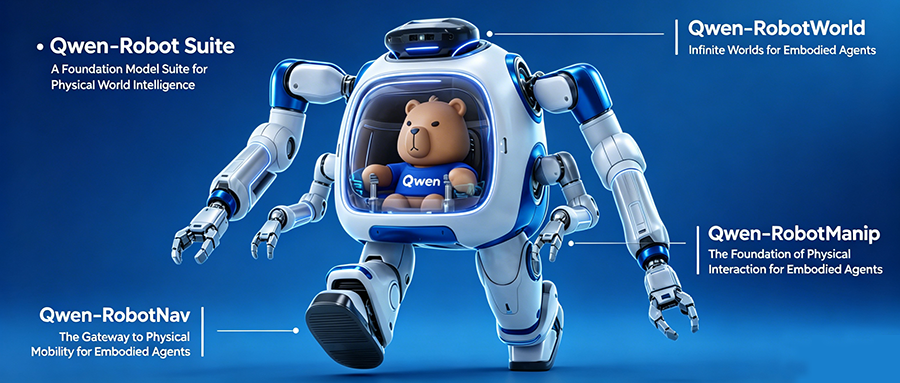
Alibaba on Monday launched Qwen-Robot, a three-model embodied intelligence suite that extends its Qwen large model family from the digital realm into physical-world robotic control — a move analysts say could reshape the software infrastructure layer of China's fast-consolidating humanoid robot supply chain.
The June 16, 2026 release comprises Qwen-RobotManip, Qwen-RobotNav, and Qwen-RobotWorld, covering manipulation, navigation, and predictive world-modeling respectively. The timing is deliberate: China's embodied AI sector is crossing the threshold from laboratory validation to commercial deployment, and the battle for model-layer dominance is intensifying ahead of what industry forecasters expect to be a consumer robotics wave arriving within two to three years.
Initial market reception focused less on the individual benchmark scores and more on the architectural ambition: Alibaba is not merely releasing three models, it is proposing a universal abstraction layer between robotic software and fragmented hardware — a proposition that carries significant implications for every player in the domestic robot stack.
Manip Model Targets the Hardware Fragmentation That Has Stalled China's Robot Ecosystem
The most strategically significant component is Qwen-RobotManip, a Vision-Language-Action (VLA) model that encodes the motion commands of mechanically disparate robotic arms into a unified 80-dimensional action representation. In plain terms: a developer writing an application on top of Qwen-RobotManip does not need to rewrite core logic when switching from one robotic hardware vendor to another. Adaptation requires only a few fine-tuning steps rather than full retraining.
The analogy to NVIDIA's CUDA parallel computing platform is structurally apt. CUDA succeeded by inserting a universal software interface between GPU silicon and application developers, commoditizing hardware differentiation and concentrating value at the platform layer. Qwen-RobotManip pursues an identical leverage point: if its 80-dimensional action space becomes the de facto standard accepted by major domestic hardware vendors, the cost of building robotic applications on top drops materially, accelerating ecosystem formation.
Hardware fragmentation is currently the single largest friction point in China's robot industry. Leading domestic manufacturers including Unitree Robotics and Zhiyuan Robotics have each developed proprietary interfaces and protocols, making cross-platform software reuse structurally difficult. The domestic hardware layer has matured; what the ecosystem has lacked is precisely the kind of open, model-layer infrastructure that Qwen-Robot now proposes to supply.
Qwen-RobotManip completed pre-training on more than 38,000 hours of data — and critically, the entire training pipeline relied exclusively on open-source datasets rather than the proprietary self-collected data that most competitors depend on. In the RoboChallenge Table30 v1 benchmark, a third-party real-robot evaluation spanning 30 real-world tasks across four robotic platforms, the model's two variants — codenamed "Lira" and "Atlas" — claimed first and second place respectively. Tasks ranged from turning a water faucet and inserting a network cable to dual-arm french-fry dispensing, with evaluators noting stable baseline task performance and breakthrough capability on high-difficulty operations.
Nav Model Unifies Five Navigation Task Families Under One Framework
Qwen-RobotNav addresses locomotion and spatial reasoning. Built on the Qwen-VL visual foundation model, it consolidates language-instruction navigation, object search, autonomous driving, and two additional task families into a single unified framework — eliminating the engineering overhead of maintaining separate models for each scenario.
Prior Vision-Language Navigation (VLN) models have suffered from rigid memory strategies that force a binary trade-off: insufficient memory leads to disorientation in complex environments, while excessive memory creates conflicting signals. Qwen-RobotNav introduces a task-adaptive observation mechanism that dynamically switches memory strategies based on real-time task context.
The model is also designed as a callable universal interface, making it one of the few VLN models natively compatible with multiple agent frameworks. In a demonstrated use case, a Unitree Go2 quadruped robot running Qwen-RobotNav successfully executed an open-ended retrieval command — "help me find the suitcase I can't remember where I put" — by autonomously patrolling, applying visual reasoning, and completing the navigation without human intervention.
World Model Gives Robots Predictive Rehearsal Before Physical Execution
Qwen-RobotWorld operates as the cognitive layer, enabling robots to simulate physical processes internally before committing to action. The model generates predictions of future robotic states and action trajectories based on learned physical laws, allowing the system to identify and correct error-prone motion sequences prior to execution.
Beyond inference-time planning, Qwen-RobotWorld serves a second function that addresses a persistent bottleneck in embodied AI development: training data scarcity. By generating synthetic video data that faithfully reflects physical dynamics, the world model can augment training pipelines for the other two models, reducing dependence on expensive real-world data collection.
The three models are designed for both independent deployment and coordinated operation, selectable by scenario. The architectural modularity lowers the barrier for developers who need only one capability — manipulation, navigation, or world-modeling — while preserving the option for full-stack deployment as hardware and use cases mature.
Supply Chain Implications Arrive Two to Three Years Ahead of Consumer Market
For investors tracking the embodied AI supply chain, the near-term read-through is less about consumer product timelines and more about infrastructure lock-in dynamics. Robot developers can now build on Qwen's foundation rather than constructing Vision-Language-Action architectures from scratch, which compresses development cycles and creates a gravitational pull toward Alibaba Cloud compute paired with Qwen model licensing — a bundled go-to-market strategy consistent with Alibaba's broader cloud monetization playbook.
The consumer robotics market that analysts project to enter households within two to three years will likely run on next-generation descendants of today's Qwen-Robot models. The June 16 triple release positions Alibaba as an upstream infrastructure provider in that future, competing directly with Huawei, Baidu, and international players including Google DeepMind and Physical Intelligence for the model layer that will govern how robots perceive, decide, and act in the physical world.
The embodied intelligence sector sits at an inflection point. Qwen-Robot's open-source training approach, benchmark-leading manipulation results, and CUDA-style abstraction logic suggest Alibaba is not merely participating in the robotics race — it is attempting to define the rules of the software layer before the hardware market consolidates around a dominant form factor.
Related Coverage:
Alibaba Bets on Proprietary Chips and Autonomous AI Agents to Drive Cloud Growth