
Noetix Robotics Bets on OpenHarmony to Break Humanoid Robots Isolation
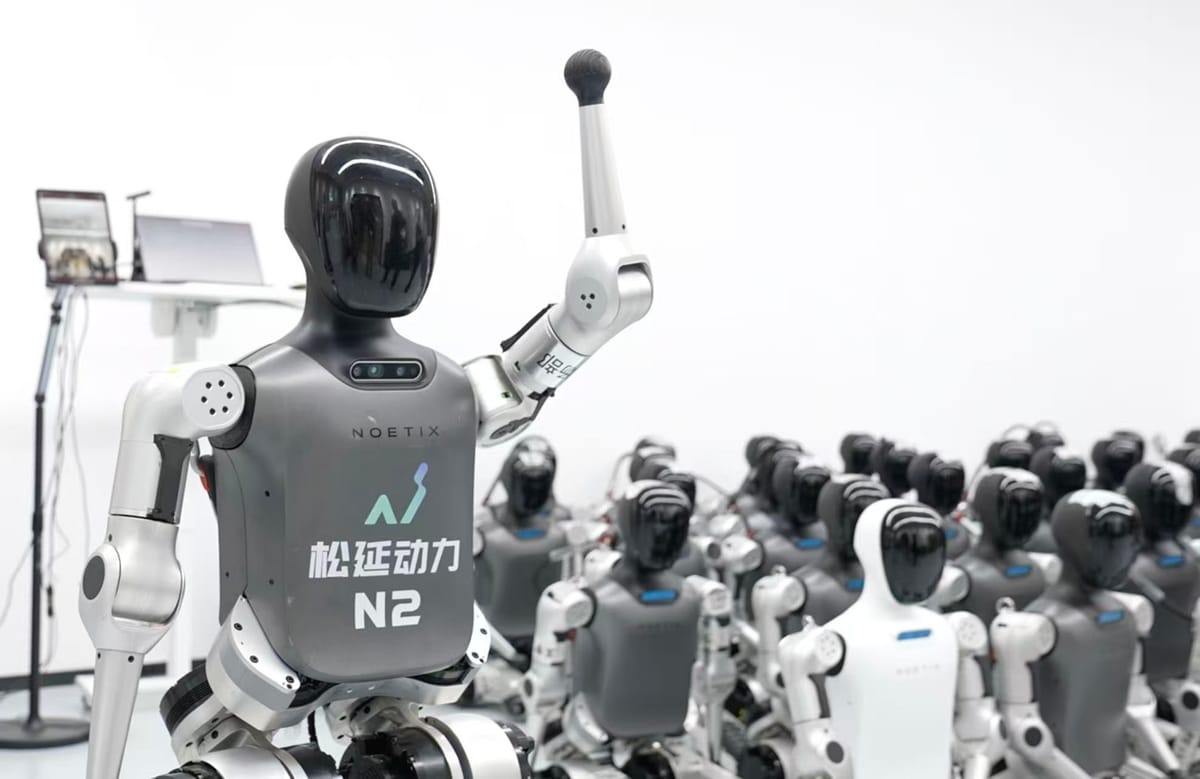
Noetix Robotics has debuted what it claims is the industry's first consumer-grade humanoid robot running on OpenHarmony, positioning the move as a direct assault on the "ecosystem island" problem that has long constrained mass-market adoption of bipedal machines.
The OpenHarmony-powered N2 robot made its public debut on June 13, 2026, at Huawei's annual developer conference HDC2026 — a venue that carries outsized signaling weight in China's technology supply chain. Critically, Huawei Executive Director and Terminal BG Chairman Richard Yu singled out Noetix Robotics as the representative robotics brand within his keynote showcase of six product categories driving OpenHarmony's push "into every household," a public endorsement that effectively places the startup alongside established consumer electronics players in Huawei's ecosystem roadmap.
The market read is straightforward: Huawei's explicit backing transforms Noetix Robotics from a niche robotics vendor into a potential anchor tenant of the OpenHarmony connected-device stack — a stack that competes directly with Google's Android and Apple's HomeKit in China's smart home arena.
Solving the Isolation Problem That Has Stalled Consumer Robotics
The central thesis Noetix Robotics VP of Product Tang Ziyang presented at the HDC2026 OpenHarmony Ecosystem Forum is a direct rebuttal to a structural weakness in the consumer humanoid segment: most units on the market today function as standalone hardware terminals, incapable of deep interoperability with smartphones, smart displays, connected appliances, or educational devices.
The consequences of that isolation are commercially significant. Developers face redundant protocol-adaptation work and heterogeneous data conversion overhead each time they attempt cross-device integration — costs that extend product iteration cycles and suppress third-party application development. Compounding the problem, legacy external operating systems carry computational footprints that conflict with the low-power, lightweight hardware trajectories that define competitive humanoid robot design in 2026.
OpenHarmony's microkernel architecture directly addresses each constraint. Its distributed soft-bus technology enables device-agnostic connectivity, while the OS's low resource footprint aligns with the power budgets of mobile bipedal platforms. For Noetix Robotics, porting the N2 to OpenHarmony is less a feature addition and more a platform repositioning — shifting the robot from a closed appliance to a node within a broader intelligent terminal network that already spans hundreds of millions of Huawei-ecosystem devices in China.
"100 Developers, 100 Robots" Plan Targets Ecosystem Depth Over Breadth
The product announcement alone would be incremental news. What elevates Noetix Robotics' HDC2026 appearance into a strategic signal is the concurrent launch of the "100 Developers, 100 Robots" co-creation program — a developer seeding initiative that mirrors playbooks previously deployed by Android and ROS (Robot Operating System) communities at comparable inflection points in their ecosystem formation.
Under the program, Noetix Robotics will select 100 individual developers or teams, providing each with one high-compute humanoid robot unit for local development at no hardware cost. The initiative supports both Ubuntu and OpenHarmony environments, ships with a native SDK and full development toolchain, and maintains compatibility with mainstream robotics frameworks. The dual-OS support is a pragmatic hedge: Ubuntu retains dominance among research and industrial robotics developers, while OpenHarmony targets the consumer and smart-home integration use cases that represent Noetix Robotics' core commercial market.
Tang framed the program's logic in competitive terms: the humanoid robotics industry is transitioning from a hardware performance race into an application scenario race. The company that builds the most open, developer-populated ecosystem first gains a compounding advantage — a dynamic well-documented in smartphone platform history and now playing out in embodied AI.
The 100-unit hardware commitment carries direct cost implications. Consumer-grade humanoid robots in China's current market typically carry bill-of-materials costs in the range of tens of thousands of renminbi per unit. A 100-unit seeding program therefore represents a meaningful cash outlay, signaling that Noetix Robotics is prioritizing ecosystem formation over near-term hardware margin — a capital allocation decision consistent with platform-building logic rather than product-company logic.
Repositioning Signals Broader Industry Consolidation Pressure
Noetix Robotics' OpenHarmony pivot lands in a humanoid robotics competitive landscape that has grown materially more crowded since 2024. Domestic competitors including UBTECH Robotics, Unitree, Fourier Intelligence, and Kepler are all scaling hardware production, while embodied AI platform players such as Galaxy General Robotics and AgiBot are racing to establish software moats.
In that context, Noetix Robotics' decision to anchor its differentiation to Huawei's OpenHarmony ecosystem — rather than competing on hardware specifications alone — reflects a calculated bet that OS-level integration and developer community depth will be harder for hardware-focused rivals to replicate than incremental improvements in bipedal locomotion or actuator torque.
The move also aligns with a broader 2026 policy direction. China's Ministry of Industry and Information Technology has continued to prioritize domestic operating system adoption across intelligent terminal categories; OpenHarmony's expansion into robotics provides a commercially credible vehicle for that policy objective, giving Noetix Robotics potential access to government procurement channels and pilot program support that pure hardware vendors may not access as readily.
Whether the "100 Developers, 100 Robots" program generates the application density needed to sustain a platform narrative — or remains a marketing-weight initiative — will become measurable within 12 to 18 months, as HDC2026 developer commitments translate (or fail to translate) into deployable applications. That timeline places the first meaningful ecosystem read-through squarely in the second half of 2027.
Related Coverage:
China's Noetix Unveils Sub-$1,400 Humanoid Robot to Crack Consumer Market