
Alibaba's Qwen3.8 Joins a 2.4T Parameter Arms Race as China's AI Giants Surge in Unison
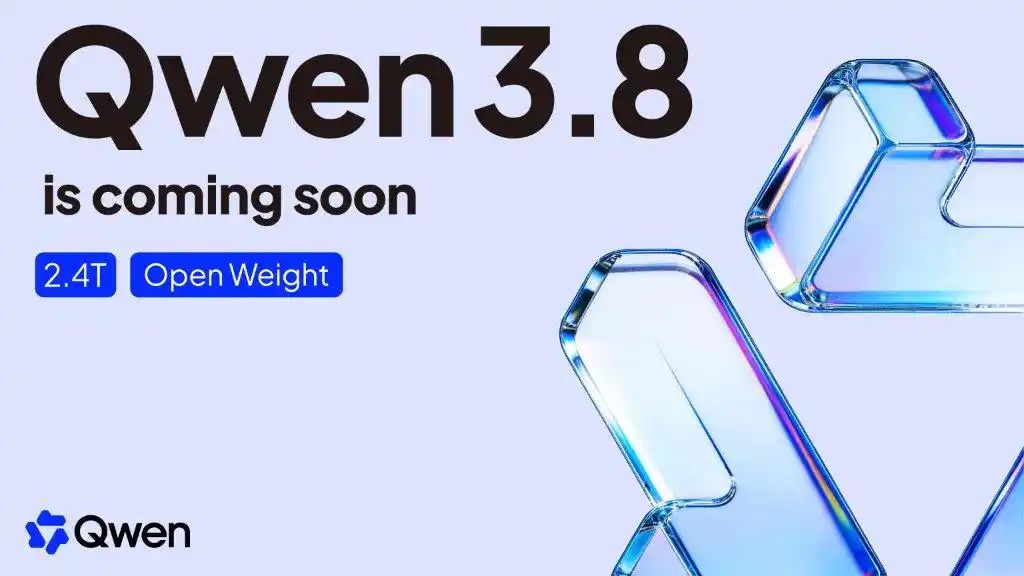
Alibaba's Qwen team announced its largest model to date — Qwen3.8 at 2.4 trillion parameters — positioning it as the world's most capable open-source model behind only Fable 5, as a cluster of Chinese AI labs simultaneously push frontier-scale releases in what is shaping up to be the most concentrated domestic model-launch cycle of 2026.
The announcement, made on July 19, 2026, marks a strategic inflection point: rather than a staggered release cadence, at least four major Chinese AI labs are converging on the same two-week window with trillion-parameter models, intensifying competitive pressure on both pricing and developer mindshare. Qwen3.8-Max, a preview build of the model, has already gone live on Alibaba's Qianwen AI platform, Qoder, and QoderWork, with daytime token costs discounted to one-tenth of standard rates and a personal subscription starting at RMB 35 per month (approximately US$4.86), a pricing signal that underscores the race to capture enterprise and developer adoption at scale.
The timing is not coincidental. Within the same fortnight, Moonshot AI open-sourced Kimi-K3, a 2.8 trillion-parameter model whose long-horizon task completion, front-end rendering, and Agent Swarm capabilities drew public praise from Tesla and SpaceX CEO Elon Musk — who posted "impressive" on social media — as well as Carnegie Mellon University machine learning professor Ruslan Salakhutdinov, doctoral supervisor to Moonshot AI co-founder and CEO Yang Zhilin. Salakhutdinov described Kimi-K3 as a "major breakthrough" for the open-source community.
DeepSeek and MiniMax Threaten to Extend the Cycle Further
The release wave shows no sign of cresting. DeepSeek, whose V3 model triggered a global repricing of AI infrastructure assumptions earlier in 2026, is understood to be in limited grey-test deployment of DeepSeek-V4, with a full public launch expected as early as July 20, 2026, according to developer community reports. Separately, The Information reported that MiniMax is preparing to release its next-generation large language model, M3 Pro, with a parameter count between 2.5 trillion and 3 trillion, and plans to open-source the weights upon launch.
Taken together, the four models — Qwen3.8 (2.4T), Kimi-K3 (2.8T), DeepSeek-V4 (scale undisclosed), and MiniMax M3 Pro (2.5T–3T) — represent a coordinated, if unplanned, demonstration of China's capacity to operate at the frontier of foundation model scale.
Alibaba's "Only Behind Fable 5" Claim Signals a Benchmark Pivot
Qwen's self-positioning as "possibly the most powerful model except Fable 5" is analytically significant beyond marketing. Fable 5, widely regarded as the current global performance benchmark, is a closed, proprietary system. By framing Qwen3.8 as the strongest available open-weight alternative, Alibaba is directly targeting the segment of enterprise and developer customers who require model access, fine-tuning rights, and on-premise deployment — a market that closed frontier models structurally cannot serve.
This framing also reflects a broader strategic divergence between Chinese AI labs and their U.S. counterparts: while OpenAI, Anthropic, and Google DeepMind have progressively restricted model access, Chinese labs — including Alibaba Cloud, Moonshot AI, DeepSeek, and MiniMax — are competing on openness as a primary differentiator. For enterprise buyers evaluating total cost of ownership, the combination of open weights and aggressive token pricing creates a value proposition that closed-model vendors will find difficult to match on cost alone.
Pricing Aggression Points to a Winner-Take-Most Developer Ecosystem Play
The commercial structure of Qwen3.8's preview launch deserves particular attention from investors. A daytime token cost at one-tenth of standard rates, with even deeper discounts overnight, mirrors the loss-leader strategies that defined cloud infrastructure pricing wars a decade ago. At RMB 35 per month (US$4.86) for individual access, Alibaba is pricing below the psychological threshold that would trigger procurement scrutiny in most small and medium enterprises — a deliberate move to maximize developer onboarding velocity before competitors reach general availability.
Alibaba Cloud, which houses the Qianwen model family, reported cloud revenue growth of over 15% year-on-year in its most recent fiscal quarter, and AI-related products have been cited by management as the primary growth driver. The Qwen3.8 launch, structured around the Token Plan subscription and integrated directly into developer tooling via Qoder and QoderWork, is designed to convert model curiosity into recurring API consumption — the metric that ultimately flows through to cloud segment revenue.
Impact Assessment: What the Parameter Race Means for the Global AI Supply Chain
The simultaneous surge in Chinese frontier model releases carries three distinct implications for global market participants:
For GPU and compute suppliers, the 2.4T–3T parameter range implies training runs that stress even the most advanced accelerator clusters. While U.S. export controls have constrained Chinese labs' access to Nvidia's highest-end H100 and H200 chips, the fact that multiple labs are reaching this scale suggests either significant domestic compute accumulation prior to tightened restrictions, or meaningful progress in training efficiency on available hardware — both scenarios relevant to investors tracking Nvidia's China revenue exposure and the trajectory of Huawei's Ascend chip program.
For global open-source developers, the week of July 14–20, 2026 may be remembered as the moment Chinese labs collectively displaced the prior generation of Western open-weight models as the default frontier reference. Kimi-K3's reception — validated by an academic of Salakhutdinov's standing — suggests the quality gap that once separated Chinese and U.S. open models has effectively closed at the top end.
For enterprise software vendors building on top of foundation models, the pricing compression implied by Alibaba's token discounts and MiniMax's open-source plans will accelerate margin pressure across the AI application layer, regardless of geography.
Related Coverage:
Qwen’s Apple Win Reframes Alibaba as an AI Infrastructure Play