
WAIC 2026: China’s AI Chips Take Aim at Nvidia’s Ecosystem
Seven Chinese AI computing vendors — from Huawei's Ascend to Sugon's 100,000-GPU supercluster — unveiled full-system architectures at the World Artificial Intelligence Conference in Shanghai, marking a strategic pivot from raw chip performance to system-level innovation that directly targets Nvidia's supply-chain stranglehold on China's AI infrastructure market.
The convergence at WAIC 2026 represents the most concentrated display of domestic AI compute hardware in China's history, with vendors moving beyond benchmark comparisons to demonstrate deployable, production-grade super-nodes. The shift signals that China's AI hardware ecosystem has entered a new competitive phase: one defined by interconnect architecture, memory bandwidth, and full-stack integration rather than transistor counts alone.
Market observers note the timing is deliberate. With U.S. export controls continuing to restrict access to Nvidia's H100 and B200 series, Chinese cloud providers and state-backed research institutions face mounting pressure to qualify domestic alternatives at scale — and the WAIC floor has become their de facto procurement showcase.
Huawei Deploys 1,024-Card Ascend Cluster, Pushing 1 EFLOPS Compute Threshold
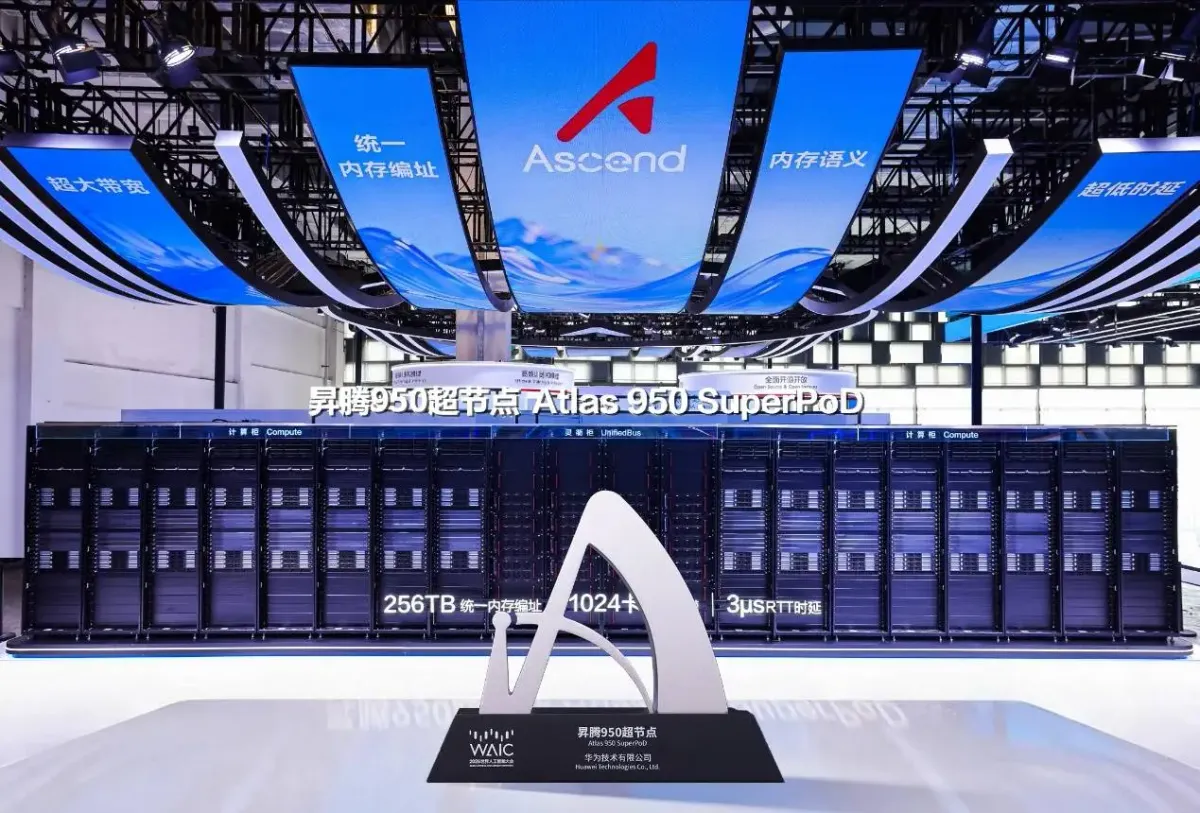
Huawei made its most significant hardware disclosure to date, exhibiting the complete physical system of its Ascend 950 SuperNode — commercially designated Atlas 950 SuperPoD — for the first time. The system aggregates 1,024 Ascend 950 NPU cards via Huawei's proprietary LingQu interconnect protocol, delivering 1 EFLOPS of FP8 compute alongside 256TB of globally unified memory addressing. Chip-to-chip interconnect bandwidth reaches the terabyte-per-second range, with round-trip latency held to 3 microseconds — a specification designed to eliminate the communication bottlenecks that typically degrade efficiency in large-scale distributed training runs.
The Ascend 950 SuperNode is not a paper product. Huawei disclosed that its predecessor, the Ascend 384 SuperNode (Atlas 384), has already been deployed in more than 750 installations domestically, and the company describes it as the only domestic AI compute super-node capable of independently training state-of-the-art large language models. A parallel exhibit, the Atlas 850E air-cooled super-node, extends the Ascend ecosystem into conventional data centers through VCE phase-change thermal management, supporting 96-card commercial deployments with sub-10-millisecond inference latency — a configuration optimized for multi-turn agentic dialogue and million-token context windows.
The dual-track product strategy — high-density liquid-cooled training clusters alongside air-cooled inference nodes — suggests Huawei is engineering for the full AI workload lifecycle, not merely the headline training benchmark.
Biren, Moore Threads, and Enflame Introduce Competing Interconnect Philosophies
Biren Technology, in a joint announcement with Lightelligence and ZTE Corporation, publicly unveiled the LightSphere X optical interconnect super-node — the first Chinese AI compute platform to replace copper-wire GPU interconnects with near-package optics and silicon photonic chiplets. The architecture scales to 1,024 GPUs, with Biren claiming the interconnect density surpasses conventional electrical interconnect solutions from Nvidia by an order of magnitude. The full-stack design integrates Lightelligence's proprietary distributed optical switching fabric with Biren's own high-compute general-purpose GPU liquid-cooling modules, positioning the consortium as a credible challenger in the interconnect layer where Nvidia's NVLink and InfiniBand have historically been uncontested.
Moore Threads took a different architectural path, debuting the MTT C256 Super-Node with a single-tier Scale-up network that achieves full 128-card interconnect within a standard single-width rack, expandable to 256 cards with sub-microsecond inter-card latency. The company cited a real-world 10,000-card training environment as the engineering baseline, and positioned the system for high-concurrency inference workloads including Agentic Coding, with single-user token output exceeding 100 tokens per second.
Enflame Technology announced three concurrent initiatives: a zero-cable OEX orthogonal backplane-free super-node co-developed with ZTE; a CoPoS-plus AI chip packaging solution developed with Advanced Semiconductor Packaging Technology that pairs Enflame's high-end AI compute chips with domestic panel-level advanced packaging; and, most distinctively, a space-based compute application developed with Stellar Computing that aims to build a distributed three-dimensional compute network addressing radiation hardening, high-power energy supply, and thermal management in orbital environments — extending China's AI compute ambitions from terrestrial data centers into low-earth orbit infrastructure.
Lenovo and Sugon Anchor the Enterprise and HPC Segments
Lenovo formally entered the super-node market last month with its Wentian Super-Node solution, a 40-GPU single-node system delivering over 28 PFLOPS of FP8 compute, more than 5.76TB of HBM memory capacity, and aggregate memory bandwidth exceeding 80TB/s. Chip-to-chip P2P communication latency is rated at the sub-100-nanosecond level. Critically, Lenovo engineered the system around a 19-inch chassis with a cable-free orthogonal direct-insertion architecture, reducing cluster deployment cycles from weeks to hours — a specification that addresses one of the most persistent operational pain points for enterprise data center operators scaling AI infrastructure rapidly.
The headline exhibit, however, belonged to Sugon (also known as Dawning Information Industry). The company unveiled the Sugon 8000 — commercially branded "Dengfeng" (meaning "summit") — the first fully domestic 100,000-GPU AI supercluster in China, making its global public debut at WAIC 2026 and receiving the conference's designated "centerpiece exhibit" designation. The system adopts a "super-intelligent convergence" architecture that natively integrates scientific computing and AI workloads, supporting full-precision computation from FP64 to INT8, and is designed to serve scientific simulation, large-model training and inference, and industrial modeling simultaneously.
The Sugon 8000's full-stack domestic supply chain is its most strategically significant attribute. Compute is anchored by Hygon domestic processors; networking relies on Sugon's proprietary scaleFabric RDMA high-speed fabric, a native InfiniBand-class interconnect connecting all 100,000 cards with high reliability; and storage is managed by Sugon's ParaStor distributed storage system, which claimed dual first-place rankings — Production Full System and 10-Node categories — on the 2026 Global IO500 benchmark list.
Cloud-Native Inference Economics Emerge as a Distinct Competitive Dimension
While the hardware arms race dominated the WAIC floor, Shenzhen Intellifusion Technologies articulated the clearest long-term economic thesis. The company disclosed a two-year inference chip roadmap comprising three purpose-built silicon variants: DeepVerse 100P (Prefill-optimized), 100D (Decode-optimized), and 100L (FFN-layer-within-Decode-optimized). The disaggregated inference architecture — deploying heterogeneous 10,000-card clusters where each chip type handles only its designated workload stage — is explicitly designed to drive down per-token generation costs toward an eventual target the company describes as "one cent per 100 million tokens," a benchmark that would structurally lower the economics of inference-as-a-service for Chinese cloud providers.
The inference disaggregation strategy reflects a broader industry recognition: as frontier model training becomes increasingly concentrated among a handful of state-backed hyperscalers, the commercial battleground is shifting to inference efficiency and cost-per-token at scale.
Impact Assessment: Architecture Wars Signal a New Phase of China's AI Hardware Autonomy
The collective WAIC 2026 showcase crystallizes a structural transition in China's AI hardware industry. The prior phase — characterized by individual chip vendors racing to close the performance gap with Nvidia's A100 equivalent — has given way to a systems competition in which interconnect architecture, thermal management, memory hierarchy, and full-stack software integration determine real-world cluster efficiency.
The emergence of optical interconnects (Biren/Lightelligence), zero-cable backplane designs (Enflame/ZTE), and 100,000-card fully domestic superclusters (Sugon) within a single conference cycle indicates that China's AI compute supply chain has achieved sufficient depth to sustain genuine architectural experimentation — rather than merely replicating established Western designs.
For investors tracking China's AI infrastructure buildout, the WAIC 2026 hardware showcase provides the most granular public evidence to date that domestic alternatives to Nvidia's H-series and B-series are transitioning from controlled pilots to deployable production systems. The critical remaining question is software ecosystem maturity: whether CUDA-equivalent developer toolchains for Ascend, Biren, Moore Threads, and Enflame chips can achieve the breadth required to retain workload portability at scale.
Related Coverage: