
Alibaba Cloud Commercializes China’s GPU Alternative, Reshaping AI Infrastructure
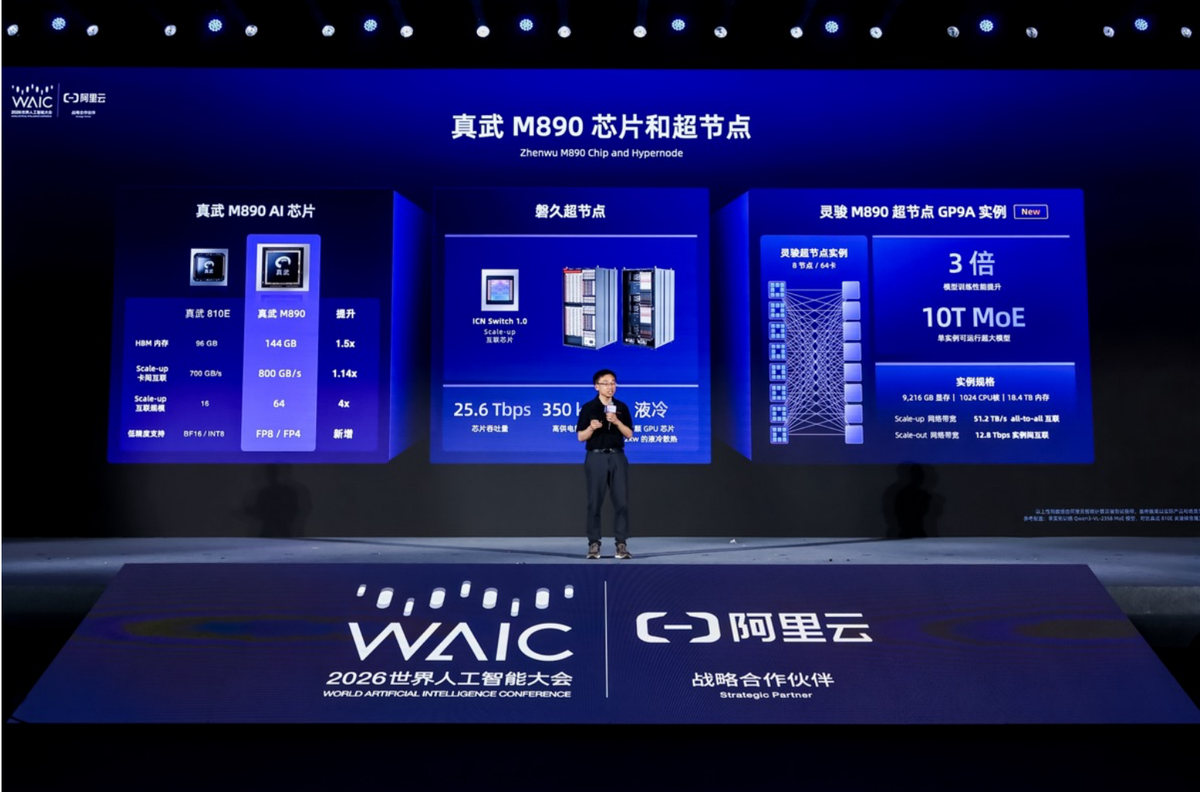
Alibaba Cloud's decision to commercialize its Lingjun Zhenwu M890 supernode as a public cloud instance is less a hardware announcement than a structural pivot: China's homegrown AI compute is transitioning from captive internal asset to monetizable infrastructure commodity.
The launch, unveiled at the World Artificial Intelligence Conference (WAIC) in Shanghai on July 20, 2026, marks the first time a domestic Chinese supernode — built around proprietary ASIC silicon — has been packaged as an externally billable, ready-to-deploy cloud product. The move bypasses the conventional GPU-rental model and positions Alibaba Cloud directly against hyperscaler compute offerings at a moment when U.S. export controls continue to constrain Nvidia H100/H200 availability in China.
Early-access testing has opened at Alibaba Cloud's Ulanqab data center in Inner Mongolia, with commercial pricing terms yet to be disclosed. The controlled rollout signals that the company is stress-testing cluster utilization and per-token economics before a broader market commitment — metrics that will ultimately determine whether this announcement is a genuine inflection point or a well-timed conference headline.
Hardware Specs Reveal a Three-Phase Commercialization Roadmap
The M890 supernode instance is built atop the Pangiu AL128 physical server, a single-rack, 128-card chassis that uses ALink interconnect fabric to deliver petabyte-per-second-class internal bandwidth. The underlying Zhenwu ASIC supports FP8 and FP4 precision compute. The cloud instance exposes 64 cards per unit, linked via ICN Switch 1.0 at 800 GB/s card-to-card bandwidth — sufficient, Alibaba Cloud claims, to run inference on mixture-of-experts (MoE) models at the trillion-parameter scale, including architectures comparable to the recently open-sourced Kimi K3 at 2.8 trillion parameters.
The AL128 chassis carries a design ceiling of 350 kW power draw and 500 kW thermal dissipation capacity. Alibaba Cloud has not confirmed whether the current 64-card public instance operates at full rack power — a distinction that matters for both data center operators and supply-chain investors tracking high-density power and cooling demand.
What the specification sheet does confirm is a deliberate three-stage strategy: Stage 1, Zhenwu silicon deployed exclusively for internal Alibaba workloads; Stage 2, chips integrated with AL128 hardware to form proprietary supernodes; Stage 3, the full stack — silicon, server, networking, storage, and orchestration software — wrapped into a cloud instance and sold externally by the hour.
Commoditizing Compute Solves the "Open Model, Closed Infrastructure" Problem
The strategic logic is sharper than it appears. Since mid-2025, a wave of Chinese frontier models — including those from Moonshot AI, Zhipu AI, and DeepSeek — have adopted open-weight release strategies. Yet open weights have not translated into enterprise deployability: a 2.8-trillion-parameter MoE model requires a tightly coupled, high-bandwidth multi-card cluster that no mid-sized Chinese enterprise can self-provision economically.
Until now, enterprises faced a binary choice: build a private GPU cluster (capital-intensive, 12-to-18-month lead times) or consume inference via a third-party API (surrendering data sovereignty and model customization). The M890 cloud instance introduces a third path — rent a pre-integrated, high-speed domestic compute unit, deploy proprietary models and datasets, and pay per token consumed.
This construct directly addresses the gap between model availability and compute accessibility, and it creates a new demand surface for Alibaba Cloud at precisely the moment when enterprise AI adoption in China is accelerating beyond pilot phases.
Supply Chain Implications Extend Well Beyond the Chip
For investors tracking China's AI data center (AIDC) infrastructure build-out, the AL128's power and thermal specifications are the more actionable data point. A rack-level design envelope of 350 kW places domestic Chinese AI hardware firmly in the same density tier as Nvidia's GB200 NVL72 configurations — and triggers parallel infrastructure requirements.
Components directly in the demand path include: liquid cooling systems (immersion and direct-to-chip), high-current busbars, high-power rectifiers and DC power distribution units, optical transceivers and switch ASICs (to support ICN-class fabric), and high-speed NVMe or CXL-attached storage. Domestic suppliers across these categories — including Vertiv's Chinese competitors, domestic busbar manufacturers, and liquid cooling specialists — stand to benefit as AIDC design philosophy shifts from sequential park-then-populate deployment to co-engineered silicon-server-power-cooling systems.
This shift in design methodology is itself significant: it mirrors the integrated rack solution (IRS) approach that Nvidia and its ODM partners have pioneered globally, and suggests Chinese hyperscalers are compressing the timeline between chip tape-out and full-stack infrastructure readiness.
Four Metrics Will Determine Whether This Is a Pivot or a Press Release
Alibaba Cloud's announcement is commercially credible but not yet commercially validated. Four indicators will separate signal from noise over the next two to four quarters:
- Conversion from invite-only beta to general availability with published pricing — the clearest signal of confidence in cluster stability and unit economics.
- External customer count and mix — whether adoption is concentrated in Alibaba ecosystem partners or extends to genuinely independent enterprises.
- Cluster utilization rate — the critical margin driver; underutilized supernodes are a balance-sheet liability, not a revenue engine.
- Per-token cost competitiveness — whether the M890 instance can match or undercut cloud compute priced on imported GPU capacity, accounting for China's current spot-market dynamics on H800-equivalent hardware.
If those four metrics converge positively within the next two reporting cycles, the WAIC launch will be remembered not as a product announcement but as the moment China's domestic ASIC ecosystem crossed the threshold from "technically functional" to "commercially scalable."
Related Coverage:
China's AI Cloud Wars: How Tencent, Alibaba, and Baidu Are Adapting Their Strategies
Alibaba T-Head Unveils Next-Gen AI Chip Roadmap Targeting Enterprise Agentic Workloads