
China's EV Price War Reaches a Breaking Point — and Two Automakers Illustrate Why
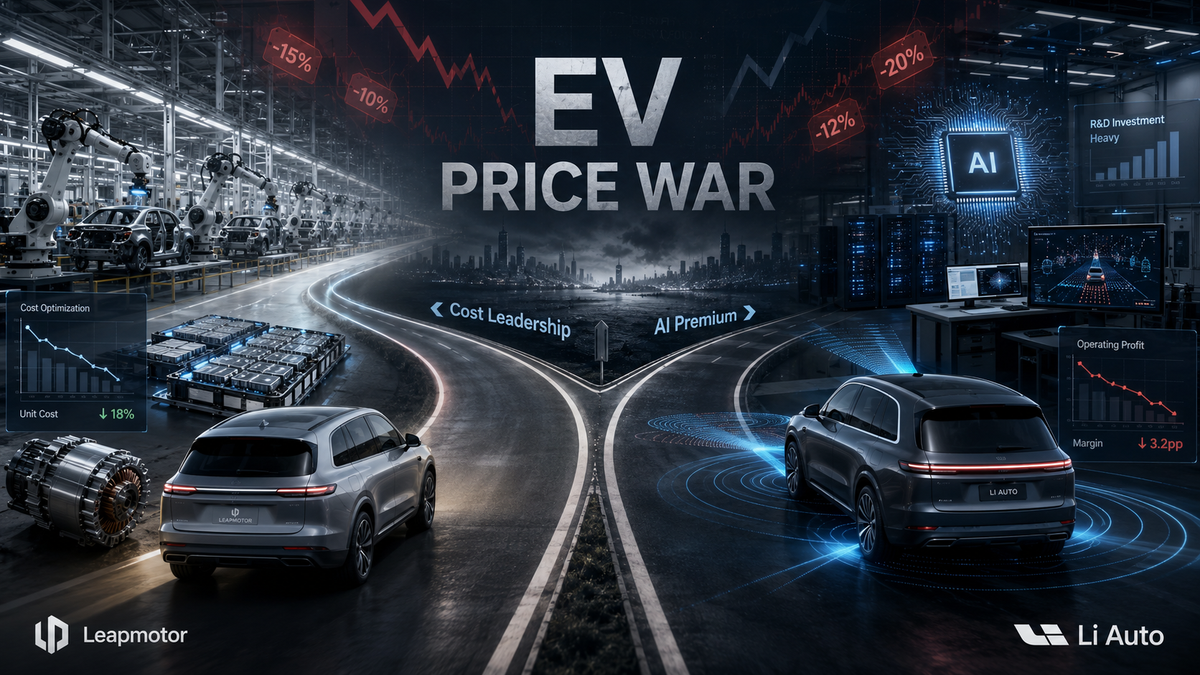
China's electric vehicle industry is confronting a structural reckoning: price cuts and technology stacking are no longer generating profit, and the diverging fortunes of Leapmotor and Li Auto in the first half of 2026 have crystallized a question the entire sector must now answer — when autonomous driving stops commanding a premium, what exactly are you selling?
The inflection point arrived quietly in March 2026, when Leapmotor reported its first-ever full-year profit of RMB 540 million (US$75 million) for fiscal 2025, on the back of 596,600 annual deliveries — a 103% year-on-year surge that placed it atop China's new-energy vehicle (NEV) startup rankings. The same reporting season, Li Auto posted annual revenue of RMB 112.3 billion (US$15.6 billion) but net profit of just RMB 1.1 billion (US$153 million), down 85.8% year-on-year. The gap between those two profit figures — less than RMB 600 million — is the most damning single data point in China's automotive sector this year.
Markets have not been forgiving. Seventeen listed automakers saw a combined market capitalization erosion exceeding RMB 1.1 trillion (US$153 billion) in the first half of 2026, as retail sales of passenger vehicles contracted 20.2% year-on-year to 8.701 million units — a contraction that unfolded even as manufacturers flooded showrooms with more than 630 new model launches, averaging 3.5 new vehicles per calendar day.
Leapmotor Rewrites the Cost Equation by Cutting What Buyers Ignore
Leapmotor's path to profitability is analytically straightforward, even if it required years of discipline to execute. Founder Zhu Jiangming has attributed the company's margin recovery to two levers: a vertical integration rate of approximately 65% across core components — battery systems, electric drivetrains and smart cabin electronics — and a deliberate decision to stop paying for features consumers in the RMB 100,000–150,000 (US$13,900–US$20,800) segment do not prioritize.
The company's C10 and C11 models, which together accounted for more than 200,000 deliveries in 2025, are positioned against BYD's Song PLUS and Song L. Neither vehicle ships with lidar as standard equipment. What they do offer — heat-pump air conditioning as standard across all trims, fast-charging interfaces, and audio-visual systems benchmarked to vehicles in a higher price bracket — reflects a deliberate reading of what has shifted in Chinese consumer behavior since 2022.
Industry channel data and dealer feedback consistently point to the same trend: buyers in the RMB 100,000–200,000 band now rank total cost of ownership, cabin space and basic comfort ahead of advanced driver assistance systems (ADAS). One dealer cited in the source material put it bluntly: "Customers ask about the final on-road price first, then maintenance costs. Autonomous driving? Half of them don't even try it on the test drive."
Leapmotor's autonomous capability stops at L2+. That is not a gap — it is a cost-allocation decision. The capital freed from sensor arrays and compute hardware is redirected into components that generate perceived value at the point of sale. The result: a gross margin structure capable of sustaining profitability at scale.
The overseas dimension adds a further layer. Leapmotor's partnership with Stellantis has opened European distribution, and first-half 2026 exports approached 100,000 units — surpassing the company's entire 2025 export total. A CKD assembly project in Spain is operational, with additional manufacturing bases under evaluation. The strategic logic is explicit: lock in a domestic profit model first, then use higher-margin international sales to expand the earnings pool.
Li Auto's AI Bet Generates Costs Faster Than It Creates Pricing Power
Li Auto's trajectory runs in the opposite direction, and the numbers make the tension visible. The company spent RMB 11.3 billion (US$1.57 billion) on research and development in 2025 — approximately 20 times Leapmotor's full-year net profit — with roughly half allocated to AI and autonomous driving. Its 2026 R&D budget holds at approximately RMB 12 billion (US$1.67 billion). The strategic rationale is coherent: defend premium positioning in the RMB 250,000–450,000 (US$34,700–US$62,500) segment through full-stack ADAS development and city-level Navigation on Autopilot (NOA) without HD maps.
The problem is that the market is not rewarding that investment with incremental margin. Li Auto's vehicle gross margin fell to 6.1% in Q1 2026 — the lowest recorded since the company's founding — and the quarter produced a net loss of RMB 2.3 billion (US$319 million). CFO Ma Donghui, on the Q1 earnings call, expressed hope for gross margin recovery in the second half but offered no quantitative guidance on the contribution of ADAS option-take rates to that recovery. Critically, Li Auto has not publicly disclosed the selection rate for its AD Max autonomous driving package, nor the frequency with which buyers who do select it actually engage city NOA in daily use.
That data gap matters analytically. Autonomous driving is undergoing a structural transition from optional premium feature to standard equipment across China's mid-to-high segment. Standard equipment, by definition, cannot independently generate a pricing premium — it raises the floor for the entire competitive set. Buyers of Li Auto's L-series vehicles at RMB 300,000+ did not pay extra for ADAS; it was included. Buyers in the RMB 100,000–200,000 bracket treat it as a secondary consideration. Neither cohort is compensating Li Auto for the capital it deployed to build the capability.
One analyst quoted in the source material invokes what they term the "Ford Paradox": the historical pattern in which manufacturers that aggressively expand capability and capacity find that each investment cycle simply raises the industry's baseline, compressing unit economics rather than protecting them. Li Auto is running that experiment in real time on autonomous driving.
630 New Models, 30 Winners — Industry Consolidation Accelerates
The competitive backdrop against which both companies are operating has deteriorated sharply. Of the 630-plus new vehicles launched in China in the first half of 2026, fewer than 107 — less than 20% — represent genuinely new platform architectures. The remainder are annual refreshes, incremental specification changes or cosmetic updates. The most congested segments are large five- and seven-seat SUVs, where 800V charging architecture is now standard at the RMB 120,000 price point, full ADAS suites appear at RMB 220,000, and air suspension arrives at RMB 240,000. Differentiation has collapsed.
The consequence: of all new model launches in the first half, only approximately 30 achieved monthly sales volumes above 10,000 units — a 5.5% success rate. McKinsey & Company's May 2026 China consumer insight report found that more than 30% of prospective buyers described themselves as confused by the volume of new launches, with a significant proportion expressing concern about purchasing a vehicle that would be superseded before delivery.
Wang Xia, president of the China Council for the Promotion of International Trade's automotive committee, said at the Chongqing Forum in June: "Hundreds of new vehicles entered the market in the first five months, yet sales contracted. Consumers are beginning to reject the price war — those with a negative attitude now outnumber those with a positive one." That statement, from an industry body rather than a market participant, signals that the structural limits of price-led competition are now visible to regulators and trade associations, not just to investors.
Seres Group, whose AITO brand operates in the same premium NEV segment as Li Auto in partnership with Huawei, is forecast to report a non-recurring net loss of RMB 2.2 billion to RMB 2.5 billion (US$305 million–US$347 million) for the first half of 2026, reversing a prior period of profitability. The industry's overall net profit margin stands at 3.4% — below the 6.1% average for downstream industrial manufacturing.
Diverging Trajectories Define the Second Half Outlook
For Leapmotor, the central question is whether its cost model scales. Achieving its stated 2026 net profit target of RMB 5 billion (US$694 million) requires average monthly deliveries exceeding 100,000 units in the second half — a threshold the company has not yet sustained. Global supply chain capacity, overseas margin durability as competition intensifies in Europe, and the remaining headroom for cost reduction in sub-RMB 150,000 vehicles are the variables to watch.
For Li Auto, three metrics will determine whether the market re-rates the stock positively or continues to apply pressure. First, the gross margin trajectory of the new L6, which enters the market in July 2026: if it cannot recover vehicle gross margin above 20%, the capital market will reassess the value of the company's shift to a semi-franchise dealer model, which was introduced in March 2026. Second, whether the RMB 12 billion R&D budget faces any mid-year reduction following the Q1 loss. Third, the ramp trajectory of the i9, which is expected to address the RMB 300,000+ pure-electric segment in the second half — a price point where consumer willingness to pay for technology features remains the most contested assumption in the entire EV sector.
Li Auto's cumulative first-half 2026 deliveries of 193,500 units represent a 5.1% year-on-year decline, making it the only major NEV startup to post negative cumulative growth in the period. June deliveries of 30,900 units fell 14.84% year-on-year, with both month-on-month and year-on-year comparisons negative — a distinction it holds alone among the top-tier NEV startups.
The broader industry verdict for the first half of 2026 is unambiguous: dealer inventory warning indices have risen year-on-year for three consecutive months, with 17 mainstream brands carrying more than two months of stock. The era in which technology investment reliably translated into pricing power is over. The companies that recognize this earliest — and restructure their cost bases accordingly — are the ones that will still be generating positive margins when the consolidation that the data is clearly signaling finally arrives.
Related Coverage:
China's EV Price War Reverses as Soaring Supply Costs Crush Margins