
Antwork Technology Secures Financing to Cement Dominance in China’s Low-Altitude Logistics Market
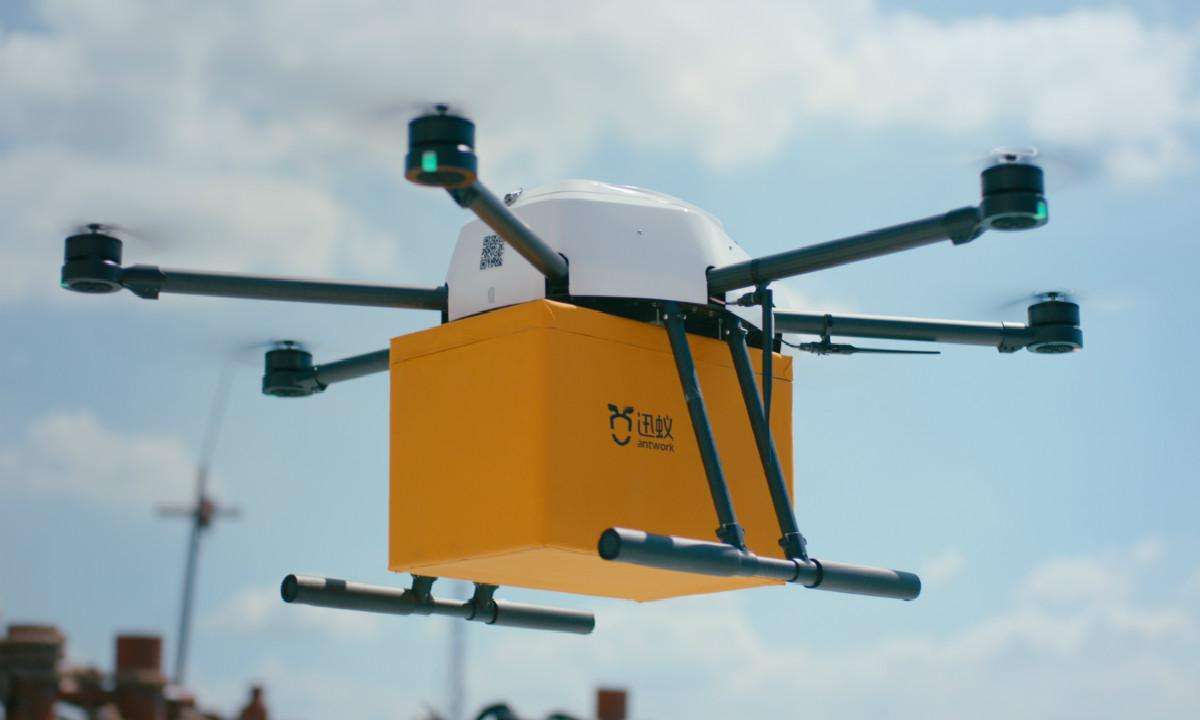
Antwork Technology, a leading operator in China’s burgeoning low-altitude economy, has secured a new round of capital to expand its drone delivery network, signaling growing investor confidence in the commercial scalability of autonomous urban logistics. The financing reinforces the company’s status as a "hidden champion" in a sector rapidly transitioning from experimental pilots to daily infrastructure.
The Hangzhou-based company announced on Nov. 17 the completion of its Series C+ financing round, raising tens of millions of yuan. The investment was jointly led by state-backed Hangzhou Low-Altitude Industry Development and the Zigong General Aviation Industry Fund. This strategic backing highlights the crucial role of government support in facilitating the regulatory and infrastructural framework required for urban air mobility.
The capital injection comes as Antwork consolidates a demonstrable lead in the market. In 2024, the company’s urban logistics drones accounted for over 60% of China's domestic commercial flight mileage. With a network now spanning 193 routinized flight paths across 23 cities, Antwork has moved beyond proof-of-concept to operate the world's largest market share in similar urban scenarios, partnering with logistics and retail giants such as Meituan and JD.com.
Antwork’s trajectory offers a replicable blueprint for an industry grappling with profitability and safety. By securing the world’s first urban drone operation license and focusing on high-value medical transport rather than just commercial parcels, the company has established a competitive moat. The fresh funds are expected to further advance its automated hub technology and expand its medical logistics network, which has already significantly reduced delivery times for critical supplies.
Scaling Commercial Operations
Antwork has established a substantial operational footprint, accumulating over 800,000 kilometers of flight data—equivalent to circling the Earth 20 times. The company’s proprietary technology, featuring automated hub stations and cloud-based scheduling systems, allows its fleet to maintain stability in complex environments and extreme weather conditions.
A key differentiator in Antwork’s strategy is its specialized focus on medical logistics, a sector demanding high reliability and speed. The company has built a medical transport network in 30 cities, improving the delivery efficiency of blood and inspection samples by more than 50%. In 2021, the company launched the nation's first routine drone blood delivery route in Zhejiang province, connecting the Provincial Blood Center with major hospitals.
While the company maintains partnerships for consumer delivery—such as transporting coffee to tourists in Hangzhou’s Liangzhu Ancient City or executing intra-city deliveries in Xi’an—the medical sector provides a high-value, steady demand that separates it from competitors solely focused on e-commerce.
The "Aviation Complex" and Regulatory Firsts
The company’s technical foundation stems from founder Zhang Lei, a Ph.D. in aircraft design from Beihang University with a background in military helicopter flight control systems. Zhang founded Antwork in 2015, motivated by early industry shifts including Google’s drone delivery experiments. Despite initial skepticism and a lack of venture capital interest, the team leveraged the open airspace and government support in Hangzhou’s Yuhang district to test and iterate their designs.
Antwork achieved a critical regulatory breakthrough in October 2019 when its subsidiary received the world’s first urban drone operation license (No. 0001) from the Civil Aviation Administration of China (CAAC), effectively granting it "legal flight rights" in urban zones. This followed early successes, including the 2016 launch of China’s first drone postal route in Anji, serving remote mountain villages—a route that remains operational today.
Financially, the company survived the industry's nascent phase through strategic fundraising, including a RMB 20 million yuan (US$2.7 million) Series A round led by Sequoia Capital in 2017.
Market Landscape and Barriers to Entry
The low-altitude logistics sector faces a critical transition period. In 2024, China's low-altitude logistics market size reached approximately RMB 30 billion yuan (US 4.1 billion), while the global market stood at roughly US 14.6 billion. Despite the growth, the industry faces persistent challenges in airspace management, all-weather capability, and cost control.
Competition remains fierce but fragmented. Antwork competes with players like Fengyi Technology, a subsidiary of SF Express with over 500 routes; Aerospace Feipeng, a state-owned enterprise specializing in heavy-lift drones; and Dianying Technology. However, Antwork differentiates itself through its proprietary 3D path-planning technology—which holds a U.S. patent—and its verified reliability in the medical vertical.
For new entrants, the window of opportunity is narrowing. Established players have already secured prime ecological niches in partnerships with logistics titans like SF Express and JD.com. The barriers to entry are substantial: obtaining airworthiness certification is capital and time-intensive, and cross-regional airspace approval involves complex regulatory hurdles. With less than 500 qualified landing points nationwide, the infrastructure gap remains a significant bottleneck, making it difficult for newcomers to achieve the scale required to offset the high costs of hardware and maintenance.