
Apple’s China Memory Push Collides With Washington’s Chip Strategy
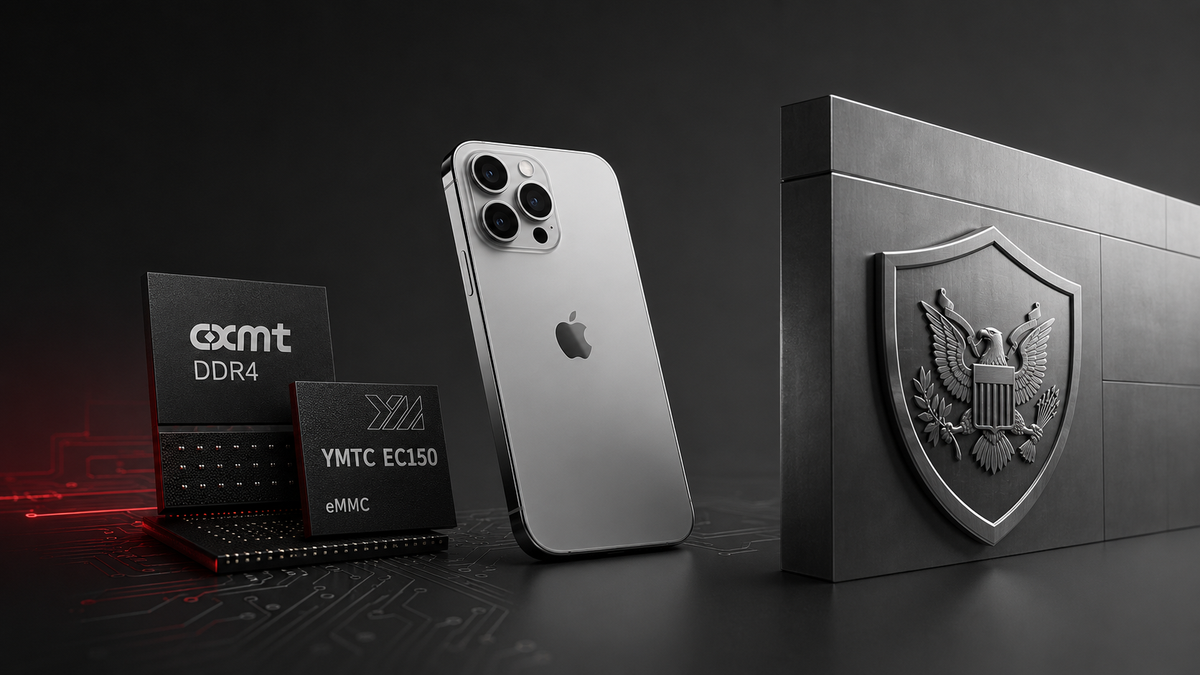
U.S. Commerce Secretary Howard Lutnick's public rebuke of Apple's push to source chips from Chinese memory makers has thrown cold water on unverified reports of an imminent White House green light — exposing the yawning gap between Apple's supply-chain urgency and Washington's strategic calculus.
Unconfirmed reports circulating on Aug. 24 — originating from a Weibo account cited by tech outlet WCCFTech — claimed the Trump administration had tentatively agreed to permit Apple to procure DRAM chips from Changxin Memory Technologies (CXMT) and NAND flash from Yangtze Memory Technologies (YMTC), with a formal agreement potentially announced in September. Neither the U.S. government, Apple, nor either Chinese chipmaker has confirmed the reports.
The rumor cycle, however, collides head-on with a material policy obstacle: mid-August remarks by Commerce Secretary Lutnick explicitly stating the administration does not support Apple sourcing memory chips from China. While not a formal executive order or regulatory action, the statement effectively signals that any approval pathway faces significant political headwinds — and investors in the Korean memory duopoly are watching closely.
"100-Year Flood" Pricing Forces Apple to Weigh the Unthinkable
The structural driver behind Apple's reported overtures is not geopolitical opportunism — it is an acute memory cost crisis that Apple's own chief executive described in historically stark terms.
At Apple's late-July 2026 earnings call — the last presided over by Tim Cook as CEO — Cook characterized the current memory pricing environment as a "100-year flood on memory pricing," stating that costs had risen exponentially in a manner he had never witnessed across four decades in the industry. Apple had already acknowledged in June 2026 that DRAM and NAND cost inflation had become impossible to absorb internally, making product price increases unavoidable.
The DRAM market's structural vulnerability is well-documented: three suppliers — Samsung Electronics, SK Hynix, and Micron Technology Inc. — control the overwhelming majority of global capacity. Cook's public comment that "if there were more suppliers, that would be a good thing" was widely interpreted by industry analysts as a barely veiled reference to CXMT, the only Chinese manufacturer with demonstrated mass-production capability in consumer-grade DRAM.
Dissecting Two Very Different Risk Profiles
The two Chinese chipmakers at the center of the speculation carry fundamentally asymmetric regulatory risk profiles — a distinction that most market commentary has conflated.
YMTC faces a near-insurmountable legal barrier. The U.S. Bureau of Industry and Security (BIS) added YMTC to its Entity List in December 2022, after Apple had briefly confirmed in October of that year that it was evaluating YMTC NAND solely for iPhones sold in China. That procurement plan was immediately shelved. Reports from July 2026 suggest Apple has re-engaged YMTC in preliminary talks, again limited to China-market devices — but with YMTC still on the Entity List, any transaction would require a specific license from BIS, an outcome analysts consider highly improbable absent a broader U.S.-China trade framework shift.
CXMT presents a more legally ambiguous, but politically fraught, scenario. Unlike YMTC, CXMT does not currently appear on the BIS Entity List, meaning no blanket legal prohibition exists against Apple sourcing its chips. Apple reportedly approached the Commerce Department in May 2026 and lobbied the White House seeking a formal policy assurance — specifically, a commitment that CXMT would not be added to the Entity List retroactively, eliminating compliance tail risk.
By July 2026, Apple had initiated engineering validation testing of CXMT's DRAM modules, evaluating performance, compatibility, and reliability. That process was ongoing when a group of U.S. lawmakers wrote to Cook demanding Apple commit — by Aug. 21, 2026 — to never incorporating CXMT or YMTC chips into any product sold globally, including China-only SKUs. Apple has not publicly responded to that demand.
CXMT's Leverage Complicates Any Deal Economics
Even if the policy obstacle were cleared, commercial terms present a separate friction point. Reports from early August 2026 indicate Apple sought CXMT pricing below prevailing rates charged by Samsung and SK Hynix — a demand CXMT flatly rejected. CXMT is understood to be operating at near-full capacity utilization, with existing output locked into long-term supply agreements with Chinese domestic device manufacturers including handset and PC brands. With demand exceeding available supply domestically, CXMT has no structural incentive to offer preferential pricing to secure Apple's business.
Some supply-chain analysts have floated an alternative interpretation: Apple's CXMT engagement may function primarily as negotiating leverage against Samsung and SK Hynix — a credible threat to diversify sourcing that could pressure Korean suppliers on price or volume commitments — rather than a genuine near-term procurement decision. If that reading is correct, Lutnick's public opposition may have inadvertently weakened Apple's bargaining position with its existing suppliers.
Geopolitical Chessboard Complicates a September Timeline
The WCCFTech-cited report framed any U.S. approval not as a pure technology policy decision but as a "bargaining-chip concession" — a goodwill signal timed to a September diplomatic window. That framing, while speculative, aligns with a broader pattern in which technology export controls have increasingly been deployed as negotiating instruments in U.S.-China trade talks.
However, the sequence of events through August 2026 argues against a clean resolution: congressional opposition has hardened, the Commerce Secretary has gone on record against the deal, and YMTC's Entity List status remains unchanged. For CXMT specifically, the absence of a formal prohibition creates a narrow legal corridor — but navigating it would require explicit political will from an administration that has publicly signaled the opposite.
For Apple, the calculus is stark. A China-only memory supply arrangement would insulate global product lines from regulatory risk while providing marginal cost relief in its largest single market by unit volume. But the political cost of being seen to deepen reliance on Chinese semiconductor suppliers — even in a geographically ring-fenced configuration — may outweigh the supply-chain benefit, particularly heading into a U.S. election cycle.
The September window referenced in unverified reports is weeks away. What is certain is that Apple's memory cost problem is not.
Related Coverage:
Apple Turns to CXMT as AI Memory Crunch Reshapes the Global DRAM Market