
Apple's Qwen Deal Exposes Alibaba's AI Dilemma: Power Without the Interface
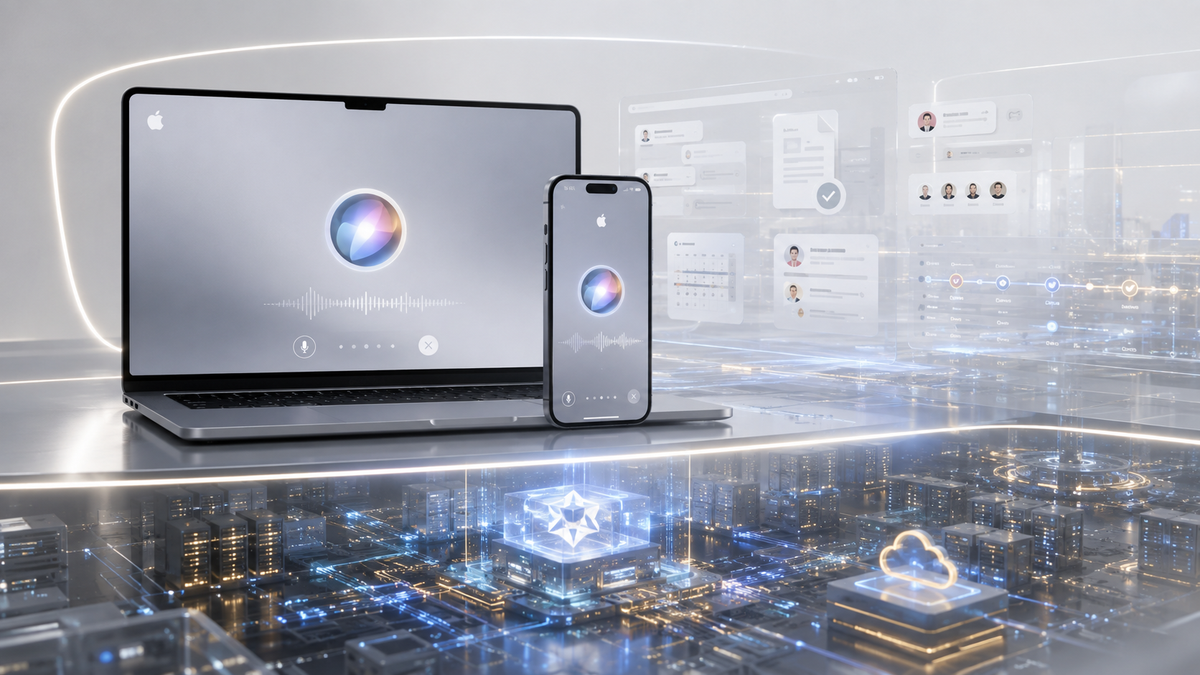
Apple's fleeting website update on August 8 confirmed what months of speculation had circled: Alibaba has secured the generative AI contract powering Apple Intelligence for mainland China — yet the deal's architecture reveals as much about Alibaba's strategic vulnerability as it does about its technological ascent.
The confirmation was accidental and brief. Apple's Chinese-language support page was updated to state that Mac users in mainland China could invoke Alibaba's Qwen model through Apple Intelligence, covering iOS, iPadOS, macOS, and visionOS. The page was pulled within 24 hours, reverting to the ChatGPT-integrated version visible in other markets. No public statement from either company has addressed the premature disclosure. The most defensible reading: the page went live ahead of schedule, with formal launch conditions not yet fully satisfied.
The episode nonetheless delivered a market-moving signal. Alibaba Cloud's AI revenue for the quarter ended March 2026 reached RMB 8.971 billion (approximately US$1.25 billion), marking eleven consecutive quarters of triple-digit year-on-year growth. Annualized, that run rate exceeds RMB 35.8 billion (US$4.97 billion), representing roughly 30% of Alibaba Cloud's total external commercial revenue — a share that the Apple partnership is positioned to expand further.
Apple's China Dilemma Forces a High-Stakes Vendor Selection
Apple's urgency in securing a domestic AI partner is rooted in competitive erosion. In China's PC market, Omdia data for Q1 2026 shows Apple holding approximately 9% market share with around 800,000 Mac units shipped, trailing Lenovo at 31% and Huawei at 16%. On the smartphone side, Huawei's return to the premium segment with its HarmonyOS ecosystem and proprietary Kirin chips has clawed back market share from Apple at the high end — the segment Apple can least afford to cede.
Without a functioning Apple Intelligence suite in China, Apple was selling hardware stripped of its marquee software differentiator. The same Siri that can manage complex tasks in the United States was functionally neutered for mainland users.
Apple reportedly began evaluating Chinese AI partners as early as 2023, initially approaching Baidu. After that process stalled, the evaluation expanded to include Tencent, ByteDance, and DeepSeek. According to reporting by The Information, DeepSeek was ultimately ruled out due to limited experience serving large enterprise clients at scale. The field narrowed to Alibaba and Baidu, with the two reportedly splitting responsibilities: Alibaba providing generative AI capabilities, Baidu contributing search, visual recognition, and Chinese-language Siri enhancements.
"Apple is very picky — they talked to many companies in China, and in the end, they chose to do business with us," Alibaba Chairman Joseph Tsai said at the World Government Summit in Dubai in February 2025, more than 18 months before the accidental website confirmation.
Qwen's Technical Stack Meets Apple's Uncompromising Requirements
Apple's requirements for an OS-level AI partner go well beyond model quality. The integration must span multiple system modules, diverse chip architectures, and hundreds of millions of active devices — demanding model capability, cloud infrastructure, and service-level reliability simultaneously.
Alibaba's case rested on three pillars. First, the Qwen model series: as of March 2026, the Qwen ecosystem had spawned more than 170,000 derivative models on open-source platforms, and Qwen3.8-Max — released August 3, 2026 — ranked second globally on the LMSYS Chatbot Arena leaderboard, behind only Anthropic's Claude Fable 5, with 2.4 trillion parameters and top-four global rankings in coding benchmarks. Second, Alibaba Cloud's infrastructure: a Frost & Sullivan report places Alibaba Cloud's share of China's full-stack AI cloud services market at 40.1% for 2025, the highest of any provider. Third, data depth: Alibaba's ecosystem spans e-commerce, payments, local services, mobility, and enterprise collaboration — a dataset footprint that Morgan Stanley analyst Erik Woodring has suggested could materially improve Apple Intelligence's personalization capabilities for Chinese users.
Bloomberg Intelligence had previously estimated that the Apple partnership could accelerate Alibaba Cloud revenue growth by 11 percentage points annually from fiscal year 2026 onward, above prior consensus — though analysts cautioned that associated R&D and infrastructure spending could compress near-term margins.
The Architecture of the Deal Exposes a Deeper Strategic Tension
The commercial logic of the Qwen-Apple arrangement is straightforward on its surface: Apple becomes a significant enterprise client for Qwen API calls and Alibaba Cloud inference infrastructure, while Alibaba gains a global-tier reference customer that strengthens its pitch to financial institutions, manufacturers, and retailers evaluating AI cloud services.
But the deal's user-facing structure tells a more complicated story. When a Mac user in China asks Siri a question, Qwen processes the request and returns the answer — which Siri then delivers. The user's mental model is that Siri has become more capable. The underlying model is invisible. Qwen provides the intelligence; Apple retains the user relationship, the brand equity, and the interface.
This dynamic is not unique to Alibaba. Across the global technology stack, a hierarchy is crystallizing: hardware manufacturers control the terminal entry point, operating systems control the interaction layer, super-applications control social and commercial traffic, and pure-play model companies are being pushed to the infrastructure base — alongside compute and inference. The stronger the model, the more seamlessly it disappears behind the interface that owns the user.
For Alibaba, a company that has historically monetized infrastructure rather than consumer relationships — Taobao created the marketplace, Alipay enabled the transaction, Alibaba Cloud hosted the application — the model-as-utility path is familiar and financially validated. Alibaba separately disclosed that its model and application services ARR is projected to exceed RMB 10 billion (US$1.39 billion) in the June 2026 quarter and surpass RMB 30 billion (US$4.17 billion) by year-end.
Qwen Office Launch Signals a Bid to Escape the Infrastructure Trap
Alibaba's response to the entry-point problem is visible in its product moves. On the same day Qwen3.8-Max launched, Alibaba opened public beta for "Qwen Office" — a unified agent platform consolidating three previously competing internal products: Wukong, MuleRun, and QoderWork, covering enterprise collaboration, cloud execution, and desktop operation respectively.
The consolidation was driven by Chen Yusen, who at 34 became Alibaba's youngest-ever business unit CEO when he replaced Chen Hang as head of DingTalk on June 11, 2026. DingTalk serves more than 26 million enterprise organizations with approximately 200 million monthly active users, of which nearly 8 million organizations have already integrated DingTalk AI capabilities — a penetration rate that neither Tencent nor ByteDance can match in the enterprise segment.
The competitive field is formidable. Tencent's WorkBuddy, launched in March 2026, reached 20.97 million monthly visits by June, exceeding the combined traffic of its two nearest competitors by integrating WeChat, Tencent Meeting, Tencent Docs, and WeCom into a single agent interface. ByteDance's combination of Doubao for consumer AI, Lark for enterprise workflow, and Volcano Engine for infrastructure gives it an end-to-end stack from entertainment to productivity.
Qwen Office's differentiation claim is DingTalk's unmatched enterprise data depth — documents, email, calendars, approvals, project data — which, if properly leveraged under user consent frameworks, could give Alibaba's agents a structural advantage in task completion over rivals whose enterprise roots are shallower.
Two Roads Diverge: Infrastructure Giant or AI-Era Platform
Alibaba's strategic choice is now explicit. The infrastructure path — maximizing Qwen API revenue, deepening Alibaba Cloud's moat, and serving Apple, handset manufacturers, and enterprise clients as a neutral utility — is commercially certain and consistent with the company's DNA. Every incremental model improvement strengthens the value proposition. The risk is becoming the invisible engine of the AI era: indispensable, profitable, and permanently off the user's radar.
The platform path — making Qwen Office the daily active interface through which hundreds of millions of workers execute tasks, with Alibaba holding the user relationship directly — is strategically transformative but unproven. It requires Alibaba to solve a problem it has never fully cracked: building consumer habit without a social graph or an entertainment feed.
The Cyberspace Administration of China's recent AI service registration disclosures show Apple Intelligence alongside Huawei's Celia, vivo's BlueOS AI, Xiaomi's HyperOS AI, and Nubia's Doubao phone model — evidence that every major device ecosystem is racing to embed AI at the OS layer. The operating system's native AI layer is becoming the new power chokepoint.
Apple's accidental disclosure, and the architecture it revealed, delivered a precise message to Alibaba's leadership: model capability is table stakes; entry-point ownership is the prize. Whether Alibaba can win that prize through Qwen Office — or whether it will remain the world's most capable AI utility that users never directly touch — is the defining question of its next chapter.
Related Coverage:
Alibaba’s Qwen3.8-Max Challenge: How China’s AI Stack Is Closing the Gap With Silicon Valley