
Chery's Global Gamble: Overseas Exports Explode 70% Even as China Home Market Implodes
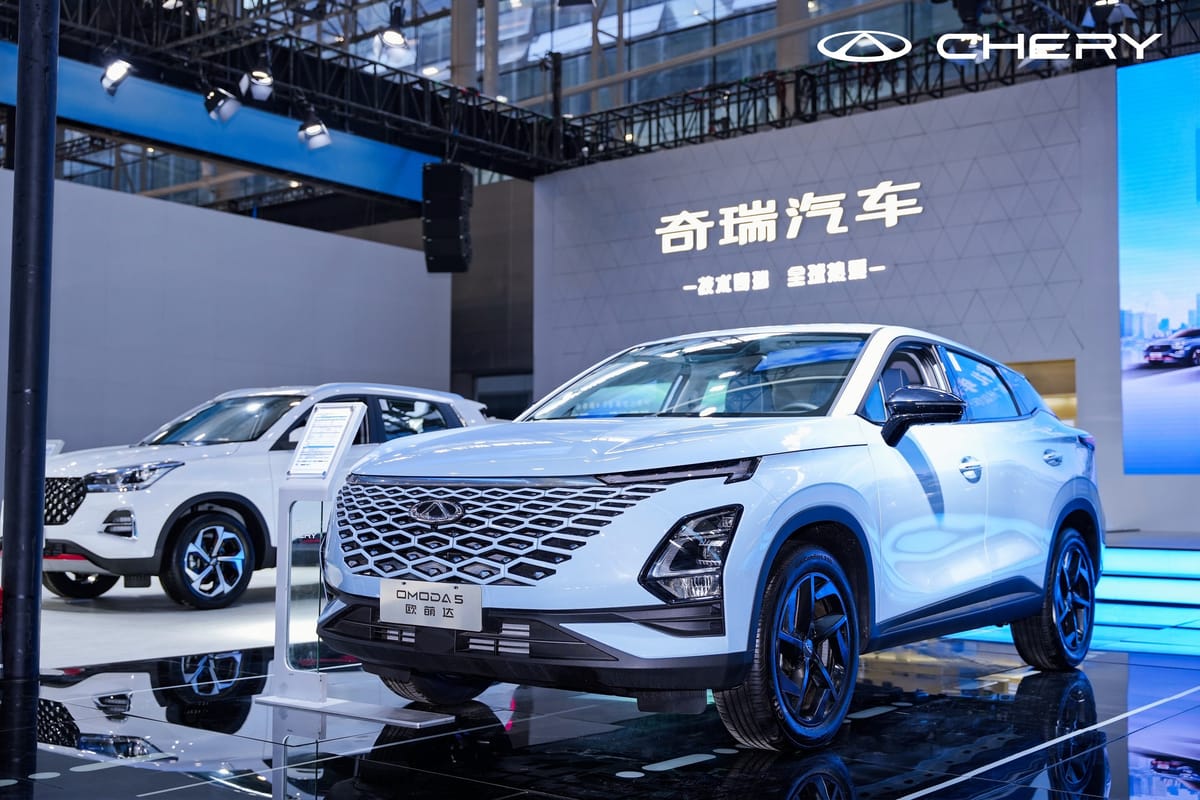
Chery Automobile is running two businesses inside one nameplate — a booming export machine shipping more than 200,000 units a month and a domestic operation hemorrhaging market share at a pace that should alarm its 3,000-plus dealer network.
First-half 2026 data released this week crystallizes the split: overseas shipments reached 923,000 units, up nearly 70% year-on-year, with monthly export records broken in each of April, May, June, and July — the latter crossing the 200,000-unit threshold for the first time in company history. Simultaneously, domestic terminal sales collapsed to 458,000 units, down roughly 30% from the same period a year earlier, leaving average monthly per-dealer volume at a barely viable 20 vehicles.
The divergence is not merely statistical noise. It represents a structural bet by Chairman Yin Tongyue — long summarized in his dictum "no stability without domestic, no strength without overseas" — that international margins can bankroll the technological transformation needed to eventually recapture China. Whether that wager holds depends on how quickly trade barriers rise and how fast domestic competitors extend their data-driven software advantage.
Domestic Collapse Exposes a Product Portfolio Running Out of Road
March 2026 was Chery brand's worst monthly domestic reading in recent memory: 40,336 units, against 63,179 units in March 2025 — a near-halving in twelve months. Full-year 2025 domestic volume had already settled at 820,000 units, and the trajectory in 2026 has worsened, with monthly averages stuck in the 60,000–70,000-unit band across the group's eight sub-brands and more than 80 model lines.
The product-mix problem is structural. In the combustion segment, only the Tiggo 8 and Arrizo 8 sustain monthly sales above 10,000 units; within the Jetour sub-brand, only the Jetour Traveler clears 5,000 units. New-energy vehicles present a starker picture: not a single Chery-group EV currently posts monthly domestic sales above 10,000 units — including the Zhijie, which had achieved that milestone for three consecutive months in 2025 before a sharp reversal.
The one bright spot is a nostalgia play. The all-new Chery QQ3 EV, launched March 30 at a starting price of RMB 58,900 (approximately US$8,180), leverages 23 years of brand equity attached to the original QQ minicar. Monthly deliveries climbed from 6,977 in April to 7,692 in May and 9,749 in June, with July expected to breach 10,000 units. The trajectory is encouraging, but the competitive window is narrowing: Leapmotor is launching the A05 on August 10 at a comparable price point of approximately RMB 60,000 (US$8,330), with high-specification variants featuring LiDAR — a technology absent from every current sub-RMB 80,000 model on sale. A single heritage nameplate cannot substitute for a coherent new-energy portfolio.
Export Engine Accelerates, Rewriting Chery's Revenue Geography
The overseas numbers require context to appreciate their scale. Chery brand alone — the core marque, excluding Jetour, Exeed, Fengyun, and iCAR — exported 700,000 units in H1 2026, up 82% year-on-year. In June, 16 distinct model variants shipped internationally from that single brand; the Tiggo 7 alone accounted for more than 25,000 units in that month.
Jetour contributed 27,000 units in June, up nearly 30% YoY, with the Jetour Traveler generating 14,000 of those. New-energy sub-brands are accelerating from a low base but at striking rates: Fengyun posted H1 overseas volume of 26,000 units, up more than 14-fold year-on-year; iCAR shipped 17,000 units overseas, up 130%.
Europe has emerged as the most strategically significant market. H1 European sales reached 174,000 units, a 212% year-on-year increase, with battery-electric and plug-in hybrid vehicles accounting for 86,000 units — up 385% — and representing nearly half of European volume. In the United Kingdom, Chery ranked second across all automotive brands for three consecutive months beginning March 2026. British automotive media outlet Carwow named the Tiggo 8 its 2026 Car of the Year, citing what it described as a redefinition of the value benchmark in the family SUV segment.
The operational infrastructure underpinning these numbers is no longer purely export-driven. Chery now operates 16 overseas manufacturing facilities and eight overseas R&D centers, employs more than 20,000 people internationally, and sources 85% of its overseas headcount from local labor markets. In April 2026, the company inaugurated a European operations hub in Barcelona alongside a dedicated Spain research institute. In July, it began refurbishing a plant in Rosslyn, South Africa, committing to retain the full existing workforce — a localization signal designed to preempt regulatory and reputational risk.
The financial consequence of this geographic pivot is significant: in 2025, overseas revenue accounted for 52.4% of Chery group total revenue — the first time in company history that international receipts exceeded domestic. Per-unit economics reinforce the logic. The Tiggo 8 Pro carries a starting price of approximately RMB 200,000 (US$27,780) in Australia versus a China domestic guide price of RMB 126,900 (US$17,625). The Tiggo 7 sells from RMB 250,000 (US$34,720) in Russia against a domestic entry price of RMB 79,900 (US$11,097). Those spreads fund the R&D budgets that domestic volume alone could no longer support.
The Nissan Precedent Raises Questions Chery Cannot Afford to Dismiss
The structural pattern — overseas strength masking domestic erosion — has a cautionary analog. Nissan Motor Co. operated for years with international markets compensating for a weakening Japan base, before consecutive net losses totaling more than JPY 1.2 trillion (approximately US$8 billion) across fiscal years 2024 and 2025 forced the closure of seven plants and the elimination of 20,000 jobs globally.
Chery's situation differs in important respects. Nissan's international operations were themselves in retreat when the crisis hit; Chery's are expanding. Nissan had largely ceded pricing power in its key segments; Chery's overseas ASPs demonstrably exceed domestic levels. And Chery's localization strategy — factories, R&D, local employment — reduces the political vulnerability that pure-export models carry.
Nevertheless, three structural risks deserve investor attention.
First, dealer network viability. With more than 3,000 domestic outlets averaging 20 units per month per location, a significant portion of Chery's China network is operating below breakeven. Dealer failures would compress distribution quality precisely when the company needs retail execution to support new-model launches.
Second, data-loop disadvantage. Advanced driver assistance and intelligent cabin features increasingly depend on large-scale, locally gathered behavioral data for iterative improvement. A shrinking domestic user base means Chery accumulates that data more slowly than BYD or Zhejiang Geely, whose domestic volumes remain orders of magnitude larger. The risk is a compounding gap: weaker domestic sales generate thinner data sets, which produce inferior software, which further suppresses domestic competitiveness.
Third, trade policy concentration. The European Union's anti-subsidy tariffs on Chinese-manufactured EVs are already in force. Mexico has raised import duties. If additional markets follow — a plausible scenario given the pace of Chinese automotive export growth — Chery's revenue base, now majority-overseas, faces asymmetric downside. The Barcelona operations hub and the Rosslyn plant refurbishment are partial hedges, but local-content requirements in key markets will take years to satisfy fully.
Group Totals Obscure the Underlying Tension
At the consolidated level, Chery Group — including all brands and export volume — posted H1 2026 sales of 1.357 million units, up 7.7% year-on-year. That headline figure is the one management will emphasize. It is also, analytically, the least informative number in the dataset, because it aggregates two businesses with opposite trajectories and different risk profiles into a single integer.
The more useful frame: Chery is currently using high-margin overseas cash flows to subsidize domestic restructuring and new-energy investment. That is a defensible strategy — provided overseas growth continues, trade barriers remain manageable, and domestic new-energy products find traction before the data-loop disadvantage becomes irreversible.
The QQ3 EV's monthly sales ramp suggests the domestic market retains price-sensitive demand that Chery can address. The question is whether a RMB 58,900 entry-level EV generates sufficient margin contribution to matter at the group level, and whether it represents a genuine portfolio pivot or a temporary volume patch ahead of more comprehensive new-energy launches.
Yin's "no stability without domestic" formulation implies he understands the dependency. The H1 2026 numbers suggest the execution has not yet caught up with the diagnosis.
Related Coverage:
Chery Pivots to Global Markets as Export Margins Eclipse Domestic Returns