
Autonomous Delivery Vehicles, Robotrucks and Self-Driving Buses Compete for Commercial Viability in China
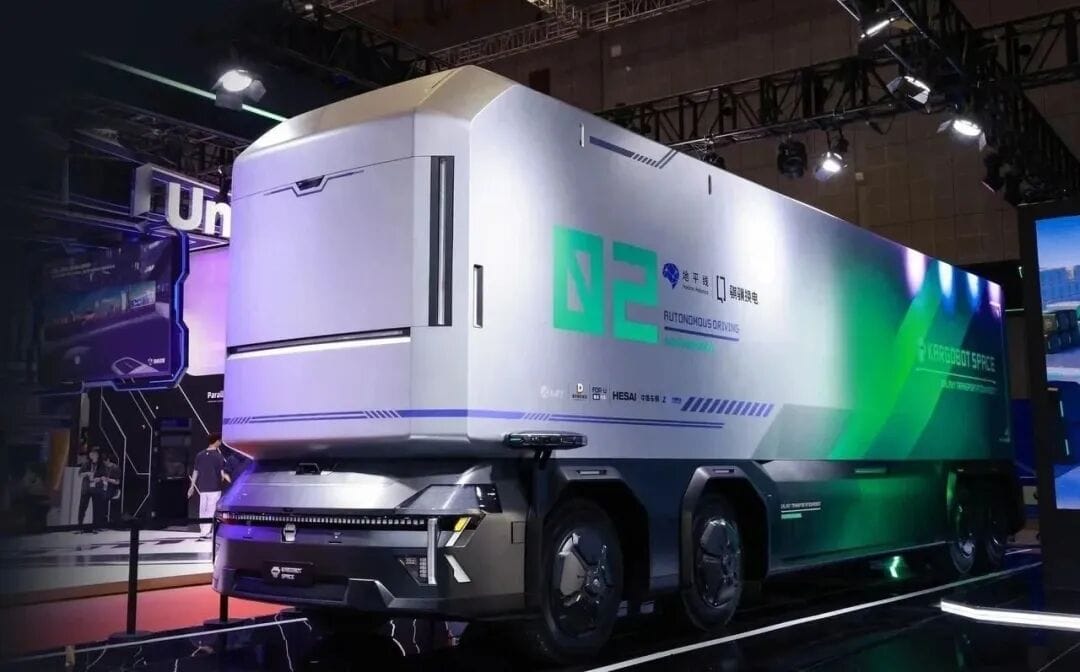
China's autonomous vehicle sector is experiencing a commercial breakthrough across three distinct segments, as companies transition from pilot programs to scaled deployment with record financing levels and falling unit costs driving adoption in delivery, freight and public transit applications.
Neolix, a L4-level autonomous delivery vehicle solution provider, recently secured over 600 million in Series D funding, marking the largest financing round in China′s autonomous driving sector. The investment reflects growing confidence in the commercial viability of autonomous vehicles.
Multiple leading autonomous vehicle companies have attracted substantial capital inflows in 2025. Karl Power completed nearly 300 million yuan in financing in May, while Bacl Technology raised a B+ round in August, bringing its total B−round financing to nearly 500 million yuan. In October, Zelos Intelligence secured $100 million in a B4 round led by Ant Group. Additionally, Mushroom Vehicle Intelligence won the bid for Singapore's first official L4 autonomous bus project, marking the first integration of self-driving buses into an overseas public transportation system.
Industry analysts project autonomous delivery vehicle sales will exceed 30,000 units in 2025, with the market potentially reaching 800,000 annual units by 2030 as companies cross critical thresholds for commercial scalability.
Delivery Vehicles Reach Critical Mass
The autonomous delivery vehicle sector is passing a historical inflection point as leading companies approach the 10,000-unit deployment threshold widely considered essential for commercial viability. This volume represents the critical point where companies can break free from "small-batch, high-cost" constraints and establish a positive cycle of technology cost reduction, scenario validation, order expansion and further cost amortization.
As of late August, Neolix had deployed over 8,000 autonomous vehicles and expects to reach 15,000 unit deliveries for the full year. Zelos Intelligence has delivered over 7,000 units and similarly targets 10,000 units by year-end. Bacl Technology projects its active vehicle fleet will reach 5,000 units by 2026.
Data from the State Post Bureau shows that as of end-2024, cumulative deployment of autonomous delivery vehicles in express logistics exceeded just 6,000 units. Within a single year, multiple companies are crossing the 10,000-unit threshold, demonstrating explosive market growth. Everbright Securities predicts that by 2030, annual autonomous logistics vehicle sales could surpass 800,000 units with a penetration rate approaching 15%, potentially creating a market exceeding 10 billion yuan ($1.4 billion).
The dramatic price reduction has been fundamental to adoption. Vehicles that initially cost hundreds of thousands of yuan now sell for as low as 19,800 yuan (2,700).In May, Zelos Intelligencec launched its E6 model at 19,800 yuan. The following month, Cainiao introduced GT−Lite at 21,800 yuan, with promotional pricing as low as 16,800 yuan.
Operational Economics Drive Logistics Adoption
The practical value proposition of autonomous delivery vehicles has rapidly materialized in operational settings. These vehicles shuttle between sorting centers and neighborhood endpoints, delivering goods directly to communities or nearby stations, eliminating time-consuming trips for delivery personnel and reducing labor costs.
For distribution centers handling an average of 8,000 packages daily, introducing autonomous delivery vehicles reduces per-item costs by 70%, while individual vehicles handle over 1,000 packages daily and improve delivery timeframes by 20% to 30%. During peak periods including Singles' Day and Chinese New Year, autonomous vehicles demonstrate approximately double the efficiency of traditional delivery modes, with single vehicles capable of handling 2,000 packages daily.
Major express delivery companies have accelerated adoption. According to Guohai Securities statistics, ZTO Express has deployed approximately 1,000 vehicles, YTO Express nearly 500 vehicles, Yunda Holding over 100 vehicles, and STO Express over 200 vehicles.
However, industry participants acknowledge that while technical approaches are maturing and reaching critical mass for commercialization, cost reduction pressures mean deployment relies on proven rather than cutting-edge technology. Marketing strategies reminiscent of passenger vehicle competition, including zero down payment options and promotional pricing, have emerged as companies compete for market share.
Most companies employ two primary business models: outright vehicle sales or low-cost hardware with monthly software subscriptions. This lack of innovation and differentiation makes it difficult for companies to stand out, further pushing the industry toward commoditization. Industry observers emphasize that true commercial models lie not in selling vehicles but in providing transportation capacity services, with competitive advantage determined by delivering optimal customer experience at lowest cost.
Autonomous Trucks Target Logistics Cost Structure
China's logistics industry faces structural challenges where traditional operations remain trapped in a cycle of low-price competition, overloading and safety hazards. Autonomous driving technology through hardware reconstruction and algorithmic iteration has become an important vehicle for reshaping logistics transportation.
The industry has pursued two distinct approaches. "Light mode" companies provide pure software system licensing, decoupling algorithms from hardware and leaving vehicle modification and operational deployment to partners. This enables rapid expansion with low initial investment but faces delivery complexity and unclear responsibility allocation. Alternative approaches focus on "scenario customization," providing deep operational refinement for specific customer needs, delivering stable implementation at higher cost but with limited scenario transferability and scalability challenges.
Recent years have seen companies including Karl Power pivot toward "universal platforms," redefining autonomous trucks as intelligent infrastructure for logistics. Modular hardware architecture combined with autonomous driving systems enables seamless adaptation from low-speed operations in enclosed port scenarios to high-speed highway convoy operations, breaking the inefficient "one scenario, one solution" paradigm of traditional autonomous driving systems.
Technical approaches have coalesced around end-to-end reinforcement learning, multi-modal perception fusion, lightweight mapping technology and modular design as mainstream solutions for autonomous heavy trucks.
Key Application Scenarios
Core autonomous truck applications span trunk logistics, enclosed scenarios and port terminals. Trunk logistics constitutes a major segment due to long-distance transportation, high-tonnage loads and high cargo values, while facing challenges of elevated labor costs, low operational efficiency and frequent safety incidents.
According to National Bureau of Statistics data, China's road freight volume reached 4.188 billion tons in 2024, with trunk freight market scale exceeding 6 trillion yuan ($828 billion). Average truck driver age has approached 49 years, with driver shortages creating clear application scenarios for autonomous freight.
For traditional trunk logistics fleets, cost structure follows a "33211" pattern, with fuel representing 30%, labor 30%, and other costs comprising the balance. Autonomous driving can reduce fuel consumption by 10%, while fully unmanned operations enable single remote operators to monitor five to ten vehicles, achieving comprehensive cost reduction of approximately 35%.
The Ministry of Transport predicts the autonomous trunk logistics market will reach 853.9 billion yuan ($118 billion) by 2030, with L4-level truck penetration exceeding 25%.
Port logistics autonomous driving has emerged as a pioneering commercialization domain due to enclosed environments and low-speed operations. Ports face harsh working conditions, extreme labor intensity and severe shortages of qualified drivers. While multiple solutions including autonomous container trucks, automated guided vehicles and autonomous straddle carriers have been proposed, autonomous container trucks appear positioned to become the mainstream solution given lower per-unit costs and stronger applicability.
Current inventory of port container tractors in China exceeds 25,000 units, but autonomous driving penetration remains very low. By 2025, L4 autonomous driving penetration in Chinese ports is expected to increase substantially, with deployment reaching 6,000 to 7,000 units.
Autonomous Buses Enter Public Transit Networks
Self-driving buses have completed the transition from technology demonstration to commercial operation, evolving from enclosed campus and scenic area shuttles to open-road urban community and metro connection services, activating the "peripheral nerves" of urban transportation networks.
According to IHS Markit projections, China's shared mobility market will reach 2.25 trillion yuan ($310 billion) by 2030, with autonomous buses potentially capturing a market worth tens or hundreds of billions of yuan. Global market compound annual growth rate is projected to maintain double-digit levels from 2023 to 2030.
Autonomous buses offer compelling advantages for public transit applications. Operating on fixed routes including bus lines, scenic area shuttles and campus commutes provides stronger route predictability, reducing autonomous driving scenario complexity and technical implementation difficulty. L4-level technology's high safety and autonomy can effectively alleviate bus driver shortages while reducing traffic accidents caused by human driving errors.
According to estimates in the "2025 China L4 Intelligent Driving Scenario Commercialization Development Insight Report," a 49-seat autonomous bus at 60% expected occupancy could generate nearly 700,000 yuan in annual operating revenue. Based on an eight−year vehicle service life, annualper−vehicle costs are projected at 513,000 yuan, yielding annual gross profit exceeding 170,000 yuan ($23,000) per vehicle with gross margins reaching 25%.
Mushroom Vehicle Intelligence's recent contract win for Singapore's first official L4 autonomous bus project demonstrates a comprehensive delivery model combining "core technology + vehicle manufacturing + local operations." This ecosystem approach avoids isolated market entry risks, leverages local partners for policy and market access, enhances localization capabilities, and establishes foundations for long-term competitive advantage through deep partner integration.
IEEE predicts that by 2040, 75% of global vehicles will achieve unmanned driving. Autonomous buses will become core nodes in urban public transportation networks, forming integrated intelligent mobility systems alongside metro systems, robotaxis and shared bicycles.