
Beyond the Rally: Are Chinese AI Stars Zhipu and MiniMax Still Worth the Hype?
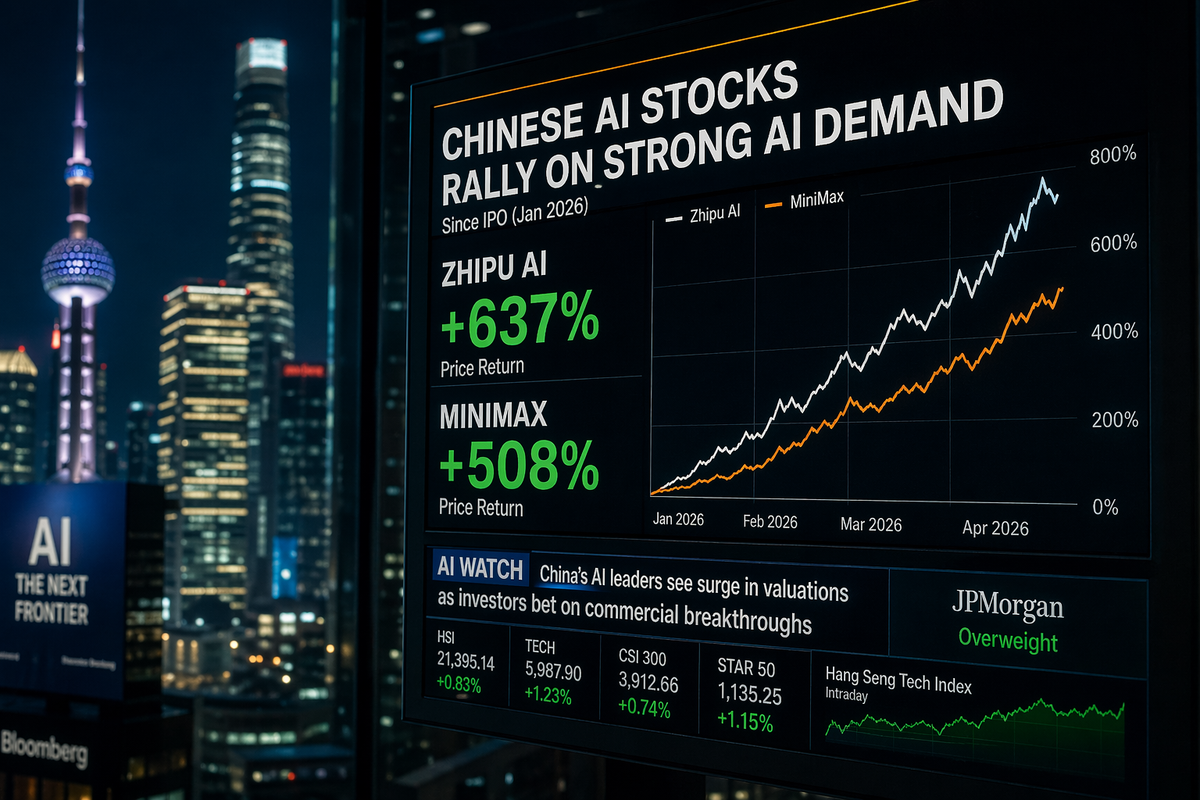
The Chinese artificial intelligence sector has witnessed a spectacular rally, with pure-play frontier model developers Zhipu AI and MiniMax seeing their stock prices surge 5–7 times since their IPOs in January 2026. This meteoric rise has cemented their status as the most representative public proxies for China’s foundational model layer. For professional investors, the pressing question is whether this rally has fully priced in the commercial opportunities or if there is still room to run. Crucially, what catalysts could trigger a major valuation reset—up or down?
JPMorgan recently released a comprehensive research note maintaining an "Overweight" rating on both stocks, viewing any technical pullbacks as buying opportunities. However, the bank also outlines a set of fundamental warning indicators in an industry still grappling with significant uncertainties in competition, pricing, and monetization.
The $1 Billion ARR Milestone: Pricing in an Anthropic-style Trajectory
JPMorgan argues that both Zhipu and MiniMax are structural beneficiaries of China’s AI application cycle. The bullish thesis is underpinned by robust API demand, improving monetization, and the early-stage scaling of enterprise AI workloads in the domestic market.
Currently, the market is pricing in an implied 2026 year-end Annual Recurring Revenue (ARR) of approximately US$1 billion for Zhipu and US$700 million for MiniMax. More importantly, the valuation anchors these firms against US counterparts like Anthropic.
"Based on market caps of $40 billion to $55 billion, we believe the market is pricing in Zhipu and MiniMax reaching 2026 year-end ARRs of roughly $1 billion and $700 million, respectively. The current valuation also embeds an external benchmark... meaning that once Zhipu/MiniMax cross the initial $1 billion ARR threshold, the market expects an Anthropic-like post-inflection growth trajectory—essentially growing ARR 5x in six months."
This sets a high bar in a fiercely competitive Chinese market. However, JPMorgan remains structurally optimistic. Due to computing constraints, current ARR likely underestimates true demand, and both companies remain firmly entrenched in the highest-value segments of the model market: coding, agents, and enterprise workloads.
Catalysts and the Pricing Power Shift
The next major wave of stock performance will hinge on model upgrades, token growth, and whether pricing power continues to translate into better monetization. The immediate operational catalysts are the impending model cycles—specifically GLM 5.5 and MiniMax M3, both expected around June. Historically, major releases have driven step-function increases in adoption and ARR.
While raw token consumption remains supportive (China’s daily token usage topped 140 trillion in March 2026), the focus has shifted. The critical metric is no longer just volume, but the conversion of demand into recognized revenue at higher effective prices.
"Pricing has been one of the most important shifts in the industry year-to-date... Pricing is improving through multiple channels, benefiting revenue conversion across the model layer. Mechanisms include direct API repricing around model upgrades, migration from subsidized coding packages to higher-value on-demand usage, and structural repricing via KV cache economics."
Navigating the Technical Headwinds: Lock-ups and IPO Scarcity
Despite the strong fundamentals, short-term capital flows present notable headwinds. The primary risks are lock-up expirations, potential post-IPO equity financing, and the erosion of "scarcity premium" as more Chinese AI firms (like Kimi and StepFun) seek public listings.
MiniMax faces a steeper near-term supply cliff, with 39.0% of post-IPO shares unlocking in early July. Zhipu is relatively better positioned, with only a 5.8% unlock at the 6-month mark and an earlier anticipated inclusion in the Stock Connect program.
"We view these as technical pressures rather than a breakdown of the investment thesis... Index inclusion (June) and Stock Connect inclusion (June/August) should provide substantial hedging demand support. If company-level execution remains unchanged, any technical pullback could create a better entry point."
The US AI Anchor: Validation or Threat?
The accelerating ARR growth of US frontier AI companies like Anthropic and OpenAI (whose combined ARR now exceeds $59 billion) provides a structural tailwind for Chinese LLM valuations. It validates the massive Total Addressable Market (TAM) and supports the aggressive growth expectations for Zhipu and MiniMax.
However, the potential IPOs of Anthropic and OpenAI in late 2026 could shift the valuation framework. If public markets begin to prioritize gross margin conversion, operating leverage, or free cash flow over simple ARR multiples, companies heavily reliant on long-term growth narratives might face valuation compression.
For now, JPMorgan’s core view holds: as long as Zhipu and MiniMax maintain their competitive edge and convert demand into revenue, the progress of US frontier AI serves more as a validation of the Chinese public LLM market than a threat. Investors should watch the upcoming model releases closely—they will be the ultimate test of whether these high-flying valuations are built on solid ground.
Related Coverage:
MiniMax Launches MaxHermes, a Cloud-Based Self-Evolving AI Agent