
BrainCo Launches World's First Brain-Controlled Robot Platform for China’s Embodied AI Race
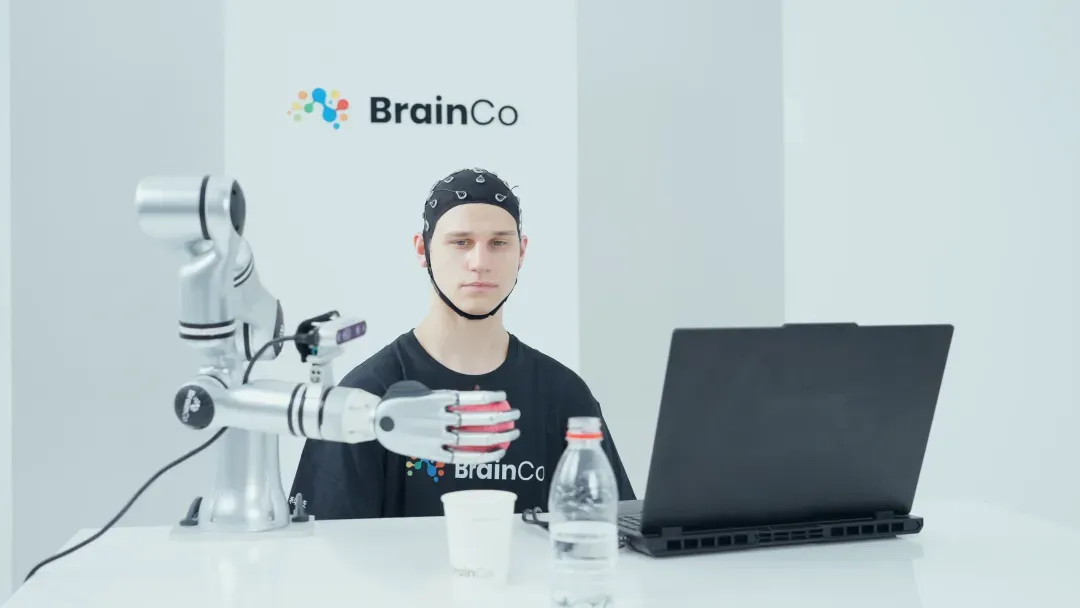
China's leading non-invasive brain-computer interface company is betting that the next frontier in embodied AI is not a faster actuator or a more dexterous gripper — it is a standardized, zero-code pipeline that lets a researcher command a robotic arm with thought alone in under 10 minutes.
BrainCo, the Harvard-incubated BCI unicorn headquartered in Shanghai, previewed its "Brain-Controlled Robot Training Platform" ahead of the World Artificial Intelligence Conference (WAIC) 2026, scheduled to open in Shanghai this week. A teaser video released July 16 shows a developer wearing a non-invasive EEG headset directing a robotic arm to grasp a cup — with no physical input, no voice command, and no lines of custom code. The company describes the demonstration as a global first for an end-to-end, commercially packaged brain-robot research environment. The announcement lands as Beijing's 15th Five-Year Plan explicitly designates brain-computer interfaces and embodied intelligence as priority emerging industries, creating both a policy tailwind and a procurement incentive for research institutions across the country.
Collapsing the Research Stack That Blocked Wider BCI Adoption
The platform's commercial logic rests on a well-documented pain point: until now, building a functional brain-controlled robot system required a multi-disciplinary team to manually stitch together EEG hardware procurement, MATLAB or Python signal preprocessing, custom neural decoding algorithms, and robot-specific communication interfaces — a process that routinely consumed months of engineering time before a single experiment could run.
BrainCo's platform compresses that stack into five integrated layers: signal acquisition, experimental paradigm management, neural decoding, instruction mapping, and robot execution. The hardware layer supports both wet and dry electrodes, 32 channels, 24-bit precision, and up to 1,000 Hz sampling over Wi-Fi 6. Data is stored in XDF+ international standard format, ensuring direct compatibility with open-source tools including EEGLAB and MNE — a deliberate interoperability choice that reduces lock-in risk for institutional buyers.
The decoding engine natively supports two classical BCI paradigms: Motor Imagery (MI), which detects sensorimotor cortex rhythm shifts when a user imagines limb movement, and Steady-State Visual Evoked Potential (SSVEP), which reads brainwave responses to flickering visual targets at distinct frequencies. Both paradigms are fully encapsulated within the graphical interface. Built-in algorithms include FBCSP+SVM, FBCCA, and EEGNet, spanning traditional machine learning and deep learning architectures, with a one-click training workflow that auto-archives calibrated models for live inference.
On the execution side, the platform ships with pre-configured interfaces for the Unitree G1 humanoid robot, the Realman six-degree-of-freedom robotic arm, and the DEEP Robotics Lite 3 quadruped — with the company signaling ongoing expansion of the compatible device library.
"Ternary Intelligence" Framework Reframes BCI's Role in Robotics
BrainCo's strategic framing is as significant as the engineering. The company is positioning its platform around a concept it calls "Ternary Intelligence": BCI handles intent decoding, AI handles recognition and task decomposition, and embodied systems handle physical execution. This division of labor directly addresses the signal fidelity ceiling that has historically constrained non-invasive BCI — the technology does not need to reconstruct a full motor trajectory at the joint level; it only needs to identify "what the user wants to do," then hand off to the robot's onboard motion control stack or a bionic dexterous hand such as BrainCo's own Revo 3.
The approach is pragmatic rather than visionary. Non-invasive EEG captured through scalp electrodes produces signals with inherently lower spatial resolution and signal-to-noise ratios compared with implanted arrays used by competitors such as Neuralink. Rather than competing on signal fidelity, BrainCo is competing on accessibility and ecosystem breadth. The same decoded intent model can drive a robotic arm, a humanoid, or a quadruped without retraining — a portability feature that materially expands the addressable research market.
Open Architecture Signals a Platform, Not a Product, Play
For advanced users, BrainCo has opened four extension interfaces: a device SDK for third-party EEG hardware, the XDF+ data layer, an algorithm plugin interface that accepts externally developed decoding models, and a robot task library API that allows new device registration. This architecture suggests the company is pursuing a platform strategy rather than a hardware-sales model — a higher-margin, higher-defensibility position if adoption scales.
The target user base spans undergraduate teaching labs in psychology and medical schools — where the zero-code interface removes computational barriers — through to specialized robotics research groups that can inject proprietary algorithms into the open plugin layer. If BrainCo succeeds in attracting third-party robot manufacturers and algorithm developers to build on the platform, it transitions from device supplier to ecosystem operator, a trajectory that carries significantly different valuation implications.
Policy Alignment Amplifies Near-Term Demand Signal
The timing of the WAIC launch is not incidental. China's 15th Five-Year Plan has explicitly elevated BCI and embodied AI to the status of "future industries," a designation that historically correlates with accelerated government procurement, university lab funding, and preferential financing for domestic suppliers. BrainCo's platform, priced and packaged for the research market rather than clinical deployment, is well-positioned to capture early institutional spending in this cycle.
The company's trajectory — from a Harvard basement startup to the developer of what it claims is the world's first integrated brain-robot training platform — reflects a deliberate pivot from single-product medical devices (its prosthetic hand and bionic leg lines) toward research infrastructure. Whether the platform achieves the network effects required to sustain an ecosystem play remains an open question. But the 10-minute onboarding benchmark, if validated at scale, represents a measurable compression of the entry cost that has kept BCI-robotics research confined to a narrow set of well-resourced laboratories. At WAIC 2026, BrainCo is arguing that the bottleneck was never the science — it was the toolchain.
Related Coverage:
China's BCI Race Heats Up as BrainCo and Neuracle Eye IPOs, Funding Jumps 230%