
BYD Deepens Price War With New Lower-Priced Qin PLUS Models
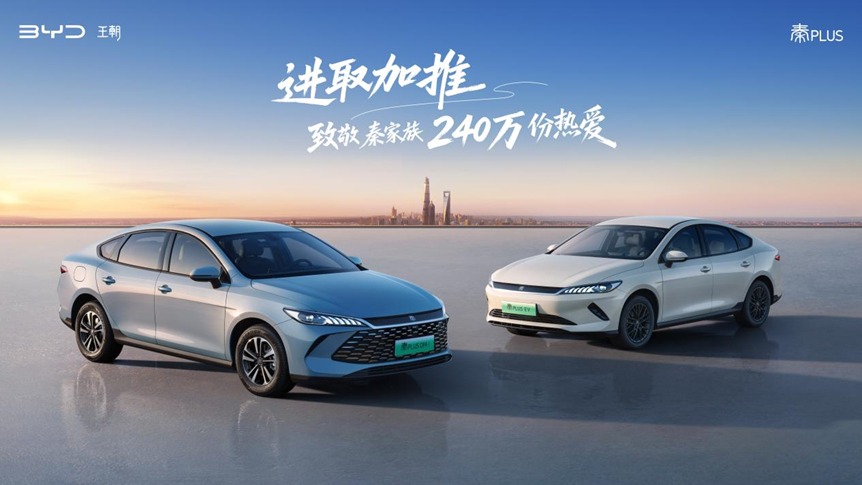
BYD is escalating the intense price war in China’s auto market, launching new, more affordable versions of its best-selling Qin PLUS sedan to further lower the entry barrier for its popular hybrid and electric vehicles.
On September 25, the automotive giant introduced three new "Advancement Edition" trim levels for its second-generation Qin PLUS lineup. The new offerings include one DM-i plug-in hybrid model and two fully electric variants, all strategically positioned to attract a wider base of budget-conscious consumers.
The announcement is headlined by a limited-time promotional campaign that slashes the starting price of the Qin PLUS DM-i model to RMB 69,800 yuan ($9,610). This aggressive move pushes the highly popular family sedan into an unprecedentedly low price bracket, significantly intensifying pressure on domestic and international competitors.
This strategy is poised to further cement BYD’s dominance in the mass-market A-segment sedan category. The Qin PLUS has already achieved remarkable success, with cumulative sales exceeding 1.5 million units and securing its position as the top-selling family sedan in China for both 2023 and 2024.
New Models Target Broader Audience
The new product launch includes the Qin PLUS DM-i 128KM Advancement Edition, the Qin PLUS EV 420KM Advancement Edition, and the Qin PLUS EV 510KM Advancement Edition. The move is a direct response to evolving consumer demand, aiming to make BYD's core technology accessible to more households and capture the growing segment of first-time car buyers who are increasingly opting for electric vehicles amid expanding charging infrastructure. With a limited-time promotional starting price of just RMB 69,800, BYD has effectively lowered the entry point for a high-quality family sedan to the sub-RMB 70,000 range.
Hybrid Efficiency and Upgrades
The new Qin PLUS DM-i 128KM Advancement Edition is engineered for users seeking longer pure-electric range for daily use, offering up to 128 kilometers on a single charge, which is sufficient for a typical week of urban commuting. BYD announced that the model’s fuel consumption during hybrid mode has been optimized, achieving a low 2.69L/100km under the NEDC standard.
Crucially, this fuel efficiency enhancement is not limited to new buyers. BYD confirmed the improvement will be delivered via an over-the-air (OTA) software update to all existing second-generation Qin PLUS DM-i models equipped with its fifth-generation DM technology. New models also feature interior updates, including a new rotary gear selector and an additional "Star River Beige" color option.
Affordable All-Electric Options
For the pure-electric segment, the new Qin PLUS EV 420KM and 510KM Advancement Editions are positioned to fill a market gap for sedans that balance strong product features with affordability. The 420km-range model is marketed as sufficient for over half a month of typical driving, while the 510km-range version offers greater flexibility for short-distance weekend travel.
Both EV models are built on BYD’s established technology platform, featuring the Blade Battery and an 8-in-1 electric powertrain. They are also equipped with a wide-temperature range heat pump system, ensuring stable performance in climates ranging from -30°C to 40°C. Despite their entry-level positioning, the vehicles come standard with features like a multi-link rear independent suspension, NFC key functionality, a built-in ETC module for automated toll payments, and a VTOL mobile power station feature.
Enhancing Value Through Software
Beyond new hardware, BYD is leveraging software to enhance value for its existing customer base. The company noted that the second-generation Qin PLUS, launched just six months ago, has already received approximately 20 new functions through OTA updates to its driver-assistance and smart cockpit systems.
These free updates include new driving-assist features such as a "traffic efficiency priority" mode and "dangerous cut-in" warnings. Parking convenience has also been improved with functions like nose-in parking, tail-out exiting, and automatic mirror folding in tight spaces. Forthcoming updates promise to add a phone-mirroring mode, a gaming center, and expanded smart voice capabilities, reflecting BYD’s strategy of delivering continuous improvement and maintaining customer loyalty without requiring additional spending.