
BYD Ignites 2026 Price War With $27,000 Flagship Seal 08, Assuming Autopilot Liability
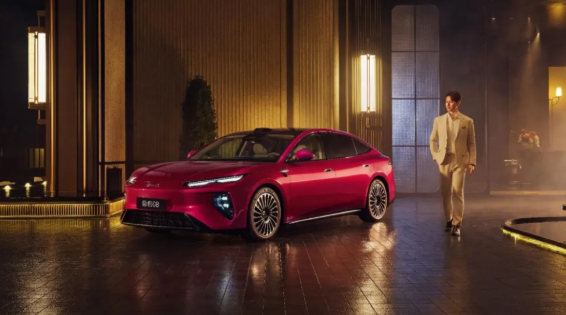
BYD Co. launched its flagship Ocean Network sedan, the Seal 08, starting at RMB 196,900 (US$27,347), injecting ultra-premium hardware and an unprecedented shift in autonomous driving liability into China's hyper-competitive mid-size vehicle segment.
The July 2 release immediately resets the valuation matrix for the RMB 200,000 to 300,000 auto market. By equipping a vehicle priced under US$30,000 with dual-chamber air suspension and rear-wheel steering—features historically reserved for luxury cars exceeding RMB 500,000 (US$69,444)—BYD directly challenges the market share of legacy joint ventures like Audi, while applying severe pricing pressure on direct domestic and foreign EV rivals including Xiaomi Corp., Zeekr, and Tesla Inc.
Shifting Liability Rewrites Autonomous Driving Norms
Beyond aggressive pricing, BYD’s strategic pivot in autonomous driving (AD) accountability marks a watershed moment for the 2026 industry. The company announced it will assume liability for accidents occurring under its LiDAR-equipped "Eye of the Gods" advanced driver assistance system during smart parking and urban navigation.
This move transitions BYD from a traditional hardware manufacturer to a co-bearer of AD risk. By providing a safety safety net for its urban Navigate on Autopilot (NOA), BYD significantly lowers the consumer trust barrier for high-level autonomous driving. Analysts note this forces a paradigm shift across the sector, compelling competitors to offer similar legal and insurance guarantees rather than merely competing on software algorithms.
Vertical Integration Drives Hardware Deflation
The Seal 08’s specifications underscore BYD’s ruthless supply chain cost control and the broader trend of hardware deflation in the Chinese EV supply chain. The 5.1-meter D-segment sedan achieves a tight 4.95-meter turning radius via its standard rear-wheel steering, neutralizing the maneuverability deficit of large vehicles in dense urban environments.
Built on an 800-volt architecture, the pure electric variant utilizes a second-generation Blade Battery to deliver a 905-kilometer range, while the plug-in hybrid version claims a combined range exceeding 1,600 kilometers. Megawatt-level fast charging adds 400 kilometers of range in five minutes. However, supply chain analysts caution that the current scarcity of megawatt charging infrastructure across China remains a near-term bottleneck for consumers to fully realize this charging efficiency.
Rapid Consumer Feedback Loops Redefine Production
The vehicle's development cycle highlights an increasingly agile manufacturing approach that legacy automakers struggle to match. Just a week prior to launch, BYD altered interior material specifications—eliminating piano black finishes in favor of pearl-shell textures—in direct response to online consumer feedback.
Coupled with democratized luxury features like zero-gravity seats, rear electric leg rests, and Devialet audio systems, the Seal 08 demonstrates how domestic automakers are leveraging rapid product iteration. This user-oriented agility, backed by vertical integration, cements BYD's strategy to capture the remaining market share from traditional premium brands in 2026.
Related Coverage:
BYD's Hybrid Sedan Seeks to Reclaim Market Share from Geely with Enhanced Features