
BYD Rolls Out 15 Million New Energy Vehicles, Cementing Global Leadership
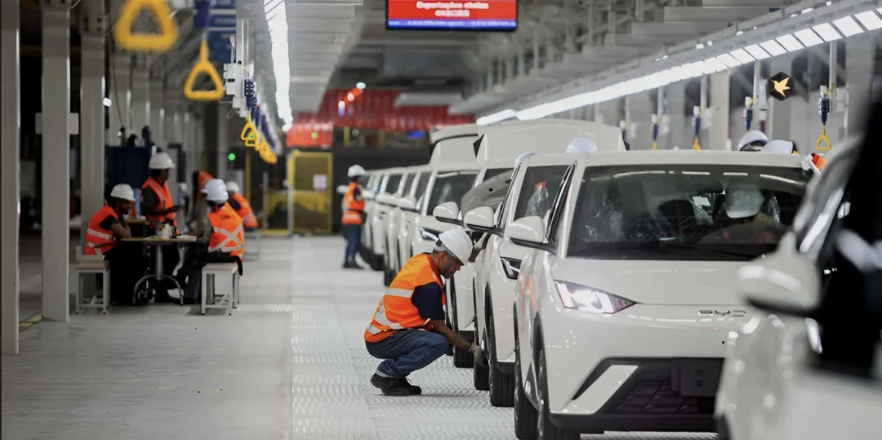
BYD produced its 15 millionth new energy vehicle on December 18, marking an acceleration in manufacturing pace that underscores China's dominance in the electric vehicle transition. The milestone vehicle was a Denza N8L, the 15,000th unit of that model, symbolizing the company's expansion across multiple market segments.
The achievement comes just 13 months after BYD reached 10 million units, a stark contrast to the 17 years required to produce its first 10 million vehicles. Through November 2025, BYD recorded cumulative sales of 4.18 million vehicles, up 11.3% year-on-year, translating to approximately 12,000 units sold daily. The company commands 18.3% of the global new energy vehicle market, meaning roughly one in five new energy vehicles worldwide is produced by BYD.
BYD's export volumes exceeded 910,000 units in the first 11 months of 2025, surging 326% year-on-year, positioning the company to surpass one million overseas deliveries by year-end. The company's global reach gained symbolic validation in October when Brazilian President Luiz Inácio Lula da Silva purchased BYD's 14 millionth vehicle, a Song Pro, directly from the company's Brazilian facility.
The company received China's first "New Energy National Regulatory Platform Compliance Certification" on December 17, securing regulatory recognition for its technology and safety standards. With over 120,000 engineers worldwide filing an average of 32 patent applications daily and cumulative R&D investment exceeding 100 billion yuan, BYD has established a comprehensive technology ecosystem that traditional automakers are struggling to match.
Technology Platform Drives Market Position
BYD's growth stems from its "technology pool" strategy, which prioritizes comprehensive coverage of core systems rather than isolated innovations. The company's Blade Battery employs structural innovations that enhance safety performance, demonstrating stability in industry-standard needle penetration tests that measure thermal runaway risk.
The DM-i super hybrid system reduces fuel consumption to approximately 3 liters per 100 kilometers when battery-depleted, while extending total range to 1,000 kilometers on a full tank. This addresses range anxiety that has deterred potential buyers from transitioning to electrified vehicles.
BYD's megawatt-level flash charging technology, introduced in 2025, delivers 400 kilometers of range in five minutes, significantly reducing charging times. The company applies a "technology democratization" approach, equipping the 100,000-yuan Qin L DM-i with advanced driver assistance features and the 200,000-yuan Seal with megawatt charging capability, while reserving specialized features like emergency flotation for the million-yuan Yangwang U8.
Executive Vice President He Zhiqi emphasized safety priorities in recent remarks, stating that autonomous driving technology enhances convenience but cannot yet operate without human supervision. This measured stance on automation contrasts with more aggressive positioning from some competitors.
Ocean Network Captures Mass Market
BYD's Ocean Network, established in 2021, accumulated 6 million units in sales within four years, a milestone that required 15 years for certain German joint ventures and 12 years for Japanese competitors. The network's flagship Dolphin model surpassed one million cumulative sales in under five years, becoming one of China's fastest-growing pure electric vehicles.
The Dolphin's 2,700-millimeter wheelbase provides interior space competitive with larger segments, while standard driver assistance and intelligent cockpit features deliver functionality typically reserved for premium tiers. Dealership personnel report diverse buyer demographics spanning young professionals, families requiring child transportation, and households purchasing additional vehicles.
The Ocean Network's rapid scaling demonstrates effective product-market fit across price segments, with design language aligned to mainstream aesthetics, practical feature sets, and accessible pricing structures.
Premium and Export Markets Expand
BYD achieved significant penetration in premium segments previously dominated by joint ventures and imports. The Denza D9 captured substantial share in the above-300,000-yuan MPV market, while the Fang Cheng Bao brand recorded monthly sales of 37,000 units in the rugged off-road category. The Yangwang U8, featuring emergency flotation and independent four-wheel control, represents BYD's entry into the million-yuan luxury electric segment.
Global new energy vehicle sales are projected to reach 19.7 million units in 2025, with BYD's production representing approximately 18.3% of the total market. The company's international expansion, particularly in Latin America and Europe, reflects growing consumer acceptance of Chinese electric vehicles across diverse markets.
Zhang Zhuo, general manager of the Ocean Network sales division, articulated the company's strategic focus: providing Chinese consumers with higher-quality, more suitable automotive products rather than merely surpassing specific competitors. This user-centric approach translates technological capabilities into tangible experience improvements, from safety enhancements through Blade Battery to cost reductions via DM-i hybrid systems and convenience gains from megawatt charging infrastructure.