
BYD Unveils 9-Minute Charging Tech and 20,000 Station Plan in 2026 Push
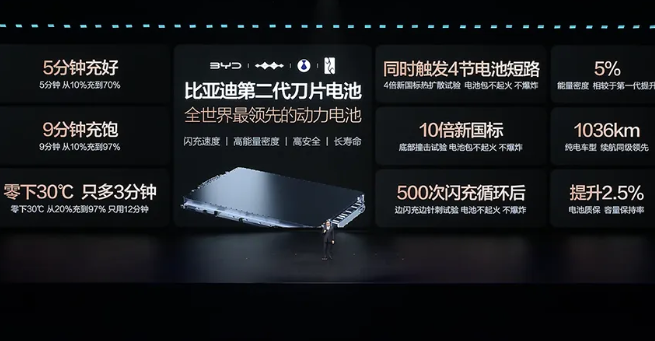
BYD unveiled its second-generation Blade Battery and an aggressive infrastructure expansion plan in Shenzhen on Wednesday, aiming to eliminate range anxiety and solidify its market dominance. The company contends that the new technology, released amidst a cooling domestic market, marks a definitive shift where electric vehicles (EVs) can match the refueling convenience of internal combustion engines.
Wang Chuanfu, Chairman and President of BYD, announced that the second-generation Blade Battery supports "flash charging," allowing a vehicle to charge from 10% to 97% in just nine minutes. The system addresses critical performance issues in extreme weather; even at temperatures as low as minus 30 degrees Celsius, the battery can charge from 20% to 97% in 12 minutes. Wang declared that this breakthrough would permanently end the limitation of EVs in cold northern regions.
To support the new technology, BYD committed to constructing 20,000 flash charging stations across China by the end of 2026. Simultaneous with the tech launch, the automaker released 11 new vehicle models across its Dynasty, Ocean, Yangwang, Denza, and Fang Cheng Bao brands, all equipped with the new battery system, signaling an immediate commercial deployment rather than a futuristic concept.
The strategic pivot comes after domestic EV growth rates decelerated in 2025, with many consumers sticking to gasoline vehicles due to charging inefficiencies. By offering a lifetime warranty on battery cells and opening its high-speed charging network to other brands, BYD is moving to dismantle the remaining barriers to mass EV adoption and capitalize on the consolidation of the automotive sector.
Second-Generation Blade Battery Capabilities
The core of BYD’s announcement centers on the performance metrics of its upgrade to the Blade Battery. While maintaining the same form factor, the second-generation unit increases energy density by 5% and significantly reduces charging times. According to official data, a charge from 10% to 70% takes five minutes, while reaching 97% takes nine minutes. Wang noted that the remaining 3% capacity is reserved for regenerative braking.
Safety remains a focal point. The company demonstrated the battery's stability through rigorous testing, including a needle puncture test conducted while the battery was being flash-charged, resulting in no smoke or fire. Furthermore, the battery passed a heat runaway test involving four cells—exceeding the national standard of one cell—and survived an underbody impact test conducted at energy levels 10 times higher than regulatory requirements.
Infrastructure Expansion: 'Flash Charge China'
Acknowledging that charging infrastructure lags behind vehicle ownership, BYD launched the "Flash Charge China" strategy. Wang highlighted that while a single gas pump can serve 50 cars daily, a standard charging pile typically serves only five. To bridge this gap, BYD introduced a megawatt-level charging pile with a peak power of 1500kW.
To mitigate stress on the electrical grid, the system utilizes a storage-charging integration method. The infrastructure roadmap for 2026 includes:
Total Volume: Construction of 20,000 flash charging stations by year-end.
City Coverage: 18,000 stations will be "stations within stations," upgrading existing facilities. The target density is one station every 3 kilometers in top-tier cities and every 5 to 6 kilometers in lower-tier cities.
Highway Network: Deployment of 2,000 highway flash charging stations, with 1,000 expected to be operational by the May Day holiday.
Global Layout: International construction of flash charging stations is scheduled to begin in late 2026.
The network will feature a proprietary app for seamless payment and will be open to the general public, not just BYD owners.
Immediate Commercial Rollout Across Brands
Unlike typical industry tech days that preview future concepts, BYD immediately launched 11 models featuring the new technology. The rollout spans the company's entire pricing planning, from mass-market SUVs to luxury performance sedans.
Denza: The new Denza Z9GT features a pure electric range of 1,036 kilometers and 0-100 km/h acceleration in 2.7 seconds. Prices range between RMB 269,800 (US$37,450) and RMB 369,800.
Dynasty and Ocean Series: The flagship D-class SUV "Tang" offers a 950-kilometer range, while the Song Ultra EV includes Lidar sensors and a 710-kilometer range with pre-sale prices starting at RMB 155,000 (US$21,500). The Ocean network introduced the Sea Lion 06 EV and Seal 07 EV, both offering ranges exceeding 700 kilometers.
High-End Performance: Steps into the ultra-luxury segment include the Yangwang U7 and U8 2026 models. The U8L "Ding Shi" edition is priced at RMB 1.3 million (US$180,500).
Current buyers of these second-generation battery models will receive one year of free flash charging rights, as BYD attempts to accelerate the replacement of internal combustion engine vehicles in the market's "second half."