
ByteDance Launches Seedream 5.0 Image Model with Search Capabilities
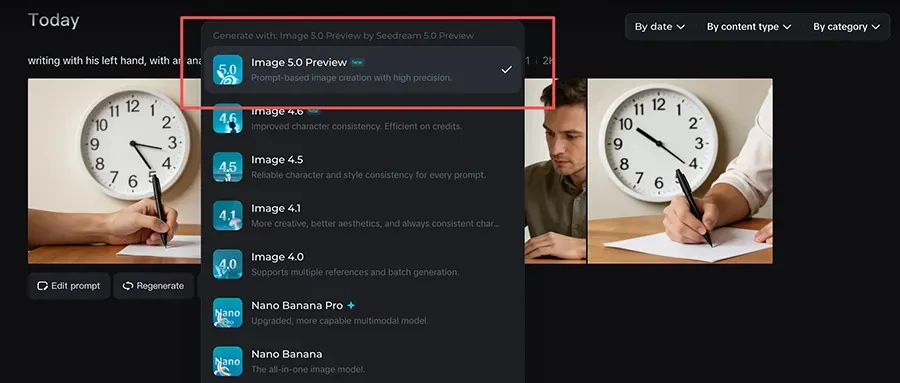
ByteDance has released Seedream 5.0, its latest image generation model, across multiple platforms including CapCut, Jianying, and Skylark AI, positioning it as a competitor to Nano Banana Pro with enhanced search integration and improved prompt understanding. The model, which went live on February 10, 2026, offers limited free access with 20 complimentary generations for users outside the United States.
The new version supports 2K native output and 4K AI-enhanced resolution, marking the first time the Seedream series incorporates retrieval-based image generation. According to CapCut's announcement, the model delivers improved accuracy in interpreting prompts and enables precise image adjustments, though early user testing suggests incremental rather than transformative improvements over its predecessor, Seedream 4.5, which launched in December 2025.
The model is currently in beta testing on ByteDance's Jimeng AI platform, while full deployment has been completed on Jianying, CapCut, and Skylark AI. ByteDance positions Seedream 5.0 as a more cost-effective alternative to Nano Banana Pro, though social media feedback indicates mixed reception regarding its competitive positioning.
Market observers note the release comes as ByteDance continues aggressive expansion in generative AI, following the recent launch of Seedance 2.0. The company's strategy appears focused on practical utility enhancements rather than aesthetic breakthroughs, targeting professional content creators who require reliable, task-oriented image generation.
Enhanced Intelligence and Search Integration
Seedream 5.0 introduces three core capability upgrades centered on practical applications. The model's enhanced prompt comprehension allows it to process abstract concepts and complex instructions with improved accuracy. CapCut's official documentation highlights strengthened multi-step logical reasoning, spatial understanding, and domain-specific knowledge.
The retrieval-based generation feature represents a significant architectural shift, enabling the model to incorporate real-time information from web searches. However, testing reveals inconsistent performance in this area. When prompted to generate posters featuring robots officially announced for the 2026 Spring Festival Gala, the model produced generic robot imagery rather than specific models confirmed for the event, indicating limitations in its information retrieval accuracy.
The model demonstrates competence with abstract descriptive prompts. Test generations using phrases like "serene technological atmosphere with sunset glow" successfully integrated multiple conceptual elements into cohesive visual outputs. Text rendering quality has improved, with fewer instances of garbled characters in complex typographic compositions.
Performance Benchmarks and Competitive Positioning
Comparative testing against Nano Banana Pro and Seedream 4.5 reveals nuanced performance differences. In a challenge to generate an infographic explaining beer production at Trappist monasteries, Seedream 5.0 produced the most detailed step-by-step instructions with comprehensive text annotations. However, users on social platform X noted the output lacked the artistic sophistication of Nano Banana Pro's rendering.
The model handles reference-based generation with reasonable fidelity. When provided an image from "The Shining" and instructed to create a Lunar New Year greeting scene, Seedream 5.0 maintained facial consistency while accurately incorporating specified elements including lanterns and couplets.
Complex spatial reasoning remains challenging across competing models. A test requiring "a person writing with their left hand, with an analog clock showing 5:25 in the background" produced failures from both Seedream 5.0 and Nano Banana Pro, with neither correctly rendering both the hand orientation and precise time display. Seedream 5.0 generated more diverse stylistic variations in a single batch, spanning modern, traditional Chinese, and cartoon aesthetics.
User feedback on X highlights that intelligence improvements take priority over aesthetic refinement in this release. One commenter characterized the upgrade as merely "Seedream 4.5 with added web search," suggesting the 0.5 version increment overstates the advancement. Others acknowledged improved Chinese language processing but maintained Nano Banana Pro retains overall superiority.
Enhanced Editing and Style Control
The image-to-image functionality has been upgraded with refined stylization effects, delivering clearer details, sophisticated textures, and balanced lighting. New editing tools allow users to employ brush controls for precise element selection and adjustment within generated images.
Testing with detailed cinematic prompts demonstrates the model's technical capabilities. A request for "close-up cinematic portrait of a young woman with freckles and dark curly hair, surrounded by vibrant wildflowers and vines, wearing a flower crown, shot during golden hour with warm backlighting creating a halo effect on hair and skin, shallow depth of field with soft-focus foreground flowers, photorealistic" produced outputs with accurate edge lighting, skin luminosity, and foreground bokeh effects.
The model interprets contextual requirements effectively. When prompted with "latest Oscar winner red carpet style," it generated complete scenes including red carpets, branded backdrops, and photographers, with Oscar statuettes visible on background panels.
Comparative analysis with Seedream 4.5 shows improved layout and structural design. Recipe card generation for tomato and egg stir-fry demonstrated more polished composition and visual hierarchy in version 5.0, though both versions successfully incorporated required instructional elements.
Market Implications and Development Trajectory
The release reflects broader industry trends toward utility-focused AI model development rather than purely aesthetic advancement. ByteDance's emphasis on retrieval enhancement, texture detail, precision adjustment, and 4K upscaling addresses practical content creation workflows, though incremental improvements may not drive significant user migration from established alternatives.
User perception of minor version updates appears to be weakening, particularly as technical bottlenecks persist in abstract semantic interpretation, text rendering consistency, and complex logical composition. The decision to offer 20 free generations suggests ByteDance is prioritizing user acquisition and feedback collection during the beta phase.
The competitive landscape for image generation models continues to intensify, with ByteDance positioning Seedream 5.0 as a value alternative to premium offerings. The model's availability across ByteDance's content creation ecosystem—spanning professional editing tools and consumer applications—provides distribution advantages that may compensate for technical parity rather than superiority versus market leaders.
Industry observers note that practical capability improvements in controllable generation and editing precision represent the current optimization path for leading image models, as pure generative quality reaches diminishing returns. ByteDance's development strategy appears aligned with this trajectory, though market acceptance will depend on whether functional enhancements justify platform switching costs for professional users.