
China's Space Solar Race Heats Up as Trillion-Dollar Market Takes Shape
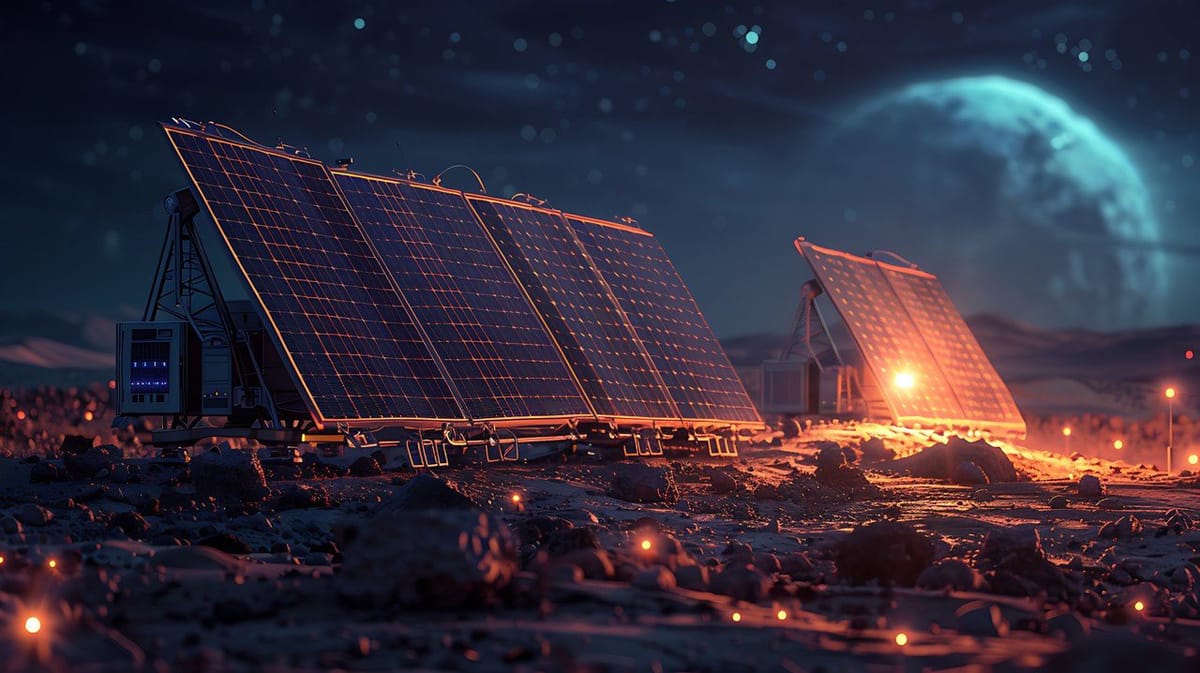
China's space solar photovoltaic industry is accelerating toward commercialization as domestic satellite constellation projects expand and companies vie for position in what analysts predict could become a trillion-dollar market. The sector gained fresh momentum recently following reports that Elon Musk's team visited Chinese solar manufacturers, sending shares of companies like GCL System Integration Technology surging with four consecutive daily limit-ups this year.
The convergence of commercial space expansion and artificial intelligence's voracious power demands is pushing space solar technology from concept to reality. Global satellite deployment is entering a critical phase, with near-Earth orbit capable of accommodating 60,000 to 100,000 satellites. SpaceX alone has received approval for 42,000 satellites under its Starlink program, targeting completion by 2030, while recently filing applications for up to 1 million satellites to support AI model applications in orbit.
China is simultaneously advancing three mega-constellation projects totaling over 40,000 satellites: the GW constellation with 13,000 satellites, the "Qianfan" constellation with 15,000, and the "Honghu-3" constellation with 10,000. These initiatives received an additional 203,000 satellite applications in December 2025, signaling an accelerated deployment timeline.
The market opportunity extends beyond satellite power systems. According to CITIC Securities estimates, China's low-orbit satellite solar market could exceed US$3 billion by 2030. If 100-gigawatt space data center deployment proceeds as planned, the global market could reach US$500 billion to US$1 trillion.
Commercial Space Drives Power Demand
The explosive growth in commercial spaceflight serves as the primary catalyst for space solar development. Under International Telecommunication Union "first-come, first-served" rules, competition for low-orbit satellite positions has intensified globally, with multiple nations pursuing massive constellation programs pushing satellite counts into the tens of thousands.
As of January 22, 2026, the world had 14,400 active satellites, including 13,500 in low-Earth orbit, according to Kaiyuan Securities Research. SpaceX's Starlink dominates with 9,542 satellites representing 70% of the total. The declining cost of satellite launches is also making space-based AI computing centers feasible, further expanding market potential. Musk has proposed deploying 100-500 gigawatt solar-powered AI satellites using Starship rockets, while Beijing's Space Data Center plans gigawatt-level systems in 700-800 kilometer dawn-dusk orbits.
Space solar offers distinct advantages over terrestrial systems, eliminating limitations from day-night cycles and weather variations. Energy density increases seven to ten times compared to ground-based installations, enabling 24-hour uninterrupted power generation while leveraging the vacuum of space for near-zero-cost cooling.
Goldman Sachs projects over 70,000 low-orbit satellites will launch within five years. Assuming 35 kilowatts average power per satellite and solar array pricing of 1,200 yuan (US$165) per watt, the low-orbit satellite solar market alone approaches 200 billion yuan (US$27.5 billion).
Technology Pathways Diverge from Ground Systems
Space solar technology faces fundamentally different challenges than terrestrial photovoltaics due to high-energy cosmic radiation, extreme temperature cycling, high vacuum, and microgravity environments. These conditions demand exceptional conversion efficiency, longevity, and specialized material structures, driving early divergence from ground-based technology paths.
Historically, space solar arrays evolved from silicon cells to thin-film gallium arsenide cells. While gallium arsenide offers high efficiency, reliability, and decades of proven radiation resistance, production costs exceed 480 yuan ($66) per watt, limiting mass production capability. The technology relies on scarce germanium substrates and MOCVD epitaxial processes unsuitable for supporting mega-constellation construction.
Cost considerations are steering future development toward P-type HJT (heterojunction) cells and crystalline silicon-perovskite tandem structures—the primary technologies Musk's team reportedly examined during Chinese facility visits. P-type silicon cells demonstrate significantly superior radiation resistance compared to N-type variants, support lightweight thin-wafer production, and feature low temperature coefficients with minimal degradation and reduced silver consumption. With costs three to four times lower than gallium arsenide and mature terrestrial production infrastructure, P-type HJT cells represent the most suitable current crystalline silicon technology for space applications.
Looking further ahead, crystalline silicon-perovskite tandem cells address the "efficiency-cost-radiation resistance" trilemma through higher performance and lower costs, positioning them as the core next-generation photovoltaic technology. Guosheng Securities Research indicates perovskite tandem cells achieve approximately 35% maximum laboratory efficiency with estimated costs below 7 yuan ($0.96) per watt, substantially undercutting gallium arsenide.
Equipment Makers and Cell Manufacturers Position for Growth
Multiple Chinese companies are accelerating space solar investments, including JinkoSolar, Trina Solar, Drinda New Energy Technology, Risen Energy, and Changelight.
JinkoSolar, a leading module manufacturer, has articulated a "Solar All Universe" long-term vision encompassing low-orbit satellites, orbital solar power stations, and post-2035 gigawatt-scale space data centers. The company's perovskite-silicon tandem cells reached 33.5% laboratory efficiency, with space environment simulation tests showing initial degradation rates controlled within 8%. Through collaboration with Jingtai Holdings on AI-enhanced perovskite technology, JinkoSolar plans to complete the industry's first thousand-square-meter AI tandem solar demonstration line, targeting commercial production between 2026 and 2028.
Trina Solar pursues parallel development across P-type HJT, perovskite tandem, and III-V gallium arsenide multi-junction technologies. In early 2026, the company developed the industry's first large-area P-type HJT/perovskite tandem cell based on 210mm half-cut cells, achieving 31.5% efficiency. Trina has also built formidable patent barriers in perovskite technology, with application volumes surpassing Japanese and British competitors to rank first globally.
Risen Energy, as a cell manufacturer, maintains batch delivery capability for approximately 50-micron ultra-thin P-type HJT cells. The company has completed small-volume deliveries totaling tens of thousands of units to European and American customers, while perovskite tandem development remains in laboratory research and pilot stages.
Equipment Leaders and Cell Producers Eye Market Share
Within the value chain, photovoltaic equipment manufacturers are expected to benefit first from industry capacity expansion, while solar array producers with technical reserves and customer relationships will capture commanding positions.
Equipment suppliers face high technical barriers and lengthy customer certification cycles, giving leading enterprises pronounced competitive moats. Maxwell Technologies, the dominant HJT cell production line equipment provider, covers both HJT and perovskite tracks with over 45% market share in HJT equipment. Through proprietary development, the company has mastered PECVD, PVD equipment, and screen printing core processes, achieving comprehensive capabilities from critical standalone machines to complete production lines. Its customer base encompasses major domestic cell manufacturers.
Unlike Maxwell's HJT and perovskite focus, S.C New Energy Technology offers broader coverage across PERC, TOPCon, and HJT technology routes, though TOPCon equipment generates primary revenue. The company holds approximately 35% domestic market share.
In the cell array segment, Changelight Optoelectronics and Shanghai Geoharbour Construction Group have achieved breakthroughs in both technology reserves and customer validation. Changelight leverages LED epitaxial wafer and chip operations as its foundation business while positioning gallium arsenide solar cells as a "second growth curve." Over a decade of gallium arsenide epitaxial process accumulation has built substantial technical barriers, capturing over 60% domestic market share with deep integration into national aerospace projects including the Qianfan constellation and Starnet.
Shanghai Geoharbour Construction Group, an infrastructure construction leader, entered commercial space through subsidiary Fuxi Xinon Space. The company assembled talent from aerospace institutes, Chinese Academy of Sciences facilities, and key universities, establishing perovskite as its core breakthrough while expanding into gallium arsenide and HJT technology reserves. Critically, Shanghai Geoharbour Construction Group holds cooperation qualifications with 12 leading satellite clients including Chang Guang Satellite, Spacety, Galactic Energy, and LandSpace, with five satellites carrying its perovskite cell modules currently undergoing on-orbit validation. The company has supported 19 successful satellite launches with 52 power systems, solar panels, and structural mechanisms achieving stable orbital operation.
Financial performance among equipment and cell manufacturers has diverged during the solar industry's recent downturn. S.C New Energy maintained mid-to-high growth rates with the largest scale, benefiting from leading TOPCon equipment market share and multi-technology route positioning. Maxwell's net profit entered negative growth after 2023, reflecting pronounced industry impact. Changelight, after posting losses in 2022, has gradually recovered, aided by LED industry demand recovery and rapid commercial space growth that should significantly increase revenue contribution as deployment accelerates.
As the trillion-dollar space solar market takes shape with increasingly clear P-type HJT and perovskite tandem technology pathways, equipment supplier Maxwell appears positioned for stronger earnings momentum, while S.C New Energy should maintain steady growth constrained by its larger base. Among cell producers, Changelight currently offers the most certain near-term volume growth, though Shanghai Geoharbour Construction Group's research capabilities and customer relationships position it to capture early benefits from the industry wave.