
Cambricon Crosses RMB 1 Trillion Threshold, Cementing China's Domestic AI Chip Crown
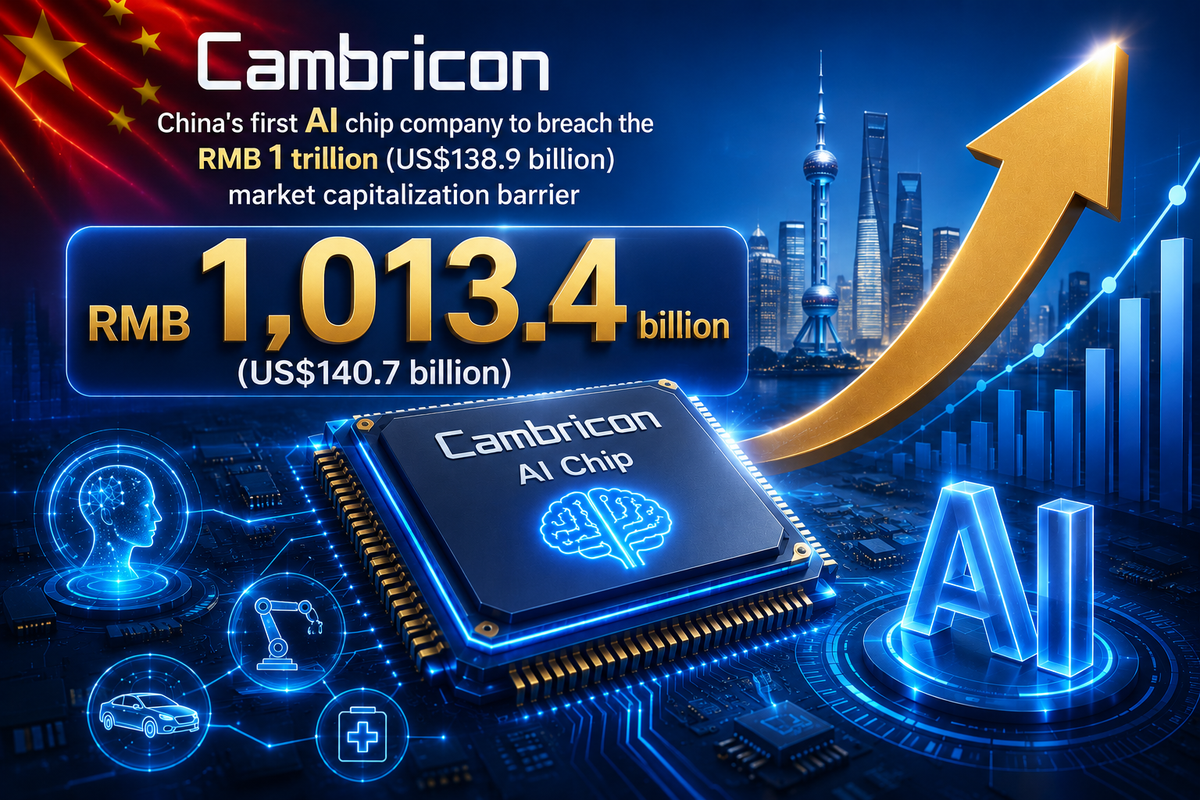
Cambricon became China's first AI chip company to breach the RMB 1 trillion (US$138.9 billion) market capitalization barrier on June 30, 2026, a milestone that crystallizes the convergence of aggressive state policy, accelerating import substitution, and a fundamental earnings inflection that has transformed the stock from a speculative bet into a benchmark holding.
Shares of the Shanghai-listed chipmaker surged as much as 8.84% in morning trading, lifting its market cap to RMB 1,013.4 billion (US$140.7 billion) by midday and propelling it into the top ten of all A-share listings by capitalization. The catalyst was immediate: China's State Council convened a dedicated session on June 29 to accelerate the buildout of national-scale intelligent computing clusters and expand "AI+" penetration into manufacturing, healthcare, and automotive sectors — a directive that positions Cambricon as the primary domestic beneficiary of state-mandated procurement.
The stock has now gained more than 80% since December 31, 2025, outpacing virtually every major semiconductor peer on the STAR Market, of which it is now the first constituent to achieve trillion-yuan status on a pure total-market-cap basis. For context, Semiconductor Manufacturing International Corporation (SMIC), which also trades in Hong Kong, carries a higher headline STAR Market valuation of RMB 1,369.7 billion (US$190.2 billion), but its dual A+H listing structure produces a divergence between its STAR Market float and consolidated total market cap.
Earnings Velocity Reframes the Valuation Debate
The trillion-yuan price tag demands scrutiny. Cambricon's trailing twelve-month price-to-earnings ratio stands at 373x, with a forward dynamic PE of 250.06x — elevated by any conventional measure, yet not the most extreme in its peer group. Haiguang Information Technology trades at a dynamic PE of 316.42x; SMIC at 251.56x. The sector-wide premium reflects a market that is pricing future earnings power rather than current profitability.
That forward bet is being validated at an unusual pace. In Q1 2026, Cambricon posted revenue of RMB 2.825 billion (US$392.4 million), representing a 159.56% year-on-year increase. Critically, operating cash flow turned positive for the first time on a quarterly basis — signaling that growth is no longer funded purely through balance-sheet expansion.
To put the trajectory into perspective: in a single quarter, Cambricon generated 43% of its full-year 2025 revenue and 49% of its full-year 2025 net profit. The company achieved its first annual profit in 2025, reporting full-year revenue of RMB 6.5 billion (US$902.8 million) and net profit of RMB 2.06 billion (US$286.1 million).
Capital Mobilization Signals Capacity Expansion Push
Ahead of the market cap milestone, Cambricon's board on May 22 approved a resolution to seek up to RMB 12 billion (US$1.67 billion) in comprehensive credit facilities from banking institutions — instruments spanning working capital loans, banker's acceptances, and performance guarantees. The scale of the credit line, equivalent to roughly 18% of its current annualized revenue run-rate, indicates that management is moving aggressively to pre-position inventory, expand production capacity, and secure supply chain commitments ahead of anticipated order surges.
This financial posture is consistent with an industry environment where lead times for advanced packaging and wafer allocation are tightening. Locking in credit facilities now provides Cambricon with the operational flexibility to fulfill large-scale contracts from cloud infrastructure operators and state-owned enterprise clients without being constrained by working capital cycles.
Market Share Reality Checks the Narrative
Enthusiasm must be tempered by ground-level competitive data. According to IDC figures cited by industry media, China's AI accelerator card shipments totaled approximately 4 million units in 2025. Nvidia retained first place with a 55% share despite ongoing U.S. export control restrictions. Cambricon and Kunlunxin tied for fifth place, each shipping approximately 116,000 units for a market share of roughly 2.9%.
The gap between Cambricon's market capitalization and its current unit-volume position is the central tension investors must resolve. The bull case rests on a structural shift already visible in aggregate data: IDC estimates that domestically produced AI accelerator cards captured 41% of China's total market in 2025, up sharply from prior years, as U.S. export controls progressively restrict Nvidia's ability to serve Chinese hyperscalers with its highest-performance products. Within that domestic cohort, Cambricon is reported to hold more than 35% share of compute deployed for large language model training and inference workloads — a position reinforced by its deep integration into state-backed intelligent computing infrastructure projects.
Policy Tailwinds Structurally Elevate the Ceiling
The June 29 State Council directive is not an isolated event but the latest in a series of top-down mandates that have systematically expanded the addressable market for domestic AI silicon. The explicit call to accelerate "super-large-scale intelligent computing cluster" construction creates multi-year procurement pipelines that favor vendors with proven reliability and domestic supply-chain independence — criteria that Cambricon, as the only publicly listed pure-play general-purpose AI chip designer in China, is uniquely positioned to satisfy.
Separately, market participants are pricing in the anticipated implementation of a semiconductor industry-wide pricing adjustment effective July 1, 2026, which is expected to improve margin structures across the domestic chip supply chain. This expectation contributed to broad sector inflows on the final trading day of the first half, with AI chip names leading gains.
Competitive Landscape Faces a Recalibration
Cambricon's trillion-yuan valuation will inevitably recalibrate how investors assess the broader domestic AI chip cohort. Peers including Haiguang Information Technology and Moore Threads will face heightened benchmarking pressure. For international investors with access to Hong Kong-listed Chinese tech equities, the milestone reinforces the investment thesis that China's semiconductor self-sufficiency drive is generating durable, earnings-backed winners — not merely policy-inflated stories.
The key variable to monitor in the second half of 2026 is whether Cambricon can sustain its Q1 revenue growth rate as base effects steepen and competition among domestic vendors intensifies. A forward revenue guidance update, expected alongside Q2 results, will serve as the next definitive test of whether the trillion-yuan valuation reflects rational expectations or anticipates a market share trajectory that has yet to materialize in shipment data.
Related Coverage: