
CATL Targets China’s Heavy-Truck Battery-Swap Market
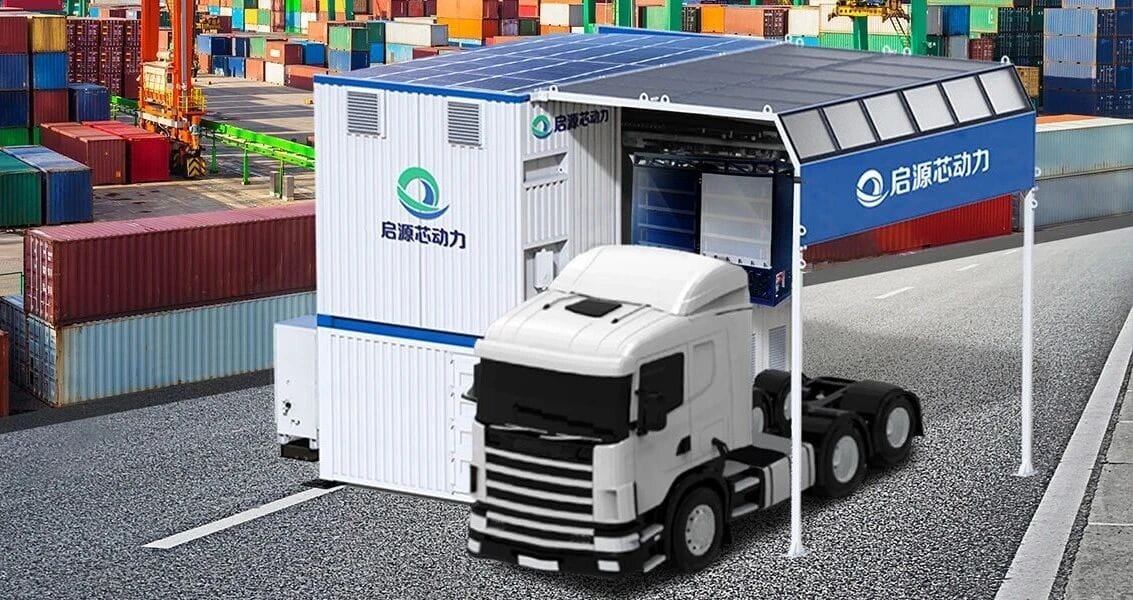
CATL's RMB 2.556 billion acquisition of Qiyuan Xindong Power signals a decisive consolidation in a sector where EV penetration has already hit 36.6%, putting the industry on course to surpass 50% within 24 months.
The Chinese heavy-truck battery-swap sector is undergoing a structural power shift: state-owned enterprises are exiting their pioneering roles, and industrial giants backed by private capital are moving in to claim the network infrastructure that will define the next decade of freight logistics. The catalyst is a pair of financing events separated by scale but united in implication — Contemporary Amperex Technology paying RMB 2.556 billion (approximately US$355 million) to acquire a 24.87% stake in Qiyuan Xindong Power, and a startup named Qiantu Holdings quietly raising a Pre-A round targeting just RMB 10 million (US$1.39 million) at a post-money valuation of RMB 200 million (US$27.8 million).
The divergence in deal size is not noise — it is signal. It maps the precise fault lines of a market that has moved from subsidized experiment to commercial battleground. With new-energy heavy-truck penetration reaching 36.6% in the first eight months of 2026, and historical passenger-vehicle data showing that once a category crosses 30%, the jump to 50% typically takes fewer than 24 months, every credible operator is treating the next 18 months as the decisive window.
State Capital Retreats, Leaving a RMB 10.275 Billion Asset Up for Grabs
The transaction's backstory reframes the conventional narrative of "state-sector exit equals loss of confidence." China Power, the State Power Investment Corporation (SPIC) subsidiary that founded Qiyuan Xindong Power in 2020, listed its 24.87% stake on the Shanghai United Assets and Equity Exchange in July 2026. CATL acquired it in August at a 119% premium to book value, implying a 100% equity valuation of RMB 10.275 billion (US$1.427 billion) for a company that recorded revenue of RMB 9.525 billion (US$1.323 billion) and net profit of RMB 356 million (US$49.4 million) for full-year 2025.
The divestiture reflects a policy reality more than a commercial one. Central and state-owned enterprises in China have faced intensifying regulatory pressure since 2023 to "focus on core mandates". For a power-generation conglomerate, operating a 1,800-station battery-swap infrastructure network — with capital locked in multi-year payback cycles — sits awkwardly on a balance sheet already scrutinized by Hong Kong equity markets, where SOE valuations have chronically lagged. "The construction phase belongs to state capital; the operational phase should be handed to the market," one person familiar with the transaction told this reporter. Monetizing at a 119% premium, with sector sentiment near peak, constitutes rational capital recycling.
What China Power leaves behind is formidable: Qiyuan Xindong Power holds more than 70% market share in battery-swap heavy trucks as of end-2025, operates or manages over 1,800 charging-and-swapping stations nationwide, and has achieved compatibility with 731 vehicle models from 105 original equipment manufacturers. The platform is deliberately open-architecture — described by one industry observer as "the Android of heavy-truck battery swapping" — meaning no single OEM or battery supplier is locked in.
CATL Consolidates Two Technical Standards, Betting on Full-Scenario Dominance
CATL's strategic calculus is straightforward. The company had already taken a strategic stake in Qiyuan Xindong Power in 2022 (7.49%, later diluted to 5.94%). In 2025, it launched its own heavy-truck swap solution, Qiji Swap, featuring an undercarriage-mounted 513 kWh battery pack promising sub-five-minute replenishment. The plan calls for more than 900 heavy-truck swap stations by end-2026, scaling to an "Eight Horizontal, Ten Vertical" national highway network covering 80% of long-haul freight capacity by 2030, spanning 150,000 kilometers.
By acquiring Qiyuan Xindong Power, CATL simultaneously controls the dominant rear-lift swap standard — optimized for mining, steel mills, and heavy-load closed sites — and its own undercarriage standard, engineered for high-speed trunk logistics. The combined portfolio eliminates the scenario risk of betting on a single technical path. "Undercarriage swap fits highway standard-load operations; rear-lift fits mine-site overloading. CATL is now playing both sides," said one analyst tracking the sector.
The financial logic runs deeper than station count. A heavy-duty truck consumes several hundred kilowatt-hours per day — roughly ten times a passenger vehicle — against a national fleet base exceeding 10 million units. CATL's "battery-as-a-service" (BaaS) model converts what would otherwise be a one-time hardware sale into a recurring revenue stream tied to every operating kilometer. Controlling the swap network means CATL controls the battery lifecycle data, the asset management fee, and — critically — the replacement cycle. Chairman Robin Zeng articulated the macro thesis at CATL's new-generation heavy-truck swap ecosystem launch in Datong, Shanxi in May 2025: "New-energy penetration in heavy trucks will exceed 50% within three years."
Guoxuan-Backed Dianlaila Challenges With an Asset-Light Counterpunch
The second major battery manufacturer with strategic exposure is Gotion High-Tech, which became the controlling shareholder of Dianlaila in 2023. The logic mirrors CATL's: a high-volume, high-frequency commercial application that ties battery procurement to network operations. Where Dianlaila diverges is on infrastructure philosophy.
Its co-founder Li Xin, a 16-year veteran of commercial EV charging and swapping who left state employment in 2010, describes his model as "battery food delivery". Rather than anchoring capital in fixed stations costing RMB 2 million or more per unit, Dianlaila deploys mobile battery packs on flatbed trucks along trunk routes, with a single swap point requiring as little as RMB 500,000 — one-quarter of a conventional station. The lesson was learned from failure: Li acknowledges sinking RMB 100 million into 12 fixed stations in Nanjing, with payback timelines that remain uncertain.
As of mid-2026, Dianlaila has deployed more than 2,000 battery packs in commercial operation, activated 12 medium-to-long-haul trunk corridors, and established 40 to 50 swap points. Li is building a blockchain-based battery asset interchange platform, conceptualizing batteries as "energy digital currency" that can circulate between operators under a mutual-trust protocol — a direct challenge to CATL's ambition to consolidate the asset layer.
Trunk-Route Economics Expose the Industry's Core Unsolved Problem
The economics of heavy-truck electrification, at the vehicle level, are increasingly compelling. A diesel truck purchased at approximately RMB 370,000 (US$51,400) burns roughly RMB 370,000 in fuel annually at 150,000 kilometers per year and 35 liters per 100 kilometers. A battery-swap electric truck, including battery leasing fees, reduces annual energy costs to approximately RMB 180,000 (US$25,000), yielding an estimated all-in operating cost saving of RMB 79,000 (US$10,970) per vehicle per year.
The infrastructure economics are harder. Qiyuan Xindong Power's expansion beyond its core closed-site base into trunk logistics — including a 604-kilometer intra-Shanxi coal transport network and a 1,000-kilometer Shanxi-to-Rizhao/Qingdao coal corridor with 14 combined charge-swap stations — demonstrates the capital intensity required. The company extended from Taiyuan Steel's plant yard, validating rear-lift swapping and BaaS under heavy-load and low-temperature conditions, then scaled outward. The coastal node includes 12 swap stations serving more than 300 container trucks across six ports including Rizhao and Qingdao.
Yet industry insiders acknowledge a persistent gap between headline metrics and genuine unit economics. "Many swap stations are running below 20% utilization," one operator said. "Profitability claims often fold the battery-leasing fee into the equation; the operational side is still loss-making." Closing that gap — not capital intensity per se, but consistent asset utilization — is the decisive variable in determining which networks survive.
Niche Players Probe the Margin Spaces CATL Cannot Efficiently Serve
While the network war plays out on highways, a cohort of specialized startups is targeting the long tail of heavy-truck applications with deliberately narrower but more capital-efficient propositions.
Qiantu Holdings, founded by Bao Xudong — a veteran of real estate marketing, automotive sales, and battery-swap operator Aulton New Energy— is building a side-mount multi-pack swap solution for unpaved surfaces and short-range heavy loads: mines, construction sites, and slag transport. Each battery pack carries only 54 kWh, roughly half the energy density of CATL's flagship heavy-truck offering.
The commercial case is counterintuitive but arithmetically sound. A lower-capacity battery pack reduces upfront vehicle acquisition cost by approximately RMB 120,000 (US$16,670), and the lighter total battery mass adds roughly 1.6 tons of usable cargo capacity per trip — translating to an estimated RMB 100,000 (US$13,900) in additional annual freight revenue per vehicle. Pilot data from a sand-and-gravel quarry in Quanzhou, Fujian, and a concrete-mixing project in Wuxi, Jiangsu, reportedly validate the model. Qiantu's Pre-A round, targeting RMB 10 million at a RMB 200 million post-money valuation, reflects early-stage institutional conviction in the sub-segment thesis.
Hongtú Zhihui Energy, led by Li Jiang, a sector pioneer in swap technology, operates from the opposite end of the payload spectrum: urban last-mile light trucks. The company claims to be among the largest urban swap logistics operators in China, running more than 300 vehicles under an outsourced fleet contract that covers two-thirds of a major Shanghai e-commerce platform's delivery capacity. Li is developing heavy-truck swap capabilities to transfer accumulated operational learning upmarket.
Penetration Data Points Toward a 2027 Tipping Point
Current data frames the urgency. Cumulative new-energy heavy-truck sales from January 2025 through May 2026 reached 337,000 units, pushing the sector penetration rate past 29.5%, according to figures from China's Ministry of Transport. In the first eight months of 2026 alone, 193,300 new-energy heavy trucks were sold out of a total 528,500 units — a penetration rate of 36.6%. Battery-swap models account for approximately one-quarter of the new-energy heavy-truck total.
The passenger-vehicle template is instructive: China's private-car EV penetration crossed 30% in late 2023 and surpassed 50% by mid-2025, a transition of roughly 18 months. If commercial vehicles follow a comparable adoption curve — adjusted for the higher capital stakes and infrastructure dependencies involved — the 50% threshold Zeng projected may arrive by mid-to-late 2027.
At that scale, the infrastructure gap becomes an acute bottleneck. Highway swap-station networks require coordination across competing operators, shared technical standards, and — as Dianlaila's blockchain initiative suggests — interoperable asset settlement. No single player, including CATL, has the capital or the regulatory mandate to unilaterally build the required coverage. The outcome is likely a coopetition structure: dominant networks on core corridors, federated standards in contested zones, and asset-light operators filling the white spaces.
Who survives will be determined not by technical pedigree or corporate lineage, but by the ability to close the utilization gap and generate genuine per-kilometer returns — without relying on battery-lease accounting to mask operational losses.
Related Coverage:
CATL’s Nvidia Moment: How China’s Battery Giant Is Trading Margins for Ecosystem Control