
China Moves to Control AI Model Exports — Here's What the Rules Actually Mean
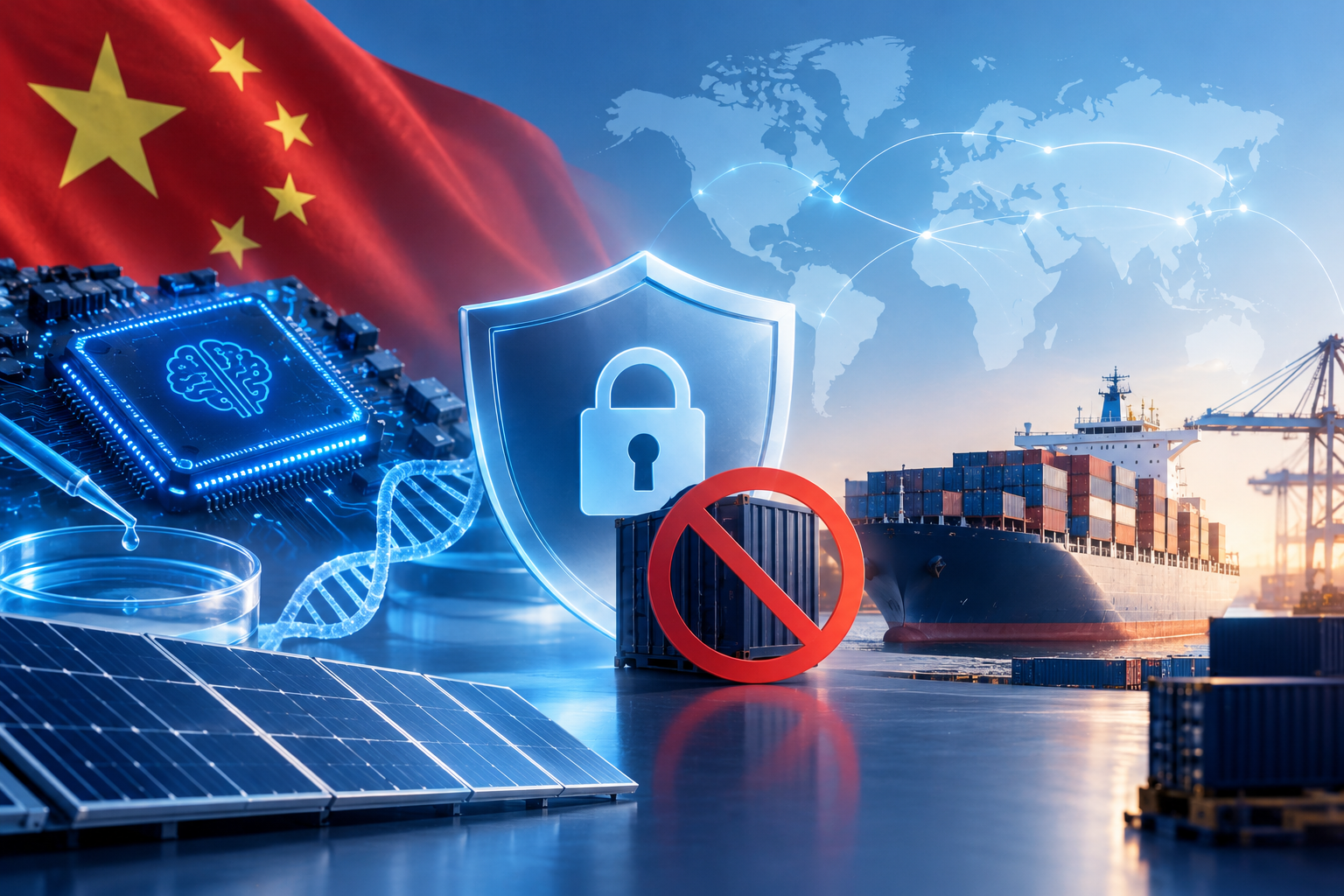
China is redrawing the boundary between selling AI capabilities and exporting AI technology — and the distinction is no longer academic.
On October 16, 2026, China's Ministry of Commerce and Ministry of Science and Technology published Announcement No. 48, proposing to add 40 technologies across artificial intelligence, solar photovoltaics, and biomedical sectors to the country's Catalogue of Technologies Prohibited and Restricted from Export. Of those 40 entries, 23 cover AI — the single largest category. A 30-day public comment window runs through November 15, 2026.
What makes this announcement operationally significant is a procedural detail that many companies are underestimating: mandatory pre-export registration took effect on the day of publication, not at the end of the comment period. Any company exporting technology that falls within the draft catalogue's scope must register the transaction now, even though the final rules have not been formalized.
What Is China's Technology Export Control Catalogue, and Why Does It Matter?
China's export control framework for technology rests on two foundational instruments: the Foreign Trade Law and the Regulations on Administration of Technology Import and Export. The catalogue translates those statutes into an actionable list of technologies that either cannot leave the country at all (prohibited) or require a government license before they do (restricted).
The catalogue is not static. It is periodically revised to reflect which technologies China considers strategically sensitive at a given moment. The 2026 revision is notable not because it introduces an entirely new legal architecture, but because it extends that architecture — for the first time in a comprehensive way — to the AI software stack, including model weights, training frameworks, inference optimization methods, and chip design specifications.
In short: if previous versions of the catalogue focused on hardware and physical manufacturing processes, this revision signals that China now treats frontier AI software as a national-security-grade export.
What Technologies Are Actually Being Controlled?
The 40 proposed entries are unevenly distributed. AI accounts for 23, photovoltaics for 12, and biomedical for 5. The catalogue employs a two-tier structure that distinguishes between absolute prohibitions and conditional restrictions.
Prohibited AI Technologies: A Narrow but Significant Set
The prohibited category — meaning no export license is available — covers three principal types:
First, large AI models trained on data classified as "core data" under China's Data Security Law. Core data is defined as information whose exposure could severely compromise national security, economic stability, or public welfare. In practice, datasets meeting this threshold are typically held exclusively by government agencies or state-authorized institutions.
Second, high-performance AI agents deployed exclusively or primarily in domains such as national critical infrastructure, defense systems, or core government operations.
Third, what the catalogue terms "information confrontation technology" — specifically, AI systems capable of autonomously generating and mutating malicious code for use against critical information infrastructure or defense systems. The catalogue devotes substantial definitional space to this category, effectively classifying AI-driven cyberweapon development tools at the same regulatory tier as conventional weapons technology.
Restricted AI Technologies: Broader Coverage, License Required
The restricted category — export permitted subject to licensing — is wider and commercially more consequential:
- Large AI models trained on "important data", a lower-sensitivity tier under the Data Security Law than core data
- High-performance AI agents not captured by the prohibited category
- AI chip and advanced memory chip design technologies, with specific technical thresholds (14nm or below process nodes; 3D NAND with storage density ≥8 Gb/mm²; memory using sub-18nm processes)
- Large-scale AI compute cluster technologies, specifically clusters comprising 10,000 or more AI accelerator cards
- AI-assisted vulnerability discovery tools — classified as restricted rather than prohibited, preserving space for legitimate defensive cybersecurity applications
The chip design specifications merit particular attention. The restricted list covers not just finished chip designs but the underlying architectural knowledge, proprietary instruction sets, IP cores, and supporting software stacks. This brings design-stage intellectual property within the control perimeter, not only manufactured products.
How Does China Define "Exporting" AI Technology?
This is the question with the most practical consequence for companies operating in the space, and the answer is broader than intuition suggests.
Article 2 of the Regulations on Administration of Technology Import and Export defines a technology export as any transfer of technology from within China to outside China through trade, investment, or economic-technical cooperation. The definition explicitly includes patent transfers, trade secret transfers, technical services, and — critically — "other means," a catch-all that regulators have interpreted expansively.
Article 13 of the same regulations establishes that sending technical personnel across borders to provide guidance is legally equivalent to exporting the technology itself. Legal analysis published in connection with the announcement, including commentary from JunHe Law Offices, concludes that the operative test is whether the substantive capability or rights associated with a technology have moved from a domestic entity to a foreign one — not whether any code, weight file, or hardware has physically crossed a border.
Announcement No. 48 enumerates three specific registration triggers: 1. Transfer of technology ownership to a foreign party 2. Licensing of domestically held technology for use by a foreign party 3. Change of actual ownership or control of domestically held technology to a foreign entity
This last trigger is notable because it captures certain inbound investment and M&A transactions, not just outbound technology sales.
What Doesn't Trigger Export Controls? The Green-Light Categories
The announcement and accompanying MOFCOM guidance explicitly exclude several commercially important activity types from the definition of technology export:
API-based access: Providing AI model capabilities through API calls, web interfaces, app interactions, or SaaS delivery is not classified as a technology export, provided the model weights and core inference infrastructure remain on servers located within China. Foreign users receive outputs or functional access — not the underlying technology.
Open-source and published research: Technologies already in the public domain through open-source releases or academic publication fall outside the catalogue's scope. This exclusion is significant given the volume of Chinese AI research disseminated through open weight releases and peer-reviewed papers. The practical effect is that China's control line is drawn at proprietary, non-public technology — not at AI capabilities broadly defined.
Unilateral licensing without ownership transfer: Licensing arrangements that do not convey ownership rights benefit from facilitated treatment.
For restricted (not prohibited) technologies, the announcement provides for automatic approval — effectively immediate clearance — in cases involving open-source publication, overseas chip fabrication at third-party foundries, joint research and development, and participation in international standards bodies.
The Gray Zone: Four Deployment Patterns That Require Careful Analysis
Between the clearly permissible and the clearly controlled lies a set of commercial structures that carry real compliance ambiguity.
Overseas on-premises deployment: Delivering a model for a foreign client to run on their own local servers is structurally different from hosting the model in a China-based cloud and providing API access. Once a foreign customer operates a complete inference stack locally, regulators may characterize the transaction as a transfer of technical capability rather than a service delivery.
Fine-tuning-enabled APIs: Standard API access is outside the control perimeter. But if a foreign customer can upload proprietary data and continuously fine-tune a base model through the API interface, the arrangement begins to resemble cross-border technical services — a category that falls within the regulations — rather than simple model inference.
Embedded technical services: Engineering teams deployed overseas for system integration, long-term training support, or remote code repository access remain exposed to the regulations' "technical services" provision regardless of how the master contract characterizes the engagement. Private deployment contracts should explicitly incorporate usage-only terms, prohibitions on reverse engineering, and prohibitions on model distillation as standard risk-mitigation clauses.
Changes in beneficial ownership: Financing rounds or acquisitions that result in a foreign entity holding a controlling stake in a domestic AI company may trigger registration requirements even when the underlying technology remains physically located in China.
Who Holds a Structural Advantage Under the New Framework?
The compliance architecture creates differentiated outcomes across types of AI companies.
Large internet platforms — Alibaba, ByteDance, and Tencent — that already operate proprietary overseas data centers satisfy the self-operated infrastructure requirement directly. Their frontier models can be deployed internationally through infrastructure they own and control, keeping model weights on servers operated by the domestic entity. This structure likely qualifies for automatic approval under the restricted-category provisions.
Independent AI laboratories that rely on third-party cloud providers for overseas inference face a more complex compliance path. Their options narrow to one of two routes: open-source publication of model weights, which triggers the exemption; or investment in proprietary overseas infrastructure, which requires capital and time. Nomura Securities estimates that overseas markets account for 30% to 50% of revenue for China's independent AI laboratories — a figure large enough to make this compliance calculus material to business planning.
Lightweight models — those below the parameter and compute thresholds that define "frontier" under the draft catalogue — are largely unaffected. Models such as those in the sub-10 billion parameter class, which have driven significant overseas adoption on cost-performance grounds, fall below the proposed restricted thresholds. This preserves a competitive channel for Chinese AI in international markets even if the heaviest frontier models face licensing requirements.
How Does the Solar and Biomedical Scope Fit the Broader Pattern?
The photovoltaic entries — 12 in total — cover the full manufacturing chain from polysilicon production through wafer fabrication to advanced cell technologies. Prohibited categories include cold hydrogenation fluidized bed processes producing 250,000 metric tons or more per year of trichlorosilane, silicon wafer preparation technologies for wafers 70 microns or thinner, and perovskite-silicon tandem cell production technologies for cells achieving 30% efficiency or above at commercial scale.
The China Photovoltaic Industry Association reported that in the first half of 2026, China produced 53.8 million metric tons of polysilicon and 201.3 gigawatts of solar modules — both globally dominant figures. The export controls do not restrict finished product exports; modules, cells, and wafers remain freely tradeable. The controls target the process knowledge and equipment designs that would allow other countries to replicate China's manufacturing cost structure.
Biomedical controls focus on cell and gene therapy platform technologies and small nucleic acid drugs. China's National Medical Products Administration disclosed in September 2026 that outbound licensing deals for innovative drugs had exceeded USD 120 billion year-to-date, a 36% year-on-year increase. Prohibiting the export of proprietary cell and gene therapy process platforms while permitting contract manufacturing and research outsourcing preserves China's service revenue while restricting the transfer of foundational platform IP.
What Remains Uncertain — and Why That Matters
Several definitional questions will determine how broadly the final catalogue is applied in practice.
The boundaries between "core data" and "important data" under the Data Security Law are not uniformly established across sectors. The ranking methodology that would place a model "in the global top ten" on public evaluations has not been specified. The 0.1% threshold for important-data content below which a model may qualify for an exemption — provided the data has been de-identified — has not been operationalized with enforcement guidance.
These open questions leave regulators meaningful discretion. Given that overseas markets contribute a substantial share of revenue to China's frontier AI sector, and given that Chinese AI models are still narrowing the capability gap with global leaders, the consensus view among analysts is that enforcement is likely to be calibrated rather than maximalist in the near term. The one-month comment period running concurrently with mandatory registration is itself a signal: the regulatory architecture is being built in parallel with the industry feedback process, suggesting the final rules will incorporate practical adjustments.
The comment period closes November 15, 2026. The final catalogue may differ from the draft in scope, thresholds, and the granularity of technical definitions. What is already in effect — and will remain in effect regardless of final catalogue language — is the pre-export registration requirement for any technology falling within the draft's perimeter.
The Structural Shift: From Selling Models to Selling Tokens
The longer-term commercial implication of the framework is directional rather than prohibitive. By permitting API-based access while restricting weight transfers and ownership changes, the controls create regulatory friction against the "sell the model" commercialization path and lower friction for the "sell the output" path.
This is not necessarily a deliberate industrial policy choice by regulators. But it is the natural commercial equilibrium that emerges from a regime in which model infrastructure must remain under domestic control. Chinese AI companies serving international markets will increasingly route that revenue through API and SaaS structures rather than through technology licensing or asset transfers. The business model shifts from IP transactions to service subscriptions — a transition that has implications for valuation, revenue recognition, and competitive positioning relative to non-Chinese AI providers that face no equivalent constraint.
Related Coverage:
ByteDance Escalates AI Overseas Push With Workplace Agent and Daily Active Users Surge
Kimi's Overseas Revenue Surpasses Domestic Sales as AI Startup Targets Global Productivity Market