
China Successfully Tests World's Largest Airborne Wind Power System
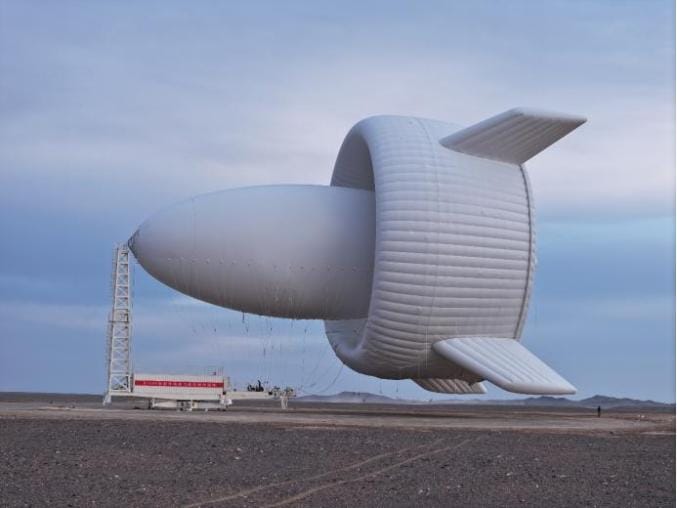
Beijing Linyi Yunchuan Energy Technology has successfully completed the maiden flight of what it claims is the world's largest commercial airborne wind power generation system, marking a significant milestone in China's renewable energy development.
The S1500 Suspension Airborne Wind Energy System (SAWES) completed a series of predetermined tests from September 19-21, 2025, at the Naomaohu base in Hami, Xinjiang. The trials included desert assembly operations, pressure testing, and day-night wind deployment procedures under strong wind conditions.
The aircraft-like system measures 60 meters in length, 40 meters in width, and 40 meters in height, resembling an airship with a designed power capacity of 1 megawatt. The device features a main airbag and ring-wing configuration forming a giant duct, equipped with 12 sets of 100-kilowatt generators. It harnesses stable high-altitude winds to drive turbines and transmits electricity to ground stations via tethering cables.
The system was assembled at Linyi Yunchuan's manufacturing base in Yueyang Economic Development Zone, Hunan Province. The company collaborated with Tsinghua University and the Chinese Academy of Sciences' Aerospace Information Research Institute to overcome technical challenges including airborne platform stability, lightweight motors, and kilometer-level high-voltage transmission.
According to the company, the airborne system offers significant advantages over traditional land-based wind turbines, requiring no heavy tower construction and featuring simplified foundation structures. This results in 40% material savings and 30% reduction in electricity generation costs, while enabling rapid deployment across various terrains including deserts, islands, and mining areas.
CEO Dun Tianrui stated at the test site that the S1500 successfully met all preset objectives under extreme desert wind conditions. The company plans to conduct multi-environment testing across various domestic locations, with mass production and first commercial deployments scheduled for 2026.
The successful trial positions China at the forefront of airborne wind energy technology, potentially offering a new solution for global energy transition as the world seeks innovative renewable power generation methods.