
China's 2026 Gaming Surge: When Every Title Costs Over $100 Million
China's gaming industry is entering a structural inflection point in 2026, with a record concentration of high-budget titles hitting the market simultaneously — a convergence that one industry executive bluntly described as a "big-title meat grinder," where no single game costs less than $100 million to develop. The cluster reflects not a sudden boom, but the compounded release of years of accumulated capital, technical capability, and regulatory normalization.
The implications extend well beyond any individual launch. For investors and publishers alike, this moment represents a fundamental stress test of China's maturing games market: whether domestic studios have built the industrial pipelines and creative depth to sustain global-tier production at scale, and whether the market can absorb simultaneous competition across virtually every major genre.
The stakes are amplified by the sheer breadth of the lineup. From open-world urban RPGs and tactical shooters to life-simulation titles and single-player console games targeting Western audiences, the 2026 slate spans categories that rarely converge in a single calendar year. The question is not whether blockbusters will launch — they will — but how many can survive in a market where differentiation is no longer optional.
A Structural Release, Not a Coincidence
The 2026 surge is best understood as a delayed wave, not a spontaneous one. Around 2020, during the industry's most optimistic cycle, Chinese studios initiated a dense round of new projects. Those that survived years of market turbulence, regulatory uncertainty, and internal attrition are now surfacing simultaneously.
The regulatory environment has also stabilized in ways that meaningfully de-risk the pipeline. China issued 1,771 game licenses in 2025 — 1,676 domestic and 95 imported — a roughly 25% increase over 2024. For studios that had projects stalled in regulatory limbo, the normalization of license approvals has converted latent development investment into confirmed launch schedules.
Underlying demand has kept pace. According to Gamma Data, China's domestic gaming user base reached 683 million in 2025, a year-on-year increase of 1.35% and a historical record. Growth in female players has driven new demand for life-simulation titles; rising PC and console adoption has expanded the addressable market for premium, cross-platform products; and the mainstreaming of niche genres — including mild horror and Lovecraftian aesthetics — has opened new competitive lanes that were previously too narrow to justify large-scale investment.
Open World: Genre Innovation as Competitive Moat
The open-world category remains the most crowded and most contested segment of the 2026 slate, but the competitive dynamic has shifted. Studios are no longer competing primarily on visual fidelity or map scale. The new battleground is gameplay density and thematic differentiation.
Arknights: Endfield by Hypergryph has already demonstrated the commercial viability of this approach. Within two weeks of launch, the title crossed RMB 1.2 billion yuan (approximately US$165 million) in cumulative revenue across all platforms — validating a design philosophy that fuses industrial construction, action RPG, and puzzle mechanics rather than defaulting to the conventional gacha-plus-open-world template.
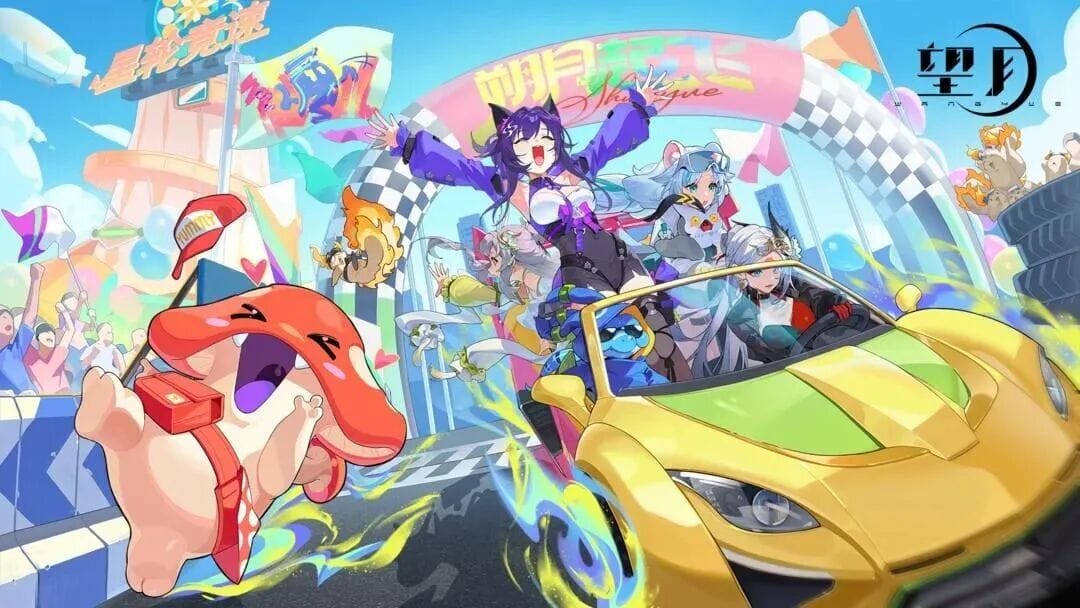
Three titles — Aether Gazer: Parallel, Wangyue, and Ananta — have been grouped by the industry as the "anime GTA trio," each building dense urban simulation systems into their open-world frameworks. Aether Gazer: Parallel, developed by the team behind Tower of Fantasy at Perfect World, is scheduled for April 23 launch across PC, console, and mobile — including Mac — having accumulated over 20 million pre-registrations following two test phases. The title emphasizes granular urban realism, with individual map zones corresponding to single city districts rendered with street-level detail.
Beyond urban settings, creature-capture mechanics are emerging as a secondary axis of open-world innovation. Luo Ke Wang Guo: World, backed by Tencent Holdings Limited's social infrastructure and an established IP, is targeting broad user acquisition ahead of its imminent public beta. Meanwhile, Yimo, Blue Archive: Journey, and NetEase Inc.-adjacent title Honkai: Nexus Anima are each pursuing differentiated takes on pet-collection mechanics.
Tencent's Honor of Kings: World is targeting a spring 2026 release, leveraging the IP recognition of one of China's most-played mobile games to pursue a distinct competitive positioning against the anime-oriented open-world field.
Shooters, MMOs, and Action: Segmentation as Strategy
In the shooter category, the defining trend is deliberate fragmentation. Rather than competing head-on, major titles are carving out defensible niches — a rational response to a segment where direct confrontation typically destroys value for all parties.
Ni Zhan: Future opened 2026 by topping the iOS China revenue chart following its Season 1 update, validating a PvE-focused design that announced four seasons of content at launch. Tencent's CrossFire:Rainbow and CrossFire:Rainbow — the latter having secured its license in mid-2025 — are both pursuing mild-horror and asymmetric PvEvP formats that deliberately avoid overlap with mainstream military shooters.
The arrival of international franchise localizations adds another competitive layer. Rainbow Six Siege is scheduled for a Chinese server launch this year, bringing a title that has repeatedly ranked in Steam China's top five sales charts and counts 7.26 million registered players on the domestic platform Xiaoheihe. Squad: Dawn Offensive, the Chinese server version of the military simulation title, has received its license and is widely expected to launch in 2026, with upgrades including an Unreal Engine 5 migration and reworked gunplay mechanics.
In the MMO space, Lord of Mysteries, developed by Kuaishou subsidiary Danzhi Universe, is incorporating asymmetric social deduction and investigative mechanics into a traditional MMORPG framework — a combination that has no direct competitive analog in the current market. AS LUNAR WHISPERS, set in late Tang Dynasty China and blending Taoist fantasy with soul-possession mechanics, is expected in the second half of the year following its late-2025 license approval.
Life Simulation: Major Studios Enter a New Battleground
Perhaps the most strategically significant new front is life simulation — a category historically underserved by Chinese studios but now attracting simultaneous investment from Tencent, miHoYo, NetEase, and Moonton.
Tencent's Lili de Xiao Ren Guo uses a miniaturization conceit — placing players in a world scaled to tabletop objects — to generate novel environmental interaction. miHoYo's Astaweave Haven adopts a small-planet life simulation structure emphasizing exploration over task completion. Moonton's Dai Hao: Lovania differentiates on art direction, employing a handcrafted textile aesthetic that distinguishes it visually from Western benchmarks like Animal Crossing and Stardew Valley.
NetEase's Xing Hui You Qing Tian has already moved furthest along the commercial path, launching a large-scale non-deletion test on February 28. The others remain in pre-launch phases, though the pace of media coverage and development milestones suggests multiple releases within the calendar year.
The category's commercial precedent is established — domestic title Overtown by X.D. Network demonstrated meaningful market traction — but the simultaneous entry of four well-capitalized studios will test whether the segment can support multiple large-scale products or will consolidate around a single dominant title.
Single-Player and Global Ambitions: Dismantling the Gacha Stereotype
Running parallel to the free-to-play ecosystem is an accelerating push into premium single-player development targeting global PC and console markets. The commercial and cultural success of Black Myth: Wukong has validated the model; what follows in 2026 is the first real test of whether that success can be replicated at scale.
Shadow Blade: Zero announced a September 9 release date at The Game Awards and accumulated over one million Steam wishlists within 15 days. Its promotional video has generated 7.53 million views on YouTube — a metric that signals genuine international demand rather than domestic hype. Annihilation Tide, developed with Western audiences as the primary target market and featuring Western fantasy settings, closed Xbox's showcase presentation with its gameplay reveal last November.
NetEase's Gui Tang, in development since 2018 and formally in production since 2021, is framed around the Tang Dynasty's reconquest of the Hexi Corridor — a subject with both cultural specificity and cinematic scope. Showa American Story was delayed from its original 2025 target to 2026 for final quality refinement, with the developer describing the delay as a deliberate quality investment.
The competitive context is formidable. Resident Evil 9: Requiem launched to strong reviews in early March 2026, and Grand Theft Auto VI is expected before year-end — a title that has commanded sustained global market attention for years. Additional international releases including Nioh 3, Red Dead successor Red Dead: Redemption, and Pragmata are expected within the year, making the single-player segment one of the most contested in the industry's recent history.
Technology Infrastructure: The Engine Behind the Ambition
The technical preconditions for this production surge are as important as the commercial ones. The widespread adoption of Unreal Engine 5 across Chinese studios has materially raised the visual ceiling while reducing the marginal cost of achieving high-fidelity output. Specific features — Nanite virtual micropolygon geometry and Lumen dynamic global illumination — have enabled teams to approximate traditional AAA visual standards without proportionally scaling headcount.
AI tooling has progressed from peripheral assistance in art and text generation to integration across model rigging, level generation, and code support. The maturation of foundational models and development tools has effectively expanded studio output capacity without equivalent increases in cost — a structural productivity gain that partially explains how Chinese studios are sustaining $100 million-plus production budgets across multiple simultaneous projects.
These are not incremental improvements. They represent a generational upgrade in the industrial capability of Chinese game development — one that, combined with market scale, regulatory stability, and accumulated creative experience, has positioned 2026 as a genuine inflection point rather than a cyclical peak.