
Tencent's QQ Classic Farm Attracts 35 Million Players in One Day, Intensifying Battle for Mini-Game Users
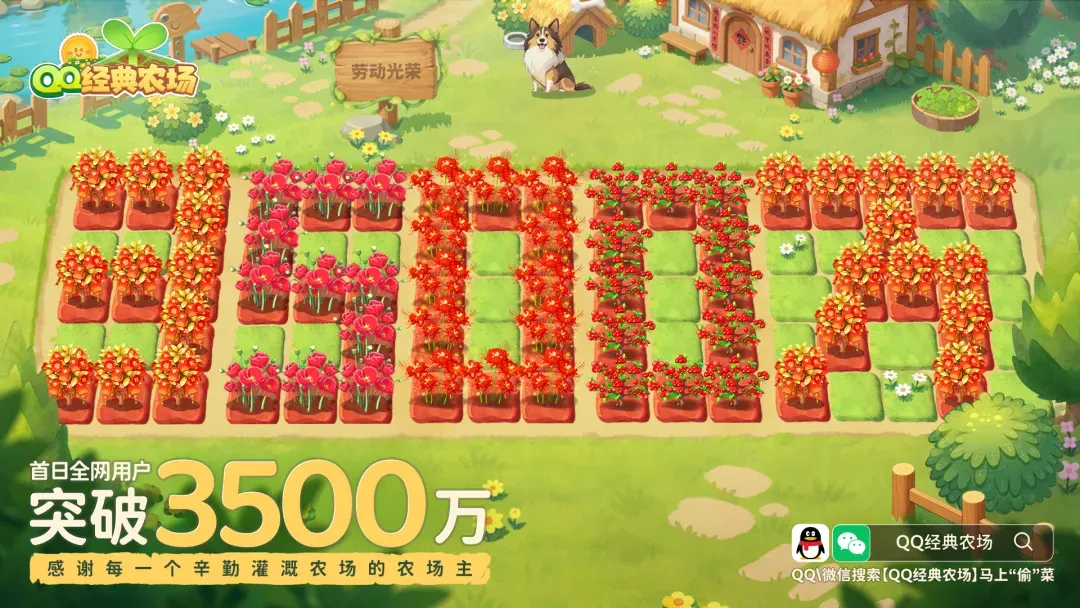
Tencent has launched a nostalgia-driven mini-game that captured 35 million users on its first day, marking the latest move by China's gaming giant to consolidate its position in the increasingly competitive mini-game sector. The release of "QQ Classic Farm" on February 6, 2026, demonstrates Tencent's strategic pivot toward leveraging its classic intellectual properties to retain users within its WeChat ecosystem as rivals like ByteDance intensify their push into casual gaming.
Developed by Tencent's Rubik's Cube Studio, the game quickly dominated social media platforms and climbed to the top of WeChat's mini-game popularity rankings within three days. By February 10, it ranked first in popularity and fifth in revenue among WeChat mini-games, according to data from DataEye Research Institute. The game's viral spread during the Spring Festival period underscores Tencent's ability to mobilize its vast social media infrastructure for product launches.
The success comes as Tencent faces mounting pressure to defend its mini-game territory against ByteDance's Douyin platform, which has aggressively courted developers and produced breakout hits. Industry analysts view the launch as part of Tencent's broader strategy to transform its classic gaming franchises into lightweight mini-games that keep users engaged within its WeChat and QQ ecosystems, rather than losing them to competing platforms.
The game's performance carries implications for investors monitoring China's mobile gaming landscape, where user attention has become the primary battleground. Tencent's approach of converting established IPs into mini-games represents a lower-risk strategy compared to developing new titles, though questions remain about long-term retention beyond the initial nostalgia-driven surge.
Rapid Ascent Masks Mixed User Reception
"QQ Classic Farm" achieved remarkable visibility metrics within its first 96 hours of availability. The iOS version's popularity also boosted downloads of a separate standalone "QQ Farm" app, demonstrating spillover effects from the mini-game launch. The title replicated the core mechanics of the original QQ Farm that gained widespread popularity during China's early internet era, featuring crop planting, harvesting, and the signature "vegetable stealing" social interaction that defined the original.
User response has split along generational lines, according to DataEye Research Institute analysis. The game successfully tapped into nostalgia among users born in the 1980s and 1990s who remembered the original, with the Spring Festival timing amplifying emotional resonance. Players created viral content around the concept of "harvesting crops equals harvesting wealth," aligning with traditional holiday prosperity themes.
However, younger users criticized the deliberately retro graphics and gameplay as overly simplistic. The game retains manual click-to-plant mechanics without the automation features common in modern farming simulators, with some players reporting limited content after 30 minutes of play. The "stealing" mechanic also generated controversy, with users expressing concerns about social pressure when friend lists include professional contacts and supervisors, reflecting evolving attitudes toward digital boundaries.
Low-Cost Marketing Leverages Ecosystem Dominance
Tencent deployed minimal paid advertising for the launch, with DataEye-ADX tracking data showing modest ad volumes that peaked only on launch day. Instead, the company relied on coordinated promotion across its product portfolio, with multiple Tencent platforms simultaneously pushing the game to users.
Creative materials focused on two primary themes: direct footage of the classic QQ Farm interface to trigger nostalgic recognition, and live-action videos featuring the tagline "QQ Classic Farm now available as mini-game." The company enlisted actress Cai Ming as a promotional partner, producing content that played on her name's phonetic similarity to the Chinese word for "vegetable."
This "low-cost, high-precision, strong resonance" approach exemplified what DataEye termed典型 "Goose-style marketing"—referring to Tencent's penguin mascot—characterized by comprehensive mobilization of internal resources. While effective in generating immediate buzz and achieving the 35 million first-day user milestone, the strategy exposed potential vulnerabilities. Multiple users reported fatigue from repetitive push notifications across Tencent services, with complaints about forced redirects disrupting their original app usage patterns. Some characterized the experience as "visual spam" that diminished goodwill toward Tencent's broader ecosystem.
The heavy emphasis on nostalgia without clearly communicating product innovations risked creating perceptions of "exploiting sentimentality without genuine effort," according to the DataEye analysis. This approach could undermine retention of new users while potentially exhausting the emotional capital associated with the QQ Farm IP among longtime fans.
Strategic Positioning in Platform Competition
The launch reflects Tencent's response to intensifying competition for mini-game users, particularly from ByteDance's Douyin platform. DataEye Research Institute has identified 2026 as a pivotal year in which both WeChat and Douyin are aggressively competing for user gaming time, operating on the principle that time spent on rival platforms directly reduces engagement with their own ecosystems.
ByteDance's strategy centers on recruiting developers and leveraging Douyin's content distribution algorithms to create viral hits through "social plus content" integration, producing breakout titles like "Snipe Aliens" and "Play Until You Fly." Tencent has countered by converting high-profile franchises into mini-game versions, including "Tencent Happy Landlord," "Happy Mahjong," and "Yuanmeng Star," rather than competing primarily through heavyweight or lightweight game development.
This IP-conversion approach serves multiple strategic objectives for Tencent. First, it validates a replicable template for transforming other classic properties into mini-games with proven user bases. Second, it reinforces WeChat's mini-game ecosystem foundation by capturing early-mover advantage in the 2026 casual gaming cycle, particularly during the crucial Spring Festival period when user engagement peaks. Third, it extends Tencent's core "social plus gaming" logic by using lightweight social interactions to deepen user dependence on WeChat and QQ platforms.
The high-DAU products function as user retention anchors within WeChat's mini-game ecosystem, with Tencent subsequently distributing these users to other titles in its portfolio. The "vegetable stealing" mechanic, despite generating some controversy, creates high-stickiness social dynamics that boost retention metrics beyond typical casual games.
Implications for Platform Ecosystem Strategy
For Tencent, "QQ Classic Farm" represents more than a successful individual launch—it marks a milestone in the company's mini-game sector positioning as it operates simultaneously as platform operator and content provider. The approach of maintaining users within its ecosystem through familiar IP rather than relying solely on third-party developers gives Tencent direct control over a substantial portion of user engagement time.
The model's success depends on balancing short-term user acquisition through nostalgia marketing against long-term retention through sustained gameplay value. The mixed user feedback regarding content depth and modern feature expectations suggests potential challenges in converting initial curiosity into lasting engagement, particularly among younger demographics less connected to the original IP.
The competitive dynamics between Tencent and ByteDance in mini-games mirror broader platform wars in China's digital ecosystem, where user attention has become the ultimate scarce resource. Tencent's advantage lies in its established social graphs within WeChat and QQ, which provide built-in distribution and viral mechanics. However, this strength creates risks if users perceive aggressive cross-promotion as platform overreach that degrades their core messaging and social networking experience.
The coming months will test whether the 35 million initial users translate into sustained engagement and whether Tencent can replicate this formula across its extensive IP catalog without exhausting user goodwill or diluting the nostalgic appeal that drove the initial response.