
China's AI App-Generation Race Fractures as Alibaba, ByteDance Retreat and Tencent Doubles Down
Diverging bets on vibe coding reveal a deeper fault line: who controls the next layer of app distribution in China's AI economy.
China's three largest internet conglomerates have arrived at sharply different conclusions about AI-powered app generation, with Alibaba and ByteDance executing strategic retreats while Tencent accelerates a two-front offensive—a divergence that exposes unresolved tensions between compute economics, regulatory compliance, and ecosystem lock-in that will shape China's AI product landscape through the remainder of 2026.
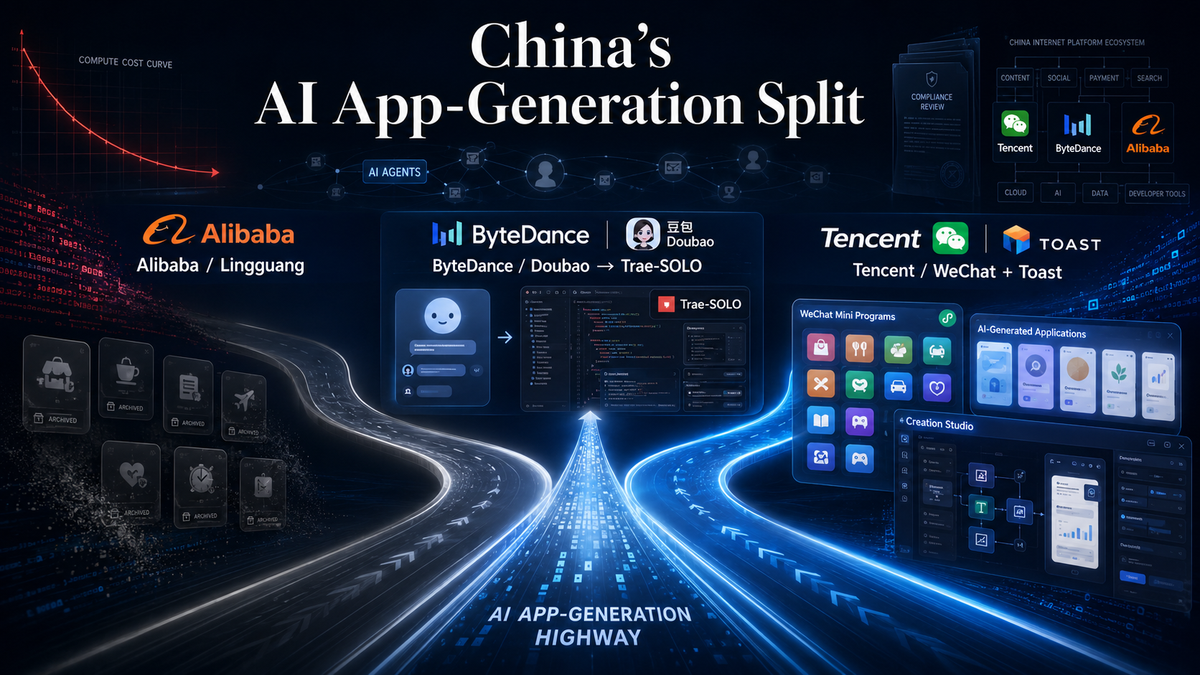
The inflection point crystallized in late June, when Ant Group confirmed an organizational reshuffle at Lingguang, its once-hyped AI app-generation assistant, reassigning the product's lead executive "Hanluo" to partially absorb responsibilities at Afu, a more commercially grounded vertical AI unit. Within days, ByteDance's flagship AI assistant Doubao quietly confirmed that its app-generation feature had been formally discontinued as of May 31, with all related capabilities migrated to Trae-SOLO, the company's standalone developer-focused platform.
Ant Group's Lingguang Hits Strategic Dead End Despite 30 Million User Creations
Lingguang's trajectory is a case study in the gap between vanity metrics and durable product-market fit. When the app launched in late 2025, it reached 1 million downloads within four days, ranking sixth on the China App Store free chart and first among free tools—a debut that positioned it as Ant Group's bid to carve out territory in the crowded general-purpose AI assistant market.
The product's differentiation rested on a "multimodal AI assistant plus Flash Apps" combination: users could generate lightweight, single-purpose mini-tools—dubbed Flash Apps —through natural language prompts, without writing a line of code. Into early 2026, Ant Group continued investing: it launched Lingguang Circle, a zero-code app-sharing community, paired with a RMB 100 million (US$13.9 million) creator incentive program. The platform also deepened integration with Alipay's financial infrastructure, enabling Flash Apps to natively connect to payment, membership, and voucher-redemption capabilities. By mid-2026, users had created more than 30 million Flash Apps on the platform.
Yet the headline creation figure masked a structural problem. Flash Apps, by design, are ephemeral—single-use tools that satisfy an immediate need and are then discarded. That "one-and-done" usage pattern generated negligible retention and failed to build the sticky user base that would justify continued resource allocation. Monthly active users never broke into the industry's top tier.
More critically, Lingguang's strategic rationale eroded as Alibaba's own AI stack matured. Qwen, Alibaba's foundation model series, has consolidated its position as the group's primary general-purpose AI interface, while Alipay's Aba has emerged as the designated AI gateway for financial scenarios. Caught between two better-resourced siblings with clearer mandates, Lingguang's positioning became redundant. Reallocating the core team toward Afu—a unit with a more defined path to monetization—reflects a rational triage decision once strategic patience runs out.
ByteDance Executes Clean Product Matrix, Shifting Compute Toward Higher-ROI Workloads
ByteDance's retreat from app generation inside Doubao is driven by three compounding pressures: content liability, compute cost, and product architecture clarity.
On the regulatory dimension, China's generative AI governance framework requires platforms to assume principal responsibility for user-generated content distributed through their services. Doubao, which operates at scale with hundreds of millions of daily active users, faces an acute moderation burden if app-generation outputs—potentially including fraudulent forms, privacy-harvesting tools, or phishing interfaces—circulate freely under its brand. Migrating the capability to Trae-SOLO, a developer-oriented platform that can enforce real-name registration and age-gating, provides a structural compliance firewall.
The compute economics are equally unfavorable at the mass-market level. App generation requires repeated calls to code-specialized models, with token consumption substantially higher than standard conversational queries. The problem is that the overwhelming majority of casual users generate a single demo, derive no ongoing utility, and never convert to paid tiers—producing a deeply negative return on inference spend.
The migration also completes a deliberate product taxonomy ByteDance has been constructing across its AI portfolio: Doubao handles lightweight, high-frequency general tasks (Q&A, copywriting, office productivity); Maohe addresses character-based agents and interactive companionship for entertainment verticals; and the Trae family—comprising Trae IDE and Trae-SOLO—serves developers and semi-professional builders who require coding assistance and zero-code app construction. The segmentation concentrates compute allocation toward segments with demonstrated willingness to pay, while keeping Doubao's product surface clean and fast.
Tencent Deploys Dual-Track Strategy, Embedding AI Generation Inside and Outside WeChat
While its peers consolidate, Tencent is running parallel experiments calibrated to its unique ecosystem advantages—a calculated move rather than contrarianism.
Inside WeChat, the company began gray-testing "Xiao Wei", a native AI assistant accessible from the app's top-left navigation, in June 2026. A key capability: users can generate personal-use lightweight mini-program tools through a single natural-language prompt. The design is deliberately constrained—generated tools are restricted to individual use, cannot be shared or redistributed, and are blocked from accessing sensitive permissions such as payments or contact lists. This containment strategy mirrors WeChat's existing Mini Program philosophy of "use and leave," while converting the friction of searching and filtering existing mini-programs into an instant customization experience. After more than a decade of cultivating Mini Program habits across its user base, Tencent is effectively AI-enabling a behavior pattern that already exists at scale.
Outside WeChat, Tencent launched Toast (吐司), a standalone AI app-generation and creative co-creation platform, with the Android version going live on May 15, 2026, followed by the iOS version in early July—completing dual-platform mobile coverage within approximately seven weeks. Unlike Lingguang, which carried the strategic burden of serving as Ant Group's general-purpose AI flagship, Toast has a singular focus: building and distributing original applications. There are no redundant conversational AI features, no image recognition overlays, no assistant-mode distractions. The product's narrow mandate functions as a hedge: Tencent is testing whether a dedicated app-creation and UGC distribution platform can preempt the next layer of app discovery, extending its ecosystem influence beyond the Mini Program sandbox.
The two tracks are structurally non-competing. Xiao Wei serves in-ecosystem, instant-utility demand; Toast addresses users with complete creative intent who want distributable, standalone applications. Together, they give Tencent simultaneous exposure to both ends of the app-generation demand spectrum without forcing a single product to serve incompatible user profiles.
Overseas Capital Signals Divergent Confidence, With Lovable Targeting US$13.2 Billion Valuation
The domestic retreat by Alibaba and ByteDance does not reflect a global consensus on the category's viability. International capital markets are pricing AI app generation with substantially more optimism.
Swedish startup Lovable closed a Series B at a US$6.6 billion valuation in late 2025. By June 2026, its annualized recurring revenue had climbed from US$400 million at the start of the year to US$500 million—a 25% increase in roughly six months. The company is now in discussions for a new financing round of approximately US$300 million that would imply a valuation of US$13.2 billion, doubling its mark in under a year, with the investor syndicate expanding from early-stage venture firms to larger institutional funds.
In the AI mini-game sub-segment, Y Combinator-backed Playabl.ai accumulated tens of thousands of user-generated games and millions of unique plays within three weeks of relaunching in 2026. Aippy, incubated by Hong Kong-listed Chizi Technology, closed a multi-tens-of-millions-of-dollars Series A in June 2026 at a post-money valuation of US$250 million, reporting 3 million global downloads and approaching 2 million monthly active users.
Domestically, Baidu's Miaoда remains the most prominent holdout among Chinese players. The May 2026 release of Miaoда 3.0 added native app generation and enterprise collaboration features, pushing registered users to the tens-of-millions range. With Baidu having ceded ground in the general-purpose AI assistant race, Miaoда represents one of the company's few credible differentiated products—a dynamic that explains why it has not been subjected to the same rationalization applied to Lingguang. However, Miaoда faces the same unresolved retention and monetization questions: mass-market users churn after a single generation, while enterprise clients remain skeptical of no-code platforms' stability and extensibility.
Monetization Gap Remains the Category's Defining Unsolved Problem
The strategic divergence among China's internet majors ultimately traces back to a single unresolved question that applies equally to domestic and overseas players: how to convert a one-time "generation surprise" into recurring user value.
Every AI app-generation tool on the market in mid-2026 remains anchored at the demo stage. Simple requests produce outputs quickly; complex business logic still generates frequent bugs. Non-technical users lack the debugging capability to iterate; professional developers find the depth insufficient for production workloads. The product sits in an awkward middle ground that satisfies neither constituency fully.
The competitive moat question is equally open. As foundation model providers—including Alibaba's Qwen, ByteDance's Doubao model stack, and international peers—increasingly embed app-building capabilities natively into their platforms, the differentiation thesis for standalone vertical tools must rest on ecosystem integration, user experience, or community network effects. None of the current market leaders has demonstrated a definitive answer.
The giants' strategic fork is a beginning, not a conclusion. The contest for who controls app development and distribution in the AI era is far from settled.
Related Coverage:
Ant Group Launches Lingguang, an AI Assistant with Native App Generation Capabilities