
China’s AI Entrance Battle: Why User Entry Points Matter More Than Models
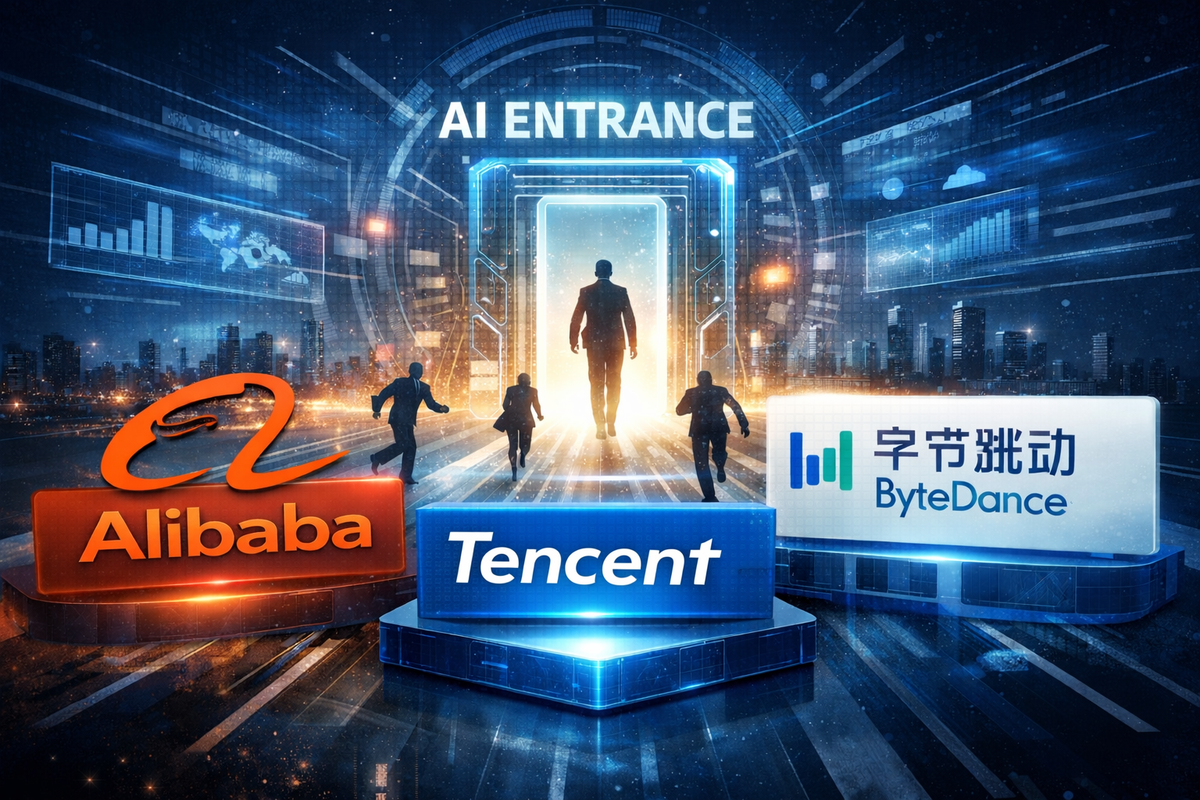
In the history of China’s internet, power has always belonged to the gatekeepers. First, it was web portals like Sina; then, search engines like Baidu; and most recently, "Super Apps" like WeChat. Now, a new structural shift is underway.
The next battleground for China’s tech giants—ByteDance, Alibaba, and Tencent—is not just about building smarter AI models, but about securing the "AI Default Entrance."
This explainer breaks down what an AI Default Entrance is, the economic logic driving this competition, and why it represents a fundamental reshaping of how digital services are consumed in China.
What is an "AI Default Entrance"?
An AI Default Entrance refers to an AI-powered interface—usually an agent or assistant—that becomes a user’s primary gateway to the digital world.
Unlike a traditional search engine that gives you a list of links, or an app store where you select specific tools, an AI Default Entrance acts as a universal intermediary. It accepts a user's intent (e.g., "Plan a trip to Yunnan" or "Buy a gift for my colleague") and executes the necessary tasks directly, bypassing traditional apps and websites.
In this model, the AI agent becomes the "browser" of the new era. If a platform controls this entrance, they control the first step of user attention. Everything else—apps, websites, service providers—risks becoming mere "backend" utilities that the AI calls upon invisibly.
Why Does This Matter Now?
The urgency behind this trend stems from a shift in how the Chinese internet is monetized. The era of "traffic growth" is over; the era of "efficiency and conversion" has begun.
- The Redistribution of Power: If users stop opening individual apps (like Meituan for food or Taobao for shopping) and instead ask an AI assistant to do it for them, the standalone apps lose their direct relationship with the consumer. The platform that owns the AI owns the customer.
- Monetization Control: Historically, whoever controls the entrance controls the advertising budget. If ByteDance’s AI becomes the default way users search for products, Alibaba’s ad revenue is directly threatened.
- From "Model" to "Product": For the past two years, Chinese tech companies competed on who has the smartest Large Language Model (LLM). Now, the market realizes that a smart model is useless without a user interface. The competition has shifted from infrastructure to the "application layer"—specifically, who can build the agent that users actually open every day.
How Does the Business Model Work?
The economic logic of the AI Default Entrance relies on "Closed-Loop" capabilities. It is not enough to just chat with a user; the AI must be able to complete a transaction.
- The Interface: It starts with a high-frequency entry point. This could be a standalone app (like ByteDance’s Doubao), an OS-level assistant on a smartphone, or an embedded agent within a social platform (like WeChat).
- The Routing: When a user makes a request, the AI analyzes the intent.
- The Execution: This is the critical differentiator. A successful default entrance doesn't just provide information; it executes the service.
- Weak Entrance: "Here is a recipe for Kung Pao Chicken."
- Strong Entrance: "I have ordered the ingredients for Kung Pao Chicken from the nearest grocery store; they arrive in 30 minutes."
The winner will be the platform that can keep the user inside their ecosystem from the initial query all the way to the final payment.
Who Are the Main Players?
While many startups exist, structural barriers suggest the market will consolidate around incumbents with deep pockets and existing ecosystems.
ByteDance (The Aggressor)
ByteDance is currently the most aggressive player. Having rapidly captured 13% of China's AI cloud market (second only to Alibaba), it is leveraging its massive user base from Douyin (TikTok China) to push its standalone AI app, Doubao. Their strategy is to use content consumption as a hook to become the default search and service agent.
Alibaba (The Defender)
Alibaba’s dominance in e-commerce is at stake. Their focus is integrating AI agents deeply into their transactional platforms. They need the AI entrance to lead directly to a purchase on Taobao or Tmall, defending their core "transactional" traffic from being intercepted by general-purpose AI assistants.
Tencent (The Connector)
Tencent holds the ultimate trump card: WeChat. Because WeChat is already the default "operating system" for daily life in China, Tencent’s strategy involves upgrading its ecosystem with agentic capabilities. If WeChat’s internal search becomes an intelligent agent, it instantly becomes the largest AI entrance in China.
Why Will Only a Few Survive?
The "AI Default Entrance" market is a classic Winner-Takes-All scenario due to high barriers to entry:
- Infrastructure Costs: Running the inference (computing power) for millions of daily AI interactions requires billions of dollars in GPU investment. Only the cloud giants (Alibaba, ByteDance, Tencent, Huawei) can subsidize these costs long enough to reach profitability.
- Data Ecosystems: An AI agent is only as good as the services it connects to. A startup’s AI might be smart, but if it cannot access WeChat Pay or Taobao’s inventory, it cannot "close the loop" for the user.
- User Habit Inertia: Changing user behavior is difficult. Users will likely gravitate toward AI features embedded in apps they already use (like WeChat or Douyin) rather than downloading a new, standalone AI app.
What Are the Key Constraints?
Despite the hype, several "bottlenecks" define the pace of this transition:
- Inference Cost vs. Monetization: Currently, it costs more to generate an AI answer than a traditional search result. Platforms must figure out how to insert ads or transaction fees into AI responses without ruining the user experience.
- Hallucination Risks: For an AI to be a "default entrance" for banking or shopping, it requires 100% accuracy. Current models still struggle with reliability.
- Regulatory Environment: The Chinese government is closely monitoring AI for content safety and data privacy. Any "default entrance" must comply with strict generative AI regulations, which favors established giants with robust compliance teams over agile startups.
What Happens Next? (The 2026 Outlook)
Looking ahead to the next 12 to 24 months, we expect the market to move from "exploration" to "consolidation."
- The "Super Agent" Emerges: We will likely see the rise of one or two dominant "Super Agents" that serve as the primary interface for the Chinese internet, much like WeChat does today for apps.
- Investment Logic Shift: Capital markets will stop valuing companies based on the number of parameters in their models. Valuation will instead be driven by "Entrance Win Rate"—the percentage of user queries that start and finish within that company's AI interface.
- Hardware Integration: The battle will spill over into hardware. Expect tighter integration between software giants and phone manufacturers (like Xiaomi, OPPO, and Vivo) to embed these AI entrances directly into the operating system layer.
The Bottom Line: The "AI Default Entrance" is not a product feature; it is a structural choke point. Whoever controls it will dictate the flow of traffic and money in China's digital economy for the next decade.