
China's AI Funding Machine: How Beijing Is Mobilizing Trillions to Win the Tech Race
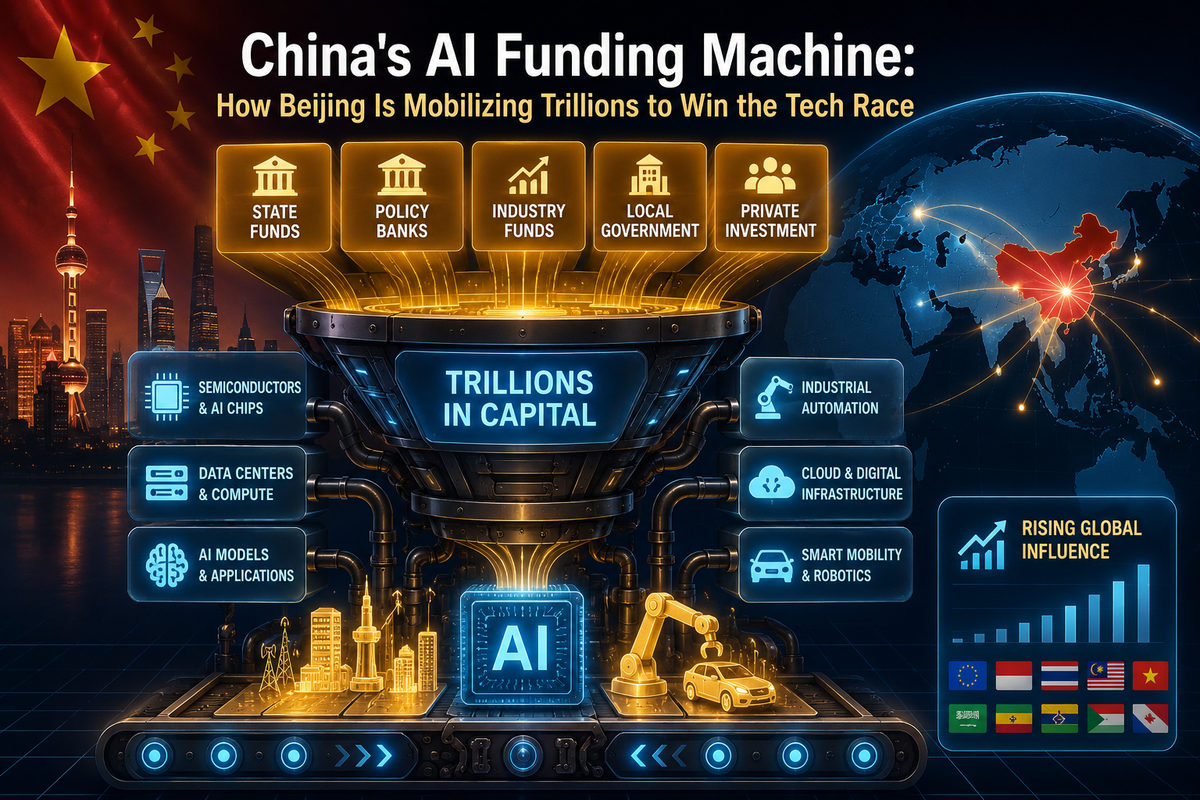
A new research note published on June 24, 2026 by Nomura International (Hong Kong) lays out in granular detail the architecture of China's state-driven AI financing apparatus — and the scale is staggering. At a moment when investment momentum is faltering and Beijing faces mounting pressure to stabilize the economy, the report argues that the AI sector is fast becoming the primary vehicle through which China channels fiscal firepower. For investors trying to understand how China competes in the global AI race despite chip restrictions and a technology gap with the US, this is essential reading.
State Capital at the Center
The structural contrast with the United States is stark. Washington's CHIPS and Science Act offers roughly $53 billion in federal funding, but American AI capex is overwhelmingly private-sector led — dominated by hyperscalers deploying their own balance sheets. China's model is the inverse: the state leads, and the private sector fills in around the edges.
"Facing restricted access to advanced chips and a substantial technology gap with the US, China has mobilized extensive, multi-tiered state capital to support its own full AI supply chains," the Nomura analysts write. That mobilization spans central government bond issuance, policy bank financing, sovereign-style industrial funds, and local government vehicles — each layer targeting a different bottleneck in the AI industrial chain.
The "Big Fund" and Its Expanding Mandate
The National Integrated Circuit Industry Investment Fund — universally known as the "Big Fund" — sits at the core of China's semiconductor strategy. Three phases have now been launched, with registered capital of RMB 139 billion, RMB 204 billion, and RMB 344 billion respectively, collectively providing nearly RMB 700 billion (approximately US$97 billion) in state capital support for semiconductors and AI.
Phase III, launched in May 2024, has taken a notably more aggressive posture. In January 2025, it co-established the RMB 60 billion National AI Industry Investment Fund alongside Guozhitou (Shanghai) Private Equity Fund Management. More recently, in early May 2026, it was widely reported that the Big Fund was in active negotiations to lead the initial financing round for Chinese AI startup DeepSeek — a move that would mark an unprecedented direct state intervention in the LLM space.
Ultra-Long Bonds and the RMB 2 Trillion Data Center Plan
Central government special bonds are increasingly being redirected toward AI. In 2026, Beijing allocated RMB 800 billion out of a total RMB 1.3 trillion in ultra-long central government special bonds (CGSBs) for "Two Majors" strategic priorities. Crucially, the second batch of RMB 217 billion announced in April 2026 explicitly identified AI as a key area — a formal policy inflection point.
The scale of ambition crystallized further on June 9, 2026, when Bloomberg reported that Beijing is drafting a RMB 2.0 trillion plan to build a nationwide data center network over five years, requiring at least 80% domestic technology content — including AI chips from Huawei. When associated power grid investments are included, total project spending could reach at least RMB 5.0 trillion, funded primarily through ultra-long CGSBs and state strategic industry funds.
Policy Banks as Quasi-Fiscal Levers
Perhaps the most potent multiplier in the toolkit is the "New Policy Financing Tools" (NPFT) program, launched in September 2025 with an initial quota of RMB 500 billion and an additional RMB 800 billion budgeted for 2026. Unlike previous infrastructure-focused iterations, this round explicitly prioritizes the digital economy and AI. China Development Bank allocated 37.5% of its tranche to these sectors; the Export-Import Bank of China designated 40%.
The leverage math is compelling: according to the NDRC, the initial RMB 500 billion is expected to catalyze over RMB 7 trillion in total project investment.
Private Sector Keeps Pace
State capital doesn't crowd out private spending — it runs alongside it. Annual AI capex from major domestic hyperscalers totals approximately RMB 500 billion. ByteDance raised its 2026 AI capex plan to over RMB 200 billion, a 25% jump from its preliminary budget. Alibaba announced a three-year investment plan exceeding RMB 380 billion for cloud and AI infrastructure, and in May 2026 signaled its five-year deployment budget would "far surpass" even that figure.
Tencent recorded RMB 37 billion in AI-related capex in Q1 2026, up 16% year-on-year and outpacing Alibaba's RMB 27 billion in the same period. Baidu has exceeded RMB 100 billion in cumulative AI capital and R&D investment since launching its Ernie Bot in 2023.
Capital Markets Join the Push
On the equity side, China's STAR Market has remained open for chip and AI listings even as broader A-share IPO activity stays largely suspended. GPU designers Moore Threads and MetaX raised RMB 8 billion and RMB 3.9 billion respectively, while advanced packaging leader SJ Semiconductor raised RMB 4.8 billion. Hong Kong, meanwhile, has relaxed its IPO rules to attract mainland tech names: PCB maker Victory Giant Technology raised HKD 23 billion in the largest Hong Kong IPO of the year to date, while LLM firms Zhupu AI and MiniMax raised HKD 4.4 billion and HKD 5.5 billion respectively.
The picture that emerges from Nomura's analysis is not one of scattered policy gestures, but a coordinated, multi-trillion-dollar state mobilization — one that is still accelerating.
Related Coverage:
Tencent Isolates AI Costs in Q1 2026, Revealing Resilient Core Bankrolling Generative Pivot