
J.P. Morgan’s Europe Auto Warning: China’s OEMs are coming for 20% Market Share
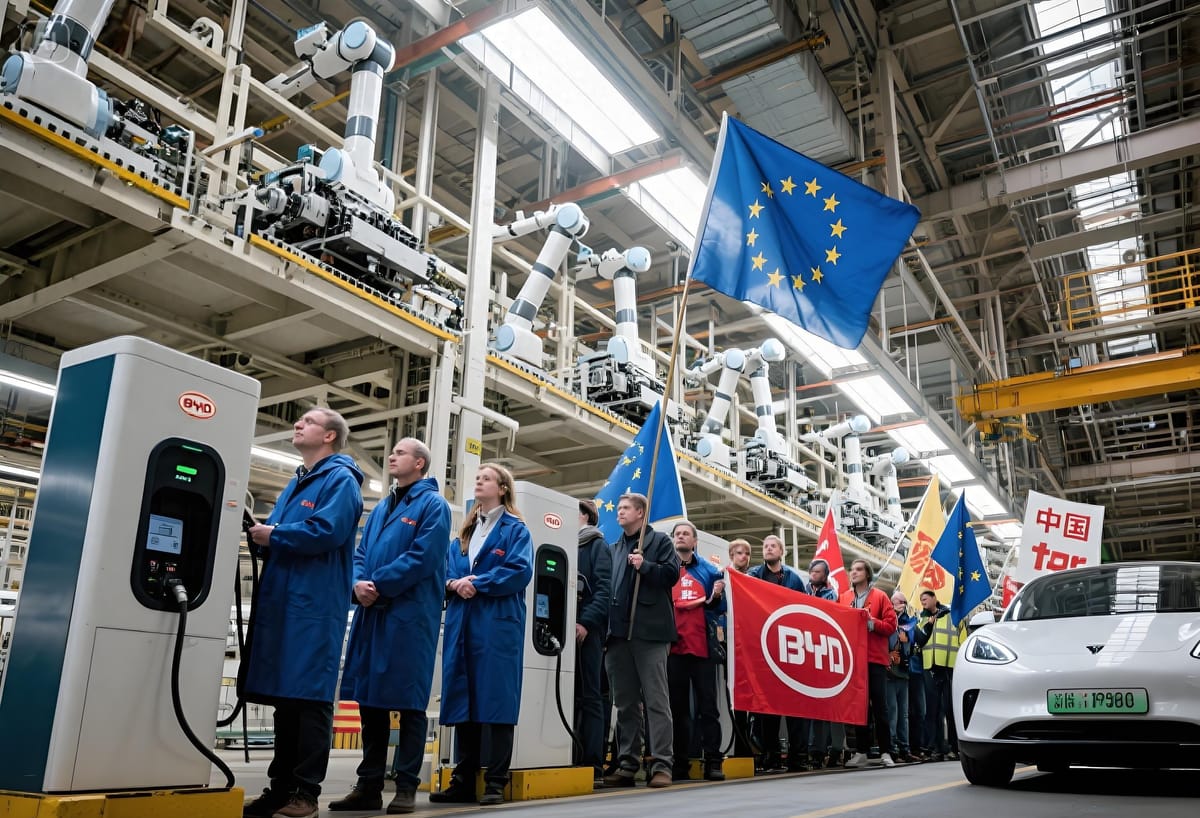
J.P. Morgan's European equity research team published its key takeaways on June 24, 2026, following the bank's 14th annual European Automotive Conference held June 1-2 in London. With more than 30 companies participating — roughly 35% of them from Asia — the event served as a real-time barometer of an industry navigating tariff crosswinds, an accelerating EV transition, and the most consequential competitive shift in a generation: the systematic advance of Chinese automakers into the European market.
The findings deserve attention not because they break new ground, but because they crystallize, with unusual directness, how deeply the industry's center of gravity has already shifted eastward.
Chinese OEMs: From 12% to 20% Market Share — and Counting
Jose Asumendi, J.P. Morgan's Head of European Automotive Research, did not mince words. Chinese original equipment manufacturers (OEMs) — including BYD, Geely, and Chery Automobile — were a dominant presence at the conference, and their trajectory in Europe is becoming harder to dismiss.
"We forecast that Chinese OEMs will take about 20% of the market share in Europe from about 12% currently," Asumendi noted, adding that Spain is emerging as a key beachhead for localizing Chinese production on the continent. That's not a distant forecast — it's a structural call on a process already underway, with policy, logistics, and supply chain infrastructure all moving in the same direction.
The "In China, For Global" Pivot Is Reshaping the Entire Industry
Nick Lai, Head of APAC Auto Research at J.P. Morgan, framed the broader strategic shift with precision. The old paradigm — building in China, selling in China — is giving way to something far more disruptive.
"There is a strategic shift from major OEMs globally and in China, from previously 'in China and for China' to 'in China and for global' right now," Lai said. The implications are twofold. First, China's vehicle exports hit 7 million units last year, and J.P. Morgan expects that figure to approach 10 million units in 2026 — a near-40% surge that would make China the world's dominant auto exporter by a wide margin. Second, global carmakers are increasingly tapping China's cost-competitive supply chain not just for domestic consumption, but to feed their worldwide operations. With elevated oil prices providing a structural tailwind, EV adoption is expected to continue rising sharply in both China and international markets.
Battery Suppliers: A Quiet Beneficiary
Rebecca Wen, who covers EV batteries for J.P. Morgan's Asia Pacific team, offered a notably constructive read on the sector. "Overall, we are coming out more positive on this sector," she said. "We are seeing more opportunities tied to Chinese OEMs expanding overseas. As they localize their sales and production footprint, they tend to bring along parts and battery ecosystems they already trust."
The implication is clear: Chinese battery suppliers don't just benefit from domestic demand — they travel with their OEM customers. And as global automakers simultaneously look to cut costs by sourcing from Chinese suppliers, the demand picture for key battery ecosystem players is compounding from multiple directions.
Credit Markets: Suppliers Outrunning OEMs
From a credit perspective, J.P. Morgan's European credit analyst Jemma Permalloo offered a nuanced but telling observation: the relative standing of parts suppliers versus OEMs has quietly inverted.
"There has been a shift in the rating agencies' positioning when it comes to parts suppliers. In their view, part suppliers seem to have better credit prospects than OEMs, which is different from last year's discussion," she said. The data is striking: at S&P, 50% of covered OEMs carry a negative outlook, compared to just 30% for parts suppliers. Suppliers, it turns out, have been more agile — restructuring operations, simplifying business lines, canceling loss-making contracts, and executing divestitures. OEMs, by contrast, have absorbed more of the tariff impact than markets initially anticipated.
On the question of AI and humanoid robots — buzzwords that dominated many sessions — Permalloo was measured: "We would need to see a much bigger revenue impact from these new areas for it to move the credit needle and be a game changer."
The Takeaway
J.P. Morgan's conference summary paints a picture of an industry at an inflection point. European legacy OEMs like Volkswagen AG, Renault S.A., and Stellantis N.V. are navigating a compressed transition in the compact EV segment, while suppliers like Schaeffler AG and Valeo S.A. are quietly positioning for the electrification wave. Meanwhile, the Chinese competitive threat is no longer theoretical — it is measurable, accelerating, and increasingly structural. The question for European automakers is no longer whether Chinese OEMs will take share. It's how much, and how fast.
Related Coverage:
Chinese Automakers Reach 6.8% Share in Europe as Profit Battle Begins