
Chinese Automakers Reach 6.8% Share in Europe as Profit Battle Begins
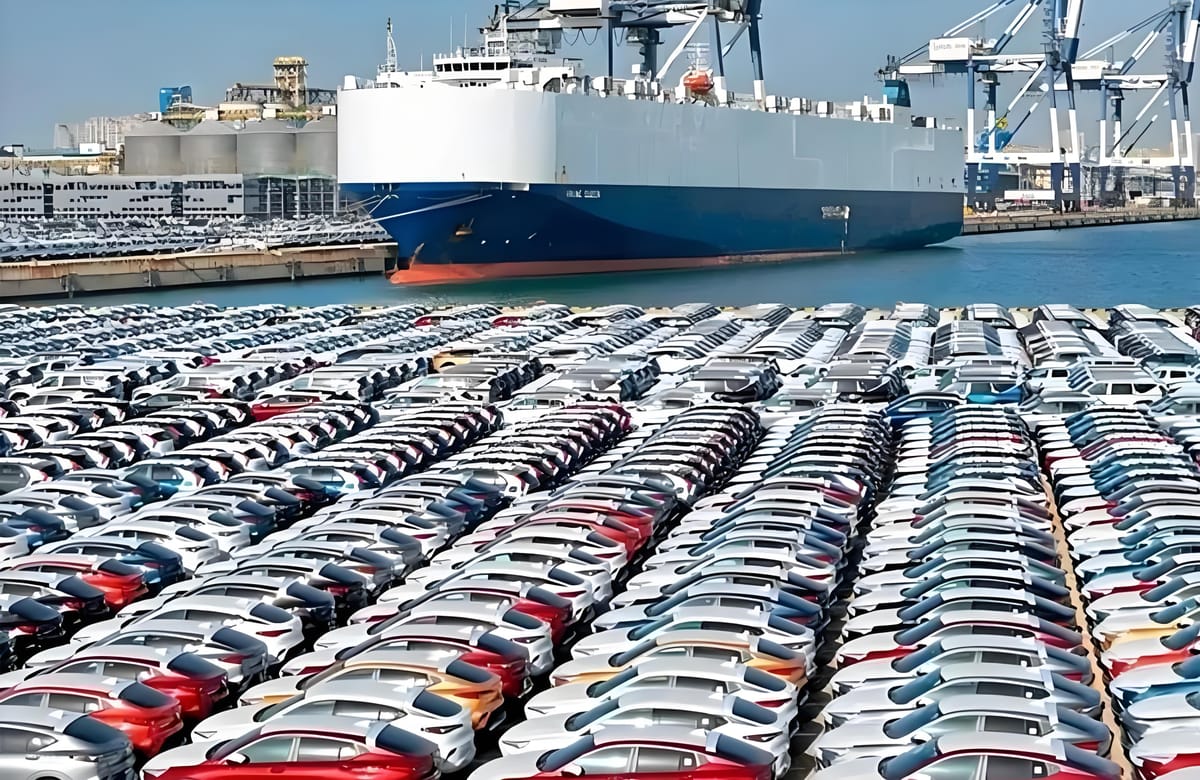
HSBC research finds Chinese OEMs have doubled their European market share in 12 months while largely holding price, exposing a structural vulnerability in incumbent strategies built around volume defense rather than margin protection.
Chinese automakers have captured approximately 6.8% of the European passenger car market as of April 2026 — more than double their share from a year earlier — but a new HSBC Global Research report argues the more consequential battle is not for registrations dashboards, but for the income statements of Europe's legacy carmakers, who are quietly pivoting toward a profit-preservation strategy that may serve shareholders better than any market-share counter-offensive.
The findings, published June 4, 2026 by HSBC analysts Michael Tyndall, Yuqian Ding, Pushkar Tendolkar, and Alice Martin, land as European auto executives publicly acknowledge the competitive threat for the first time in blunt terms. Ford Motor Company CEO Jim Farley told Reuters in December 2025 that his company is "in a fight for our lives," while Volvo Car CEO Håkan Samuelsson warned in April 2026 that Chinese entrants "will probably replace some of the old-school competitors we have."
Chinese Brands Accelerating Past Structural Barriers That Once Slowed Them
The speed of penetration is what distinguishes this cycle from previous waves of foreign entry. In the United Kingdom — one of the strongest markets for Chinese brands — BYD and Chery Group have reached 3–4% market share in a fraction of the time it took Toyota and Hyundai to reach equivalent thresholds when they first entered Europe decades ago.
New car registrations of Chinese brands across Europe's "Big 5" markets (UK, Germany, Spain, Italy, France) plus Norway have been regularly doubling year-on-year. The rolling 12-month market share curve shows near-vertical ascent, with the April 2026 reading of c.6.8% representing a structural inflection rather than a cyclical spike, according to HSBC's analysis of data from CCFA, SMMT, KBA, ANFIA, ANFAC, and ACEA.
Market share gains have come disproportionately at the expense of Stellantis NV, Ford, and Asian incumbents including Toyota, Nissan, Hyundai, and Kia. Among European OEMs, Volkswagen Group and Renault Group have broadly held or marginally grown share. Tesla, meanwhile, has lost ground due to aging models, pricing misalignment with the fleet segment — which accounts for roughly 60% of the European market — and intensifying competition across the EV spectrum.
Product Substance, Not Price Aggression, Drives Chinese Gains
The conventional narrative — that Chinese brands win on price — is, according to HSBC's analysis, largely incorrect. Across the B, C, and D segments in Germany, Chinese OEMs are not systematically undercutting European rivals on manufacturer's suggested retail price. In the B segment, the average price of Chinese EVs tracked by HSBC stood at approximately EUR33,455 in June 2026, compared with EUR25,545 for comparable European models. In the C segment, Chinese brands averaged EUR34,880 versus EUR38,699 for European equivalents — a gap that has narrowed as European OEMs cut prices (down 3.8% year-on-year) while Chinese MSRPs edged slightly higher (+1.5%).
The real competitive lever is battery chemistry. European OEMs continue to rely predominantly on more expensive NCM (nickel-cobalt-manganese) battery packs, while Chinese manufacturers have broadly adopted LFP (lithium iron phosphate) chemistry, which carries lower input costs. The Volkswagen ID.3 Pro, for instance, dropped its German list price by 8.9% between June 2025 and June 2026 — the steepest reduction in the C segment — as VW Group absorbs margin pressure to remain competitive.
The HSBC team's London dealer field trip, conducted with automotive engineer Mick Cameron, provided qualitative reinforcement. BYD ranked first overall across perceived quality, fit and finish, technology content, and retail environment — outscoring Volkswagen Group, Renault, and Stellantis brands in a head-to-head assessment. The MG IM6 Long Range, priced at GBP47,995, was found to offer 27 ADAS features, an 800-volt architecture supporting 369kW DC charging, and a 96.5kWh battery delivering 625km WLTP range — against the VW ID.7 Pro's 21 ADAS features, 400-volt architecture, 190kW peak charging, and GBP51,035 price tag.
Chery Group's Omoda and Jaecoo sub-brands scored consistently on technology and voice controls but were penalized for cramped, poorly located retail facilities — a reminder that brand infrastructure, not just product hardware, will determine long-run share retention.
Anti-Subsidy Tariffs Failing to Contain Chinese Advance; PHEV Pivot Accelerates
The EU's anti-subsidy duties on China-manufactured BEVs, imposed in October 2024, have not materially slowed the overall Chinese advance. Tariff rates range from 17.8% (Tesla, manufactured in China) to 45.3% for non-cooperating OEMs, with BYD facing a total combined duty of 27.0% and Geely Group at 28.8%. SAIC Group bears the heaviest burden at 45.3%.
Rather than absorbing margin compression or reducing volumes, Chinese OEMs have pivoted toward plug-in hybrid electric vehicles (PHEVs), which fall outside the BEV-specific tariff framework. HSBC data, sourced from Rho Motion, shows Chinese OEM BEV market share in Europe plateauing following the October 2024 tariff implementation, while PHEV share has continued to climb. Chery's Omoda 7 PHEV (EUR32,000) and Jaecoo 7 PHEV (EUR35,165) represent the commercial embodiment of this strategic pivot.
Growing political noise around further protectionist measures — including a Politico report from May 30, 2026 citing Beijing's threat of retaliation over additional EU import curbs — adds uncertainty to the regulatory outlook. However, HSBC notes that localisation offers Chinese OEMs a durable workaround: partial assembly within Europe would be exempt from anti-subsidy duties applicable to fully built imported units, allowing Chinese manufacturers to retain their domestic supply chain advantage while bypassing tariff exposure.
Stellantis's underutilized European plants — several operating at 8–54% of peak production capacity — present the most immediate opportunity. The Cassino facility (Alfa Romeo, Maserati) ran at just 8% of peak in 2026; Ellesmere Port at 10%; Melfi at 21%. Stellantis has explicitly flagged capacity-sharing arrangements with Leapmotor and Dongfeng at its Zaragoza, Rennes, and Madrid plants as a mechanism to lift European utilisation from 60% currently toward an 80% target by 2030.
European OEMs Choosing Margin Defense Over Volume War
The most analytically significant finding in the HSBC report may be structural rather than tactical: market share does not appear in the key performance indicators — and therefore the bonus structures — of most major Western OEM CEOs. BMW Group, Mercedes-Benz Group, Volkswagen Group, Stellantis, Ford, and General Motors all tie executive compensation to operating profit margin, cash flow, and share price performance. None explicitly reward market share growth.
The data bears this out. General Motors posted the strongest share price performance among global OEMs in 2025 despite a year-on-year volume decline, supported by cash flow generation and share buybacks. Chinese OEMs, despite leading the industry in three-year volume growth, register among the lowest EBIT margins in the global cohort on a three-year average basis. Stellantis in the first quarter of 2026 grew wholesale volumes by 12% year-on-year but delivered near-breakeven operating profit, illustrating the margin-destructive nature of volume-led competition.
North America remains structurally more profitable than Europe for most non-Chinese OEMs. Average revenue per unit in North America runs at approximately EUR42,000 versus EUR33,000 in Europe, reflecting a vehicle mix skewed toward large SUVs and trucks — which account for c.73% of 2025 US volumes per S&P Mobility data, compared with c.35% in Europe. Stellantis's own 2030 margin targets quantify the gap: 8–10% adjusted operating income in North America versus 3–5% in Europe.
For Chinese OEMs, the calculus runs in reverse. With the US market effectively closed — 100% import duties on Chinese EVs and restrictions on connected-vehicle software under the US Securing the Information and Communications Technology and Services Supply Chain rule — and the domestic market afflicted by hyper-competition, Europe offers ARPU approximately 60% above China levels. Europe was the number-one destination for Chinese vehicle exports in 2025.
Restructuring Intensifies as European OEMs Rebase Cost Structures
European OEMs are not standing still. Renault has achieved the deepest workforce reduction among European peers since 2019, driving capacity utilisation to approximately 90% and positioning itself as the benchmark for footprint rationalization. Its March 2026 "futuREady" strategic plan targets a further EUR400 per vehicle reduction in average variable costs.
Volkswagen Group is cutting German capacity by 700,000 units (approximately 40%) and targeting 35,000 staff reductions at VW AG by 2030. Audi has closed its Brussels plant and is pursuing 7,500 job cuts by 2029. Mercedes-Benz Group's "Next Level Performance" programme targets a 300,000–500,000 unit reduction in global capacity by 2027. Stellantis aims to improve European capacity utilisation from 60% to 80% by 2030 without full plant shutdowns, in part through the Chinese capacity-sharing arrangements described above.
The transition from NCM to LFP battery chemistry across European model ranges represents the single largest near-term variable cost lever. As Renault's Citroen eC3 and Fiat Grande Panda (both LFP, priced at EUR23,300 and EUR24,990 respectively) demonstrate, LFP adoption enables competitive pricing in the B segment without the margin sacrifice that NCM chemistry imposes. The average EV price in the EU fell to approximately EUR43,000 in 2025 from EUR63,000 in 2024, according to data cited by HSBC from sustain ability online, driven by the arrival of affordable B-segment EVs. Further price compression is likely as LFP adoption broadens across European lineups.
Investment Implications: The Sky Is Not Falling, But the Ceiling Is Lower
HSBC's framing — "it might be more than one acorn, but the sky is not falling" — encapsulates a nuanced investment thesis. Chinese OEMs will continue to gain share in Europe; the product quality, feature content, and cost structure advantages are real and durable. However, the European incumbents best positioned are those that resist the temptation to defend volume at the cost of margin, accelerate LFP battery adoption, right-size production capacity, and selectively leverage Chinese localisation partnerships to improve plant utilisation.
For investors, the 2025 precedent is instructive: the best-performing auto stocks were not those that won market share. The race to the bottom on volume is a trap. The companies that protect cash flow and earnings quality — even as their registration tallies shrink — are the ones most likely to reward shareholders through the cycle.
Related Coverage:
BYD Remains No.1 as China EV Rebound Masks Export- and Tech-Led Divergence in 2026