
BYD Remains No.1 as China EV Rebound Masks Export- and Tech-Led Divergence in 2026
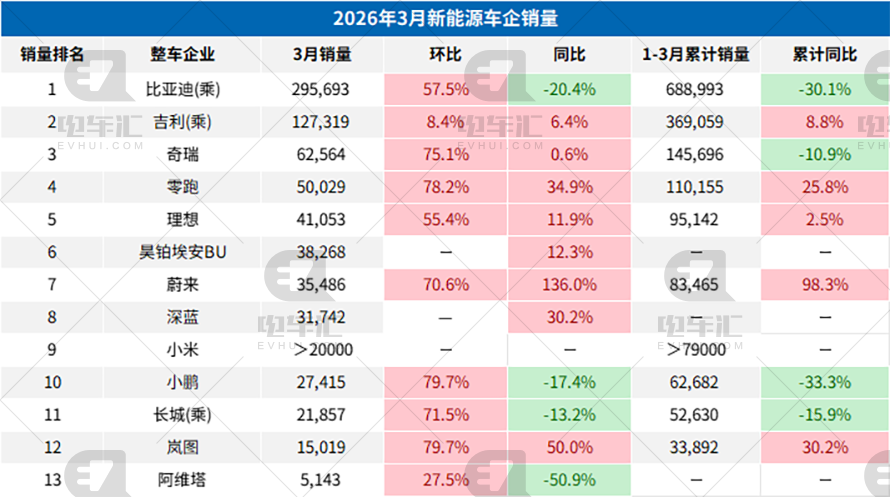
China’s major new-energy vehicle makers posted a broad March rebound as factories and logistics normalized after the Lunar New Year, but the data show a market splitting into two tracks in 2026: exporters gaining scale and pricing power abroad, and domestic-first brands leaning on fast model cycles, assisted driving and charging networks to defend share.
The latest disclosures on April 1 delivered near-universal month-on-month growth among companies that report on schedule. Several names—including Chery, Leapmotor, Nio and XPeng—reported sequential jumps of more than 70%, underscoring how seasonal disruption, not demand alone, drove February softness. The bigger signal for investors is the year-on-year divergence: BYD remained No.1 by volume but contracted, while some peers grew sharply from a low base.
BYD’s volume lead narrows as exports carry the growth story
BYD sold 295,693 passenger vehicles in March, up 57.5% from February but down 20.4% from a year earlier. First-quarter passenger sales fell 30.1% to 688,993, highlighting how the largest player is absorbing the brunt of intensified price competition and a tougher year-ago comparison.
Its March mix was nearly evenly split between plug-in hybrids (about 148,092) and battery EVs (about 147,601), suggesting BYD is using both powertrains to protect scale in the mass market. The company’s clearest momentum remains offshore: it exported more than 100,000 passenger vehicles and pickups in March, extending a high-growth trend that increasingly matters for margins as domestic pricing tightens.
Geely’s multi-brand strategy lifts penetration while Zeekr accelerates
Geely reported 127,319 new-energy vehicles in March, up 8.4% month-on-month and up 6.4% year-on-year, with NEVs at 55% of sales. First-quarter NEV volume rose 8.8% to 369,059, with penetration at 52%, positioning Geely as a steadier “share compounding” story versus more volatile peers.
Brand-level data show why: Galaxy delivered 82,744 in March and 238,859 in the first quarter; premium EV unit Zeekr delivered 29,318, up 90% year-on-year, and 77,037 in the first quarter, up 86%. Lynk & Co’s NEV family reached 13,056, up 148%, as the group pushes higher-priced trims alongside mainstream volume—an approach that could cushion gross profit if the industry’s price cuts persist through 2026.
Exports and localization emerge as the clearest demand hedge
Chery Automobile sold 62,564 NEVs in March, up 75.1% from February and up 0.6% year-on-year, but its first-quarter tally fell 10.9% to 145,696—evidence that international channels are doing more of the heavy lifting than China’s retail market. Chery said exports accounted for more than 60% of group sales, and it has 6.23 million overseas users out of 19 million globally, with strength in Europe, Southeast Asia and Latin America.
Leapmotor offered a second template: pairing China price points with overseas footprint. March deliveries hit 50,029, up 78.2% month-on-month and up 34.9% year-on-year; first-quarter deliveries rose 25.8% to 110,155. The company opened its first overseas innovation center in Munich on March 20 and rolled its B10 “global strategic model” off an SKD line in Myanmar on March 19 for localized delivery—steps that can shorten lead times and reduce tariff and logistics friction.
Tech rollouts and infrastructure spending become competitive weapons at home
Several domestic-focused brands used March momentum to tee up a dense April-to-2Q product calendar—an increasingly common tactic as Chinese EV cycles compress.
Li Auto delivered 41,053 vehicles in March, up 55.4% month-on-month and up 11.9% year-on-year; first-quarter deliveries rose 2.5% to 95,142. It plans to launch a new generation of the Li L9 in the second quarter featuring its self-developed “Mach 100” chip, a production-ready steer-by-wire chassis and an 800V active suspension system. The company ended March with 4,057 supercharging stations and 22,439 chargers, underscoring how capex-backed charging access is being used to lock in high-frequency users.
NIO reported 35,486 March deliveries, up 70.6% from February and up 136% year-on-year; first-quarter deliveries reached 83,465, up 98.3%. It is lining up refreshed ES6, EC6, ET5 and ET5T models in April, with an ES9 technology event set for April 9—an attempt to convert March’s rebound into sustained order flow.
Xiaomi Auto exceeded 20,000 March sales and topped 79,000 in the first quarter, supported by a rapid retail buildout to 490 stores across 143 cities and 275 service sites by end-March. XPeng delivered 27,415 in March, up 79.7% month-on-month but down 17.4% year-on-year, with first-quarter deliveries down 33.3% to 62,682—adding urgency to its export push to New Zealand and its Mexico strategy that targets both BEV and range-extended models by 2027. Deepal highlighted price-band expansion with the S07 range-extender version priced from RMB 149,900.
Across the board, March confirms production normalization and a release of pent-up deliveries. The more durable read-through for 2026 is strategic: scale leaders are leaning harder on exports, while challengers are trying to buy time with faster launches, localized overseas assembly, and differentiated tech—signals that the competitive battleground is shifting from pure price to channels, compliance and supply-chain execution.
Related Coverage:
Chery Pivots to Global Markets as Export Margins Eclipse Domestic Returns