
Hisense’s Overseas Push Hits a Margin Wall as Sports Marketing Fails to Lift Profits
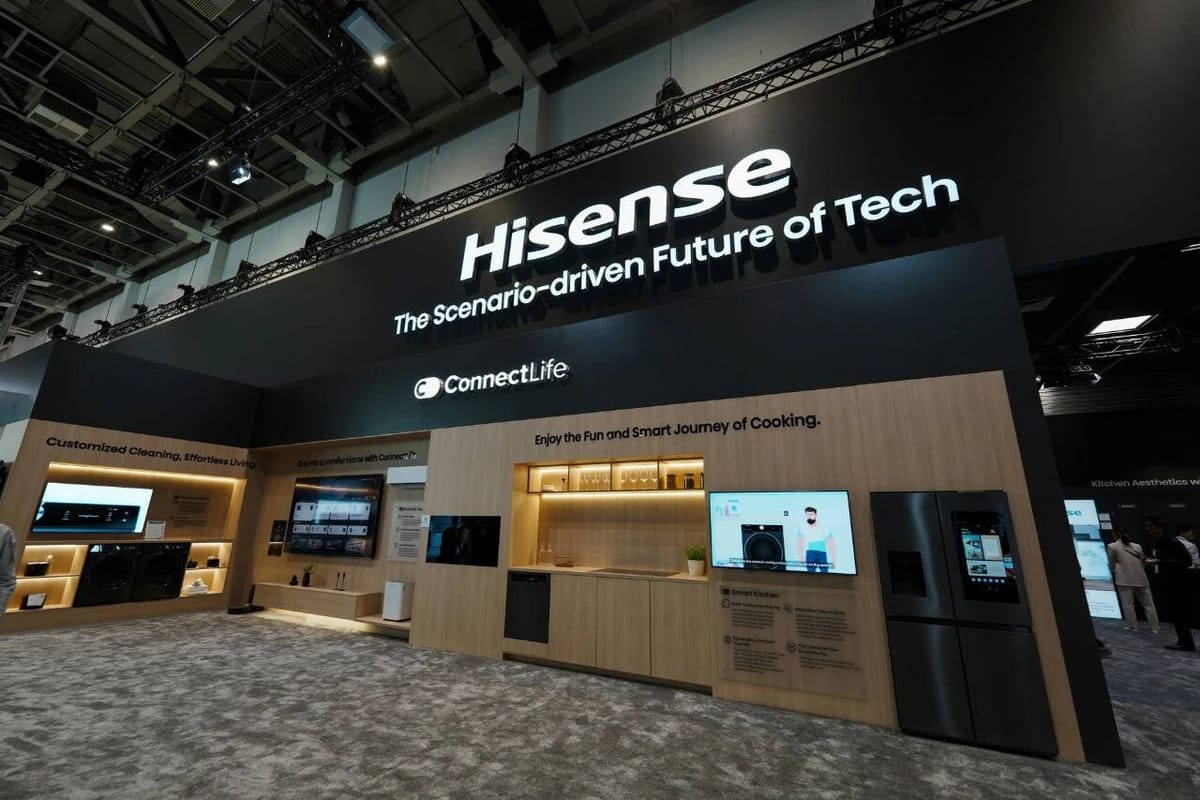
Hisense’s global expansion is running into a profitability problem: overseas revenue is rising for listed units Hisense Visual Technology and Hisense Home Appliances Group, but foreign gross margins remain far below China levels—undercutting the investment case for a premium-brand strategy built on years of top-tier sports sponsorships.
The latest disclosure shows the gap has not narrowed through 2025, even as overseas sales have become structurally more important to both companies. That mismatch—scale without margin—sets Hisense apart from Chinese peers that have built more balanced offshore economics.
Early market read-through for investors is that brand awareness gains from sports advertising have not translated into pricing power abroad, while Hisense’s overseas channel model leaves too much profit with retailers and local distributors.
Widening margin gaps expose a structural earnings drag
Hisense Visual reported domestic gross margin of 23.47% in 2023 versus 13.21% overseas, a 10.26 percentage-point gap. In 2024, the spread widened to 11.67 points (22.58% domestic vs 10.91% overseas). In 2025, domestic margin rebounded to 23.58% while overseas was 12.03%, leaving an 11.55-point gap intact.
The disparity is sharper at Hisense Home Appliances: 2023 domestic gross margin of 31.91% versus 10.20% overseas, a 21.71-point gap. In 2024 the gap was 19.35 points (30.73% vs 11.38%). In 2025 it remained elevated at 17.26 points (29.85% vs 12.59%).
For equity holders, the implication is straightforward: as the overseas mix rises, group earnings quality can deteriorate unless Hisense fixes pricing, channel capture, and cost structure abroad.
Rising overseas revenue raises the stakes for margin repair
Overseas revenue already exceeds domestic revenue at Hisense Visual. By 2025, the overseas share reached 50.68%, meaning more than half of sales were generated outside China despite materially lower profitability.
At Hisense Home Appliances, overseas revenue share increased from 32.62% in 2023 to 43.13% in 2025. That trajectory implies the offshore margin gap is no longer a side issue—it is increasingly the core determinant of consolidated profit growth.
The contrast with peers highlights why markets may treat Hisense’s global story as incomplete. In 2025, Haier Smart Home posted a much narrower domestic-overseas gross margin gap of 4.23 points (28.81% vs 24.58%). TCL Electronics Holdings showed a 6.7-point gap (21.7% vs 15.1%). Midea Group reported overseas gross margin above domestic, at 26.60% versus 26.24%.
Sports marketing lifts awareness but doesn’t secure pricing power
Hisense has leaned heavily into global sports IP, including sponsorship of three World Cups and European Championships, alongside tie-ups such as the Club World Cup and the Australian Open. The campaign improved brand visibility: Hisense’s global brand awareness rose from 37% to 59% over the past decade, and overseas share gains followed.
But the financials suggest awareness alone has not created premium positioning overseas. Research cited in the source material indicates Hisense’s overseas pricing typically sits below Samsung and LG, reinforcing a “value-for-money” perception rather than a high-end one. Meanwhile, premium labels such as Gorenje and ASKO have not delivered meaningful volume expansion, limiting mix-driven margin uplift.
This creates a key risk for investors: elevated marketing intensity can boost top-line momentum while depressing returns if product mix and channel control remain unchanged.
Channel dependence shifts profit to retailers and constrains margins
The margin gap also reflects how profits are distributed across the value chain. In China, Hisense operates a tightly controlled model—direct sales, core distributors, and e-commerce, supported by its own warehousing, logistics and after-sales network—allowing higher retention of channel economics.
Overseas, the company relies more on buyout-style exports and third-party channels, selling through local agents and big-box retailers such as MediaMarkt in Europe and Best Buy in North America. Under this structure, Hisense captures mainly the factory gate spread over production cost, while distributors and retailers take a larger share of promotion, after-sales, and logistics value—compressing reported gross margin.
The peer comparison offers a blueprint markets will likely use to judge execution risk. Haier’s overseas profitability benefits from localization of R&D, manufacturing and sales following acquisitions such as GE Appliances and Candy, which increased owned-channel and local operating leverage.
Related Coverage:
Chinese Appliance Giants Bet on AI Glasses to Seize Next Hardware Frontier
AI-Powered Appliances Take Center Stage at IFA as Chinese Firms Target Europe