
AI-Powered Appliances Take Center Stage at IFA as Chinese Firms Target Europe
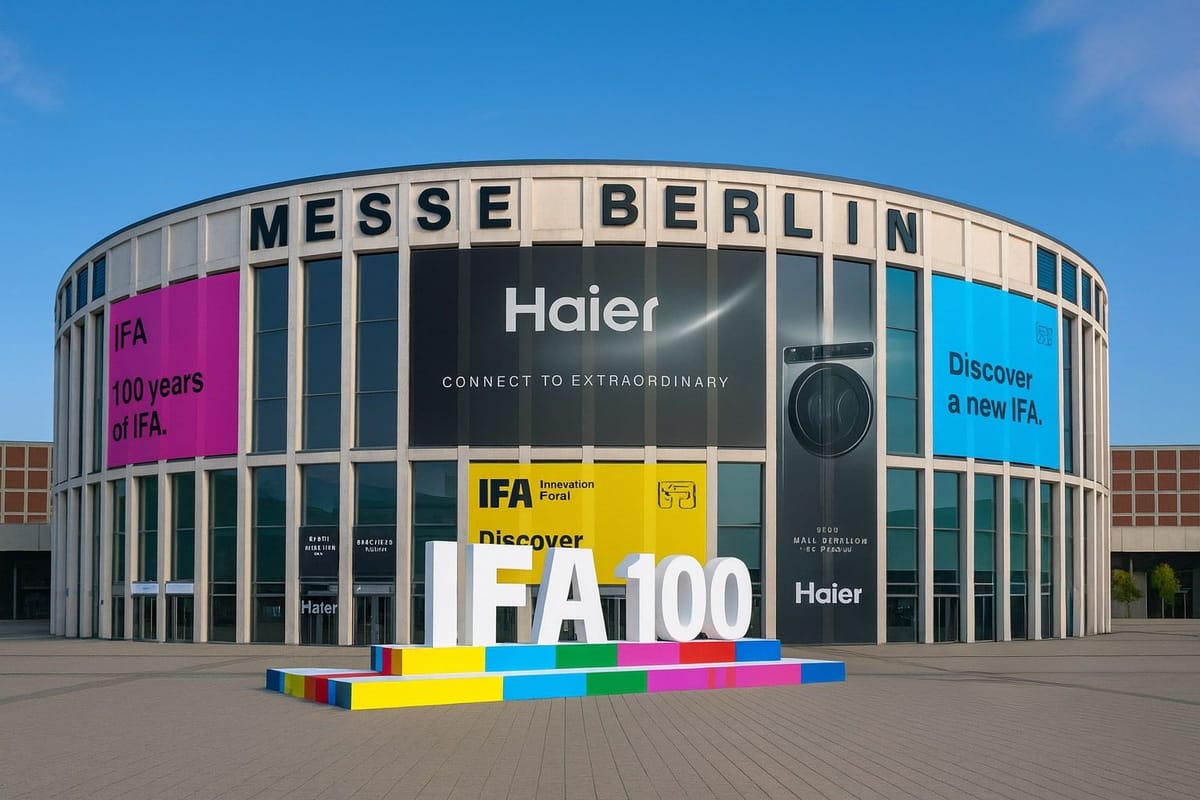
Chinese technology companies are leveraging artificial intelligence to redefine home appliances and consumer electronics, using Europe’s IFA 2025 trade show as a key battleground to assert their growing dominance in the global market.
At the Berlin event, AI has moved beyond conceptual hype to become a core feature embedded in everything from televisions to robotic vacuums. This shift sees Chinese firms like Hisense, TCL, and Ecovacs moving from the periphery to prime exhibition space, challenging established players like Samsung and Sony with tangible product advancements.
The trend underscores a strategic pivot towards the European market, which is increasingly viewed as a crucial gateway to global expansion, particularly amid ongoing trade tensions and tariff policies. “If your product can conquer the discerning Europeans, and you handle the localization details well, the doors to the global market will open for you,” a brand manager said at the show.
The fiercest competition is unfolding in high-end televisions, with a new generation of RGB-Mini LED displays, and in the rapidly growing smart cleaning sector, where Chinese brands are locked in an intense innovation race to capture the European consumer.
AI Remodels the Home Appliance Landscape
Artificial intelligence is driving a fundamental reconstruction of home appliances, a trend on full display at IFA 2025. The television market is a primary arena for this battle, with the industry marking 2025 as the “year of RGB-Mini LED” technology. According to Omdia, global shipments of Mini LED TVs reached 4.8 million units in the first half of 2025, a 150% year-on-year increase.
Hisense Visual Technology launched its new-generation RGB-Mini LED TV, the U7S Pro, alongside what it claims is the world's first RGB light and color co-control AI chip. “For the first time on the world’s display stage, RGB-Mini LED has allowed Chinese companies to release products ahead of Japanese and Korean firms,” said Li Wei, President of Hisense Visual Technology. “This allows us to extend the life of China’s display industry.”
Competitors also showcased their prowess. TCL Technology Group displayed a massive 163-inch RGB Micro LED TV, while Skyworth exhibited over 100 smart products. “Consumer demand for smart appliances has shifted from ‘functional’ to ‘scenario-based and personalized’,” said Tao Shuanghua, a spokesperson for Skyworth. Meanwhile, Haier Smart Home focused on hyper-energy-efficient appliances tailored for the European market.
Chinese Brands Vie for Smart Cleaning Supremacy
The global smart cleaning market is experiencing robust growth, with Chinese companies at the forefront of innovation and increasingly targeting overseas markets. Global shipments of smart home cleaning robots grew 33% year-on-year in the first half of 2025 to 15.35 million units, according to IDC.
“The robotic vacuum cleaner is still a low-penetration market with significant growth potential,” said a representative from Ecovacs Robotics. “Chinese brands have the capability to lead the global market and define future technology.”
To succeed in Europe, products must cater to specific needs, such as longer battery life for larger homes and advanced anti-tangle features for carpets and pet hair. Ecovacs’ new DEEBOT X11 addresses these with fast-charging technology and a proprietary anti-tangle system. Other Chinese firms, including Roborock Technology, Narwal Robotics, and MOVA, also introduced advanced models with features like stair-climbing capabilities and enhanced obstacle avoidance. Narwal reported 50% growth in the European market in the first half of 2025.
Emerging AI Categories Vying for the Spotlight
Beyond traditional appliances, AI is fueling the rise of new device categories, with AI-powered glasses and PCs gaining traction.
Lenovo Group unveiled the ThinkBook VertiFlex, a concept laptop with a 14-inch screen that can rotate between horizontal and vertical orientations. In the emerging field of AI glasses, TCL-backed RayNeo announced a long-term partnership with Bang & Olufsen for audio tuning, while INMO Technology showcased its AIR3 glasses ahead of a global crowdfunding campaign.
The sports-focused AI glasses from Tooz Technologies went on sale at IFA, featuring automatic highlight generation and risk detection for athletes. According to its founder, Wu Dezhou, mass adoption for the category will be signaled by three key developments: non-geek users exceeding 50% of the market, a single product model surpassing 10 million units in sales, and all major smartphone makers entering the market with integrated ecosystems.
Pragmatism Trumps Hype in European Push
This year’s IFA demonstrated a clear shift toward pragmatism, with companies showcasing practical AI applications rather than purely conceptual ideas. The cross-category expansions by firms like Anker Innovations Technology into 3D printing and the head-to-head competition between Insta360 and SZ DJI Technology in the panoramic camera space further highlighted the dynamic and competitive landscape.
Executives at the show stressed the need to avoid "AI for AI's sake" and instead focus on solving tangible consumer problems, such as improving television picture quality, enhancing cleaning performance, or increasing appliance efficiency. “AI can have side effects if you overuse it,” an executive from Skyworth TV noted. “We believe the best approach to AI is to be restrained.”
For Chinese firms determined to expand their global footprint, IFA 2025 served as a critical test. With the European market now a strategic priority, successfully appealing to its demanding consumers is seen as an essential step toward securing a leading position on the world stage.