
Geely Unveils “Cabin-Driving Integration” Breakthrough at Nvidia GTC 2026, Targets Mass Production of Super Eva + G-ASD 4.0
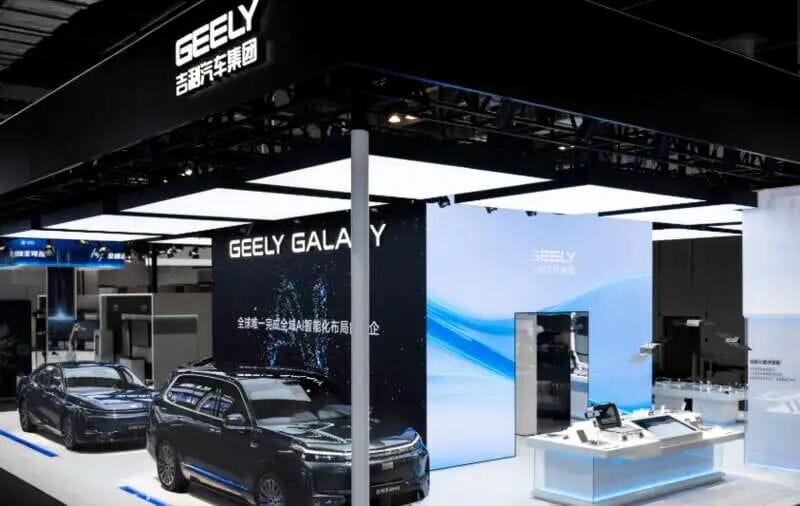
Geely Automobile Group used Nvidia ’s GTC 2026 conference on March 17 to showcase what it called a key breakthrough in “cabin-driving integration,” as automakers race to unify in-car intelligence with advanced driver assistance into a single user experience.
The company said its next iteration—Super Eva paired with Qianli Haohan G-ASD 4.0—will be launched soon and brought into mass production for vehicle deployment. Geely said the Zeekr 8X will be the first model to carry what it described as the world’s first “super intelligent agent” that connects the smart cockpit, intelligent assisted driving and a digital ecosystem, enabling conversational coordination between cabin functions and driving assistance, alongside linked services across digital scenarios.
Geely also said it will deepen cooperation with Nvidia across intelligent assisted driving, smart cockpit systems, intelligent manufacturing and R&D, as well as cloud and AI infrastructure—signaling a broader push to tie vehicle software roadmaps to scalable compute and development platforms.
According to Geely, Super Eva is a vehicle intelligent agent co-developed with StepFun. It is built on Geely’s WAM “world behavior model” and is designed to integrate natively with foundational vehicle systems including assisted driving, chassis and powertrain. Geely said the approach aligns closely with the conversational control concept represented by Tesla’s Grok, positioning Super Eva as the “thinking” layer in the cabin-driving integration stack.
The “acting” layer is the Qianli Haohan G-ASD system, co-developed by Geely and Qianli Zhijia. Geely described it as a high-parameter intelligent assisted driving solution, placing it in the same category as Tesla’s FSD in terms of model scale and capability ambition.
Geely said the combination of Super Eva and G-ASD 4.0 under its WAM model enables a “breakthrough evolution” in cabin-driving integration. In practical terms, the company framed the user experience as voice-driven, intent-based orchestration: a single spoken request can trigger planning, navigation, assisted driving activation and autonomous parking as a continuous chain of actions, with the system factoring in user preferences and habits.
For investors, Geely’s message at GTC 2026 centers on productization—moving from AI demonstrations to production deployments—and on an ecosystem strategy. The company said it does not intend to pursue a closed, end-to-end full-stack approach. Instead, it aims to define system architecture, unify interface protocols and set experience benchmarks, while working with partners including StepFun and Qianli Technology to build an open AI ecosystem for next-generation intelligent mobility.
Related Coverage:
Geely Acquires Stake in Renault's Brazilian Unit to Expand South American Presence
Geely Galaxy Unveils M7 With 225 km EV Range, Pushing Plug-In Hybrids Toward “EV-First” Use