
Geely Galaxy Unveils M7 With 225 km EV Range, Pushing Plug-In Hybrids Toward “EV-First” Use
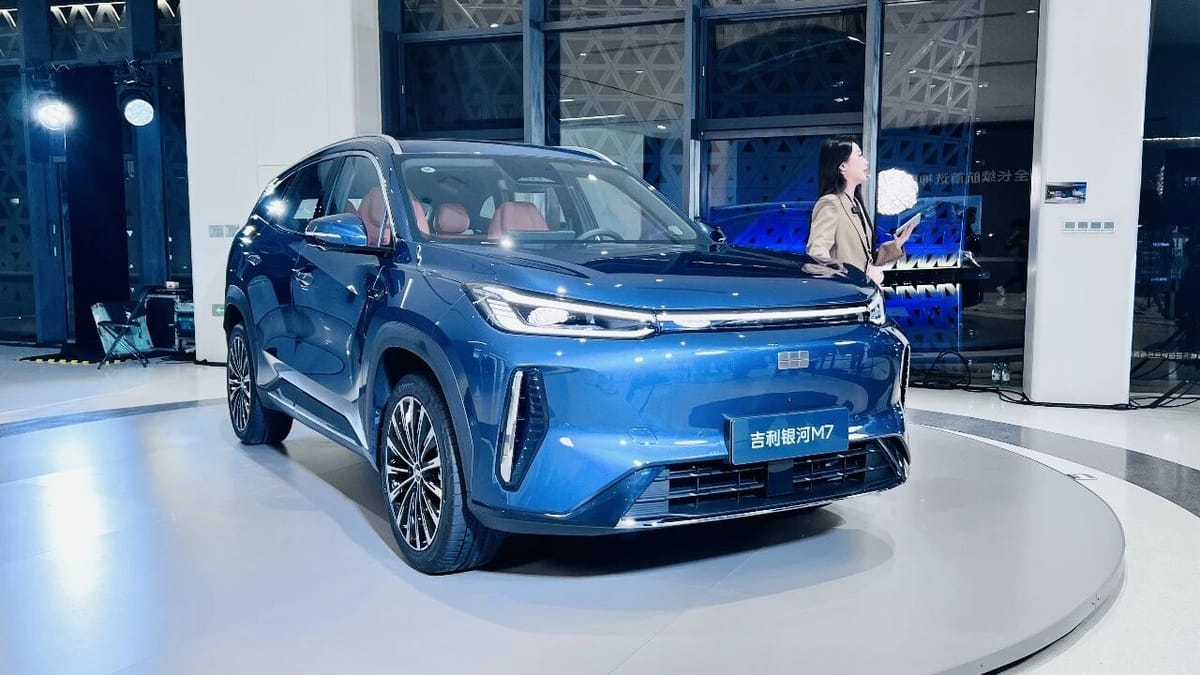
Geely Galaxy, the mass-market new-energy arm of Geely Automobile Holdings Ltd., is raising the bar for plug-in hybrids in China by launching the Galaxy M7 with a claimed 225-kilometer electric-only range—an escalation that targets the last durable advantage of gasoline cars: long-distance convenience without charging dependence.
The Galaxy M7 made its technology debut on March 13 at Geely Galaxy’s Quzhou facility, anchored by the automaker’s in-house “Shield Golden Brick” battery. Geely says the M7 carries up to 29.8 kWh of battery capacity and delivers up to 1,730 km of combined range, positioning the model as a volume play in the mid-size SUV segment rather than a halo product.
Early market context underscores the strategic timing. Geely Galaxy sold 73,125 vehicles in February including exports, taking its January–February total to 156,115 units. That figure was about 8% lower than the year-ago period, mirroring a broader slowdown: China’s new-energy passenger vehicle sales fell 25.7% year-on-year in the first two months of 2026, according to the company’s cited industry data, as purchase-tax benefits faded and trade-in stimulus had yet to fully land.
Extending Electric Range Reframes the PHEV Value Proposition
China’s plug-in hybrids and range-extended EVs are increasingly competing on electric-only range—effectively shifting from “fuel-backup” positioning to “electric-first” daily driving. Geely’s stated 225 km EV range, if realized in customer use, would allow many urban drivers to cover most commuting and errands without starting the engine, while retaining gasoline for long trips.
That matters in a demand environment where overall auto market growth is expected to stay muted in 2026, but structural substitution from internal combustion to electrification continues. Longer EV-only range and faster charging are designed to convert holdouts who still cite charging friction and winter performance as reasons to stick with gasoline.
Scaling an In-House Battery Aims to Improve Packaging and Cost Control
Geely attributes the M7’s range to battery packaging efficiency and chemistry tuning rather than simply adding cells. The company says the Shield Golden Brick battery improves space utilization by 5%, enabling the M7 to fit 3 kWh more capacity than comparable products and gain an additional 25 km of EV-only range.
Geely also highlighted cold-weather improvements: by adjusting electrolyte formulation, it said conductivity rose 26%, and capacity retention at minus 20°C improved by 13%. For northern China, where winter range loss remains a practical barrier to “EV-only” behavior, those metrics are intended to reduce seasonal volatility in real-world use—an issue investors increasingly track as automakers try to defend brand reliability and residual values.
Accelerating Charging and Durability Addresses Ownership Economics
Charging speed is a second lever in plug-in competition. Geely says the M7 can charge from 30% to 80% in 15 minutes, an attempt to narrow the convenience gap with gasoline refueling during peak travel periods.
Battery life claims are also moving to the foreground as price competition tightens. Geely said the cell cycle life exceeds 4,500 cycles and targets “vehicle-life parity,” claiming support for up to one million kilometers of driving. The company also said the battery passed an extreme safety test suite including lightning, cutting, squeezing and multi-needle puncture scenarios, and that it meets new national standards scheduled to take effect this year.
Moving a Mainstream SUV Into the Core Battlefield Pressures Rivals
Geely positioned the M7 as the first mainstream plug-in hybrid SUV in its M-series, inheriting design cues and chassis architecture from the Galaxy M9—its larger flagship SUV launched in September 2025. The M7 is a front-wheel-drive, five-seat mid-size SUV with dimensions of 4,770 mm length, 1,905 mm width and 1,685 mm height, and a 2,785 mm wheelbase.
On efficiency, Geely cites a 47.26% thermal efficiency figure for its Thor EM hybrid-dedicated engine and a peak 93.1% system efficiency for its “Thunder” 11-in-1 integrated electric drive. The company claims fuel consumption as low as 3.35 liters per 100 km in battery-depleted mode, and an 81 km/h moose test result—specifications meant to signal that plug-in hybrids are no longer a compromise on either efficiency or handling in the mid-market.
Hitting 2 Million Units Strengthens Galaxy’s Role in Geely’s 2026 Targets
Geely Galaxy said cumulative sales surpassed 2 million units by March 2026—37 months after the brand’s February 2023 launch—claiming the fastest pace to that milestone among new-energy brands. The company said it previously reached 1 million units in 25 months and added the second million in 12 months, indicating accelerating scale.
That scale is central to Geely Automobile’s 2026 ambitions. The group has set a full-year sales target of 3.45 million vehicles, including 2.22 million new-energy vehicles. With early-2026 industry demand under pressure, the M7’s “long-range PHEV” positioning signals a pragmatic push to win mainstream SUV buyers who still want gasoline optionality—while shifting their daily usage, and loyalty, toward electric driving.
Related Coverage:
Geely Launches Galaxy M9 SUV, Finalizing Lineup to Challenge BYD's Dominance
BYD Launches Extended-Range Plug-In Hybrids with 210km Electric Range